
Gaza: Has the “Yellow Line” turned into a tool for re-engineering Israeli enemy domination over the sector?
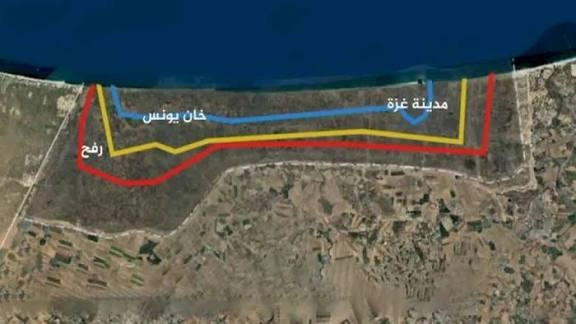
However, it appears that the Israeli enemy is exploiting the current circumstances in the Gaza Strip, resulting from the genocide crime it committed against the sector and its population, to achieve goals outside the scope of the plan and the ceasefire agreement.
Recent movements of enemy forces within the sector indicate a desire to carve out and annex parts of the Gaza Strip’s area and seize them under various pretexts and names, working to re-engineer the borders in Gaza.
The recent repeated breaches by the Israeli enemy forces of the so-called “Yellow Line” to distances that penetrate deeper into the sector, contrary to what was agreed upon in the ceasefire terms, is evidence of this Israeli trend that violates international laws. These unilateral measures also contradict the Trump peace plan.
Is the Israeli enemy seeking to turn the “Yellow Line” into new borders?
The “Yellow Line” is a temporary, imaginary boundary imposed by the United States as part of its three-phase ceasefire proposal. It aims to separate enemy forces and civilian areas after their withdrawal from the contact zones specified by the plan. The line was drawn on military maps as a temporary buffer zone that the enemy is supposed to commit not to cross, and the enemy army is allowed to remain there in the first phase of the agreement without advancing further beyond it.
Transforming the Yellow Line into a long-term, actual dividing line that splits the sector into two parts, instead of being a temporary military boundary, constitutes a fundamental violation of the agreement’s terms. The enemy manipulates this by imposing new military and administrative measures that undermine the conditions of the second phase of the agreement, practically depriving large numbers of citizens from returning to their homes.
In the same direction, statements by Zionist officials about what they wish to be a new status regarding the borders between Gaza and the Zionist entity contribute to this. This includes the statement by the Israeli enemy’s Chief of Staff, Eyal Zamir, that the Yellow Line “has become Gaza’s new border.”
Although the Israeli enemy previously denied turning the “Yellow Line” into a permanent border, the Chief of Staff of the enemy Israeli army said that “the Yellow Line represents the new border between Israel and the Gaza Strip,” stressing “the need to prepare for a scenario of a sudden war.”
Zamir described the “Yellow Line” as “a forward defense line for settlements and an attack line,” despite American pressure to complete the withdrawal process and transition to the second phase.
Reacting to the Israeli official’s statement, the spokesperson for the UN Secretary-General, Stéphane Dujarric, said, “The statement by the Chief of Staff of the Israeli enemy army that the Yellow Line is Gaza’s new border contradicts the Trump peace plan.”
He added in a press statement, “We firmly stand against any change in Gaza’s borders.”
For its part, the Islamic Resistance Movement (Hamas) announced its categorical rejection of the statements by the Chief of Staff of the Zionist enemy regarding his declaration that “the Yellow Line constitutes Gaza’s new border.”
A member of Hamas’s political bureau, Hussam Badran, said in press statements that “Zamir’s statements regarding the Yellow Line confirm that the enemy is not committed to the ceasefire agreement.”
Badran added: “All parties following the Palestinian issue witness that the enemy has not committed to any of the terms required of it during the first phase of the agreement.”
He stressed that “the continued demolition of Palestinian homes and houses in the areas controlled by the enemy (behind the Yellow Line) also forms part of the military operations that should have stopped from the first day but continues until now.”
Regarding the transition to the second phase of the ceasefire agreement, the Hamas leader considered that “any talk about the second phase must be clearly preceded by pressure on the occupation by the mediators, the United States, and all concerned parties.”
He called for the necessity of obligating the enemy to “full implementation” of all terms related to the first phase of the Gaza ceasefire agreement, emphasizing that the second phase cannot begin while the enemy continues its violations and disavows its obligations.
In the same context, Cuba condemned the “Israeli” announcement of establishing a high-fire temporary line in Gaza as a new border between Gaza and the Israeli entity.
Cuban Foreign Minister, Bruno Rodríguez, said in a post on the “X” platform, “We condemn Israel’s announcement of a high-fire temporary line, and we consider it a red line, as a new border between Gaza and ‘Israel’.”
He added that “the announcement constitutes a new violation of the new agreement and international law, and is another display of the genocidal character of ‘Israel’ against the Palestinian people.”
In a related context, the Palestinian Return Centre provided a legal and political briefing to a number of British Parliament members and relevant government bodies, addressing UN Security Council Resolution 2803 related to the Gaza Strip, warning of its serious repercussions on the rights of the Palestinian people, UNRWA’s mandate, and the future of reconstruction and return.
The briefing, prepared by the Centre in December 2025, following the Security Council’s adoption of the resolution on November 17 last year, addressed the risks associated with the proposed security arrangements within the international stabilization force. It noted that classifying large areas of destroyed Gaza as “uninhabitable” for extended periods may turn temporary displacement into permanent displacement, and prevent residents from returning to their original areas and rebuilding their lives.
Euro-Mediterranean: Entrenching Control
The Euro-Mediterranean Human Rights Monitor said that the proposed American plan regarding dividing the Gaza Strip entrenches a dangerous reality of long-term illegal control and amounts to a de facto annexation of territories by force, in flagrant violation of international law rules.
The Monitor explained in a post on the “X” platform that the plan, in its proposed form, imposes multiple forms of unlawful collective confinement on the civilian population by fragmenting the sector and isolating its areas, restricting the movement and fundamental rights of Palestinians, and turning Gaza into isolated pockets subject to sustained surveillance and control.
Axis of Field Events
In an analysis published by the Arab Center for Research and Strategic Thinking, writer Ahmed Al-Tanani said that the “Yellow Line” has gradually turned into the axis of field events in the besieged sector, which is witnessing Israeli field control over approximately half of its geographic area. The Zionist entity has used it as a starting point for its daily assaults on the people of the sector, to prevent them from returning to their residential areas and to thwart any attempts to recreate any form of life above the rubble and destruction.
He noted, however, that “the real danger does not lie in the deployment itself, but in its gradual transformation into one of the forms of imposing long-term realities, through an Israeli deployment with an unknown withdrawal date, as it is linked, according to the American plan, to the presence of an international force and the ‘disarmament’ file.”
This means, according to the writer, that it is an immeasurable linkage and is not suitable as a tool to obligate the Israeli enemy to withdraw, which makes the scene carry within it what goes beyond mere lines for gradual withdrawal and ending the war on the sector.
Al-Tanani believes that “this deployment in a large area of the sector has revived many extremist ideas that essentially confirm that the war on Gaza is not over yet, and the continuous Israeli pursuit to establish strategic realities affecting the geographic and demographic structure of the sector has not stopped, reshaping its reality to align with Zionist right-wing perceptions, not just security considerations. This places half of the sector’s area in front of scenarios ranging between being a buffer zone or neutralized land subject to Israeli investment and settlement.”
Imposing a Fait Accompli
For its part, the “Arabi Post” website questioned how the Israeli enemy is imposing a fait accompli through the “Yellow Line.”
Trump’s plan defined the “Yellow Line” in its first phase as a temporary location for the deployment of the Israeli enemy army. It was assessed as a temporary technical measure aimed at stabilizing calm on the ground and ensuring no friction between the enemy army and the population during the calm process.
It considered that field practice has shown that the enemy government deals with the line contrary to its temporary nature and has begun placing “yellow cubes” alongside increasing statements about turning it into a “new Berlin Wall.”
Enemy Controls 63.8% of Gaza
According to field data, the Israeli enemy army now controls 199.14 km² out of 365.02 km², equaling 54.5% of the Gaza Strip’s area, within the “Yellow Line” only.
Field data also indicate that the Israeli enemy exerts “fire” control over 33.39 km², equaling 9.30% of the Gaza Strip’s area.
According to the data, the actual “Israeli” control over the Gaza Strip’s area equals 63.8% of the Gaza Strip’s area, while the Palestinian population is left with only about 36.15% of the sector’s area.
Israeli enemy forces recently advanced outside the “Yellow Line” towards the Bani Suheila roundabout east of Khan Yunis city. The “Tuffah” and “Shejaiya” areas are witnessing gunfire from the enemy army towards citizens.
“Arabi Post” sees that the Yellow Line today represents one of the most important elements of Israeli maneuvering in Gaza, as it is no longer just a temporary withdrawal route but has turned into a complex tool used at three parallel levels: military, political, and negotiation.
Re-engineering the Security Environment
Through its definition, displacement, expansion, and consecration as a fire zone, the Yellow Line has become a central element in the Israeli enemy government’s strategy for re-engineering the geographic and security environment in Gaza.
This is what a study by the Palestinian Center for Political Studies said… It also noted that the Israeli enemy government deals with the “Yellow Line” not as a temporary withdrawal point but as a nucleus for a moving security belt capable of expansion and contraction, similar in structure and operating mechanisms to models of “safe zones” it adopted in previous experiences.
This belt is intended to establish a new divisive reality within the sector, redefine the form of occupation and pattern of control, and give the Israeli enemy government an additional pressure card in negotiation and reconstruction files.
The study adds that “the displacements carried out by the enemy army on the Yellow Line indicate that the enemy government deals with the line as a tool for re-drawing field borders, not as a temporary line that is supposed to be retreated from.”
It sees that the Yellow Line had hardly left its original function as a “temporary withdrawal line” until it began gradually and methodically transforming into a governing security structure used as an area of control and pressure, and practically performing the function of a “moving security belt” that was not explicitly mentioned in the agreement but has become the title of the new field phase. It is based on “gradual geographic expansion, turning parts of the line into open fire zones, and preventing the return of the population to the area adjacent to it.”
The study by the Palestinian Center added that the enemy army’s control over the areas surrounding the Yellow Line gives it “an intelligence advantage and better vision of movement paths within the sector.” The line is used as a platform to control roads separating north and south, open agricultural areas, and geographic voids that are traditional paths for the movement of the resistance or the population. Thus, the line becomes a tool for re-engineering movement within Gaza to serve the Israeli enemy’s military domination.
Moreover, the Israeli enemy government presents the Yellow Line to the international community as an “existing reality” that emerged in the context of the ceasefire, and therefore must be taken into account when discussing Gaza’s future, according to the study.
The enemy government markets the line’s presence as a “security condition” for the safety of reconstruction teams and international projects, making its stay part of the conditions for international funding, standards for humanitarian organizations’ work, and field protection protocols.
The study concludes that the line has become a negotiation element par excellence, as the Israeli enemy government can signal advancing or retreating from it, link this retreat to sensitive files, and use it to slow down the implementation of the truce or impose new conditions.