
Saleh al-Sammad’s ‘National Project’ a Model of Resistance Against US-Saudi Aggression
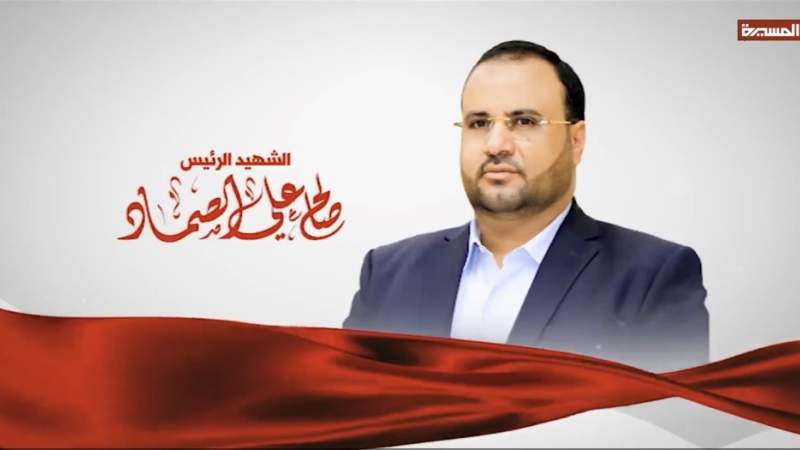
In a special broadcast commemorating the anniversary of his assassination, Almasirah TV, hosted a panel discussion to extol the martyr president Saleh al-Sammad as the ideal “Quranic leader” whose presidency fundamentally redefined the concept of leadership during wartime.
Titled “How did the ‘President of Responsibility’ forge a national project in the time of aggression?”, the program featured Ali al-Dailami, a member of the Ansarullah political bureau, and former Tunisian MP Zouhair Makhlouf. They pointed that al-Sammad, the former president killed in 2018 by US-Saudi aggression airstrike, is a transformative figure who fused religious ideology with practical statecraft.
Redefining the Presidency: From Power to Service
Ali al-Dailami opened the discussion by asserting that al-Sammad “changed the people’s perspective of presidents and leaders,” which he explained was previously understood by many as being about “authority, interests, influence, and showmanship.”
Al-Sammad’s difference, according to al-Dailami, stemmed from his allegiance to the “Quranic project,” which made him treat people with sincerity and prioritize their concerns.
Dailami emphasized that al-Sammad understood responsibility as a “trust” demanding work, effort, and sacrifice. His presidency, therefore, became a model merging “Quranic political discourse with practical, field reality,” blending leadership with humanity.
The panelist highlighted al-Sammad’s famous humility, quoting him as saying, “If President al-Sammad is martyred, he will find no place [to be buried] except the mosque,” a statement presented as proof of his desire to transform the presidency into service for the nation, not the self.
Unifying Forces, “Hand that Builds, Hand that Protects” Project
A key part of the eulogy focused on al-Sammad’s purported ability to unify disparate political forces in Yemen at a time when the Saudi-led coalition aimed to “fragment the Yemenis’ word and break up the national front.”
Dailami added that al-Sammad succeeded in gathering different factions, including those skeptical of Quranic governance, by treating them as “partners in the homeland” and promoting a shared national belonging over personal power struggles.
This led to the cornerstone of his legacy: the national project of “a hand that builds and a hand that protects.” Panelists framed this as a comprehensive response to military and economic aggression, focusing on building internal capacities, reducing external dependence, and rebuilding the national economy to create a long-term foundation for resilience.
Dailami explicitly linked this to countering American strategy, arguing that “America and imperialism control peoples by weakening the army and exhausting development.”
A “Missing” Arab Model and the Fruitfulness of Martyrdom
The Tunisian guest, Zouhair Makhlouf, positioned al-Sammad as a “rare model in the Arab world,” combining political acumen, administrative skill, and jihad—a combination he affirmed is sorely missed in the Arab street.
He contrasted leaders “produced by struggle and resistance,” like al-Sammad, with those emerging from “colonial systems or political coups,” implying the latter lead to continued backwardness.
Addressing the impact of the assassination, Makhlouf explained that martyrdom does not kill a project but strengthens it. “The blood spilled in the path of God becomes additional momentum for the renaissance and gives birth to new leaders,” he stated, adding that the “Quranic nation” is a “fertile nation” that does not know a leadership vacuum and continually produces successors to carry the project forward.
This sentiment was echoed in a statement read from al-Sammad’s son, who called the sacrifices of martyrs “an unextinguished fuel and an unyielding resolve in facing the enemies of the nation, America and Israel.”
Conclusion: An Enduring “Model” for Resistance
The commemoration concluded by asserting that a leader carrying the Quranic project “cannot be defeated, even if he sacrifices his blood,” because the project remains in the collective consciousness and reality.
Al-Sammad was presented as a historic symbol and a leadership model “reproduced in every moment the nation needs a ‘President of Responsibility’ and a Quranic jihadist leader.” His enduring message, as framed by the broadcast, is that leading, protecting, and building homelands is a responsibility requiring sacrifice and work, and that the Quranic project is the path guaranteeing steadfastness, freedom, and dignity.