
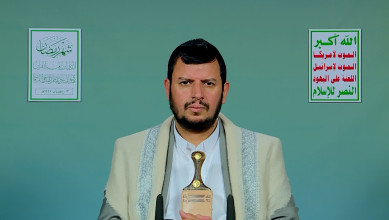
Thirteenth ramadan lecture of Sayyed Abdulmalik Badr al-Din al-Houthi 1447 AH
I seek refuge in Allah from Satan, the outcast.
In the name of Allah, the Compassionate, the Merciful.
Praise is to Allah, Lord of the Worlds. I believe that there is no god but Allah, the Sovereign and the Manifest Truth, and that our master Muhammad is His servant, Messenger, and Last Prophet.
O Allah! Confer Your salat and blessings upon Muhammad and the Family of Muhammad as You conferred Your salat and blessings upon Ibrahim and the Family of Ibrahim. You are Owner of Praise, Owner of Glory! And be pleased with Muhammad’s good companions and all Your righteous servants and mujahidin.
O Allah! Guide us and grant us acceptance, for You are the Hearing, the Knowing; accept our repentance, for You are the Relenting, the Merciful.
Brothers and sisters, peace be upon you and the mercy of Allah and His blessings.
In our previous lecture, during our discussion of the story of Prophet Musa, we reached the blessed Quranic verses in which Allah (the Almighty) says, {‘He pleaded, “My Lord! I have definitely wronged my soul, so forgive me.” So He forgave him, [for] He is indeed the Forgiving, the Merciful. He [Musa] said, “My Lord, for the favour You have bestowed upon me, I will never be an assistant to the criminals”‘}[Al-Qasas 28:16-17].
At the end of the previous lecture, we discussed how Prophet Musa (PBUH) was keen to seek forgiveness from Allah (the Almighty) for the unintended outcome of his action—although it is not in any way a crime. It could be seen as a mistake in approach that led to an unintended outcome. This reveals his profound eagerness and deep sense of responsibility to ensure that his conduct was sound and correct, serving the cause of truth and justice, and pleasing Allah (Glory be to Him). It also demonstrates his commitment to disciplined action, in accordance with the guidance of Allah. All of this took place before his prophetic mission; he was among the devoted servants of Allah, characterised by such concern, faith, and uprightness in action.
Therefore, he wasn’t worried that the incident might affect his personal situation—whether regarding his safety, his material comforts, or his elevated social status, since he was the adopted child of Firaawn’s palace and enjoyed special attention on that account, which Allah had ordained for him by His grace. Thus, neither the risks to his life nor the sacrifices affecting his livelihood and stability—what people often call ‘losses’—were his concern. In fact, he was ready to sacrifice everything for the sake of standing for a just cause. However, his primary concern was to ensure that no error, even an unintentional one, would occur in his actions, potentially leading to consequences that might affect his ability to attain Allah’s forgiveness. Thus, he turned to Allah and asked for His forgiveness: {‘So He forgave him, [for] He is indeed the Forgiving, the Merciful‘}[Al-Qasas 28:16].
The situation he found himself in after that incident marked a new and sensitive phase, a critical turning point, putting him at a crossroads. In other words, the situation was no longer as it had been before; he could not simply continue at the same pace while remaining in that community. Firrawn and his people would certainly take into account the implications of what had occurred and would likely take serious action to eliminate Musa (PBUH) if he persisted in supporting the oppressed and the vulnerable and striving for their rescue. He was at a crossroads: whether to continue fulfilling this role under different circumstances and conditions, to welcome a new reality, or to retreat from this path and seek to appease those in power—Firrawn and his people. That is, to apologise to them and resolve the issue by courting them and abandoning the stance he had adopted and his efforts to take care of the vulnerable and save them.
This was a stage unlike any that had come before. The incident itself marked a decisive turning point; what followed would be entirely different from what had preceded it. So what was the stance of Prophet Musa (PBUH)? His direction was as Allah recounts in the Quranic verse: {‘He [Musa] said, “My Lord, for the favour You have bestowed upon me, I will never be an assistant to the criminals”‘}[Al-Qasas 28:17]. It was a momentous stance. He fully understood the consequences that would result from what had occurred: that he would become a marked target, that his entire situation would be transformed. He could no longer move freely and safely under the protection he had previously enjoyed or continue to support the oppressed in the same way as before without being targeted by Firaawn and his people. The circumstances had become highly precarious.
This was now a phase in which Firaawn and his people would take decisive measures against him. He would sacrifice everything—his security, the comfort of his life, his living conditions—and even place his own life at risk. Despite all the consequences he faced for the stance he took—a just stance—he stood with complete pride and unwavering firmness upon that stance. He expressed this fact through that powerful declaration: {‘He [Musa] said, “My Lord, for the favour You have bestowed upon me, I will never be an assistant to the criminals”‘}[Al-Qasas 28:17]. This statement reflects his reliance upon Allah (Glory be to Him), and it also represents a solemn pledge he made before Allah to remain steadfast in his opposition to wrongdoing. This statement reveals his strong bond with Allah and the great honour he took in upholding a just cause. He felt no regret at reaching a point of total separation from Firaawn and his people. After that incident, the relationship effectively became one of open hostility—a state of conflict. They would pursue him as an enemy in every sense of the word, intent on targeting him by any means available.
To many, such a position—relinquishing security, former comforts, and even risking one’s life—might appear a disastrous loss and a dangerous predicament. This is how people commonly portray the cost of taking a just stand. At times, such a stance may occur within the context of passing or temporary events, after which Allah may bring about major transformations. Yet people still regard it as a predicament, a loss, and even a cautionary lesson for others—warning them not to take the same stance of truth as he did, which led him to make great sacrifices on various levels: risking his life, facing serious personal difficulties, and having his living conditions targeted and destabilised, among other consequences.
In his strong connection with Allah (Glory be to Him), the Prophet Musa (PBUH) regarded his position—the righteous stance, the clear separation from tyrants and the arrogant, the confrontation with oppression, and the dissociation from criminals—as a great blessing. He saw the abilities with which Allah had equipped him for that righteous stance, and at the same time, the divine enabling that allowed him to take such a position. He considered all of that as an immense blessing from Allah (Glory be to Him), worthy of gratitude. And what was that gratitude? It was gratitude expressed through action: remaining steadfast in that position, continuing along the path, and persisting in the journey of confronting tyrants, the arrogant, and the oppressors.
This great and important statement (which contained a promise and a pledge he made between himself and Allah, to give thanks for His blessings upon him in standing apart from the criminals and remaining distinct from them as their adversary) was described by the Martyr of the Quran as ‘one of the most beautiful words spoken by the prophets (PBUT)‘. It is a profound statement because it expresses many meanings: steadfastness in the righteous position, as well as pride and dignity in upholding the stance of truth. This is how all those who respond to Allah (Glory be to Him) and who act within that framework and in service of just, honourable, and noble causes should be. When you stand for what is right, you should be proud of it, even if others blame you and even if you face reproach.
In our present age, vast propaganda campaigns—driven by the enemies of truth, who possess diverse media resources, countless mouthpieces, and entire armies of followers, even from within Arab and Islamic circles—relentlessly direct every form of blame, reproach, suspicion, and abuse day and night. The angels of Allah occupy a noble and exalted station: {‘They glorify [Him] day and night, never wavering‘}[Al-Anbya 21:20]. In stark contrast, media tools, mouthpieces, and corrupt propaganda writers loyal to taghut devote themselves relentlessly to glorifying its position and serving its false, criminal, and oppressive cause. At the same time, they target the oppressed and the believers who stand for what is right, subjecting them to blame, abuse, and doubt, and constantly attempting to cast suspicion upon their stance—unceasingly, day and night. No matter how severe the critics’ blame or how varied their rhetoric and methods of censure—whether spoken in the name of religion, discussed in the language of material and economic interests, or cloaked in political calculations—none of the considerations, narratives, or labels they employ to criticise you should ever be granted any weight. That is because you have taken a stance of truth that pleases Allah (Glory be to Him) and serves a just and manifest cause. In doing so, you are grounded in that righteous and steadfast cause and in a clear and unequivocal position of truth. Consequently, you prioritise the pleasure of Allah (Glory be to Him) above all other considerations, placing your full trust in a favorable outcome, certain of His divine presence with you, and remaining ever-ready to make sacrifices
When the Prophet Musa (PBUH) said that prayer, he embodied steadfastness in the path of truth while embracing self-sacrifice. He did not regret risking his life or giving up his former secure position, comfortable living conditions, elevated status, and certain protections. Despite all the sacrifices made in service of the stance of truth, he took immense pride in it, which reflects a profound attachment to Allah (Glory be to Him). That is because a true believer evaluates his position primarily by whether it pleases Allah (Glory be to Him). Hence, he should ask himself if his position pleases Allah (Glory be to Him)!
When you realise that such a righteous stance is one of the greatest means of drawing nearer to Allah and of attaining a higher rank with Him, you place it above every other consideration and priority. At the same time, there must be a clear awareness of the value of this righteous stance, recognising it as the correct position that offers a solution for the people and sets the proper direction towards it. Even if it does not bring an immediate resolution and even if its role is simply to define the right course and present an influential, persuasive, and inspiring model, it will yield its effect in time. Indeed, it is Allah who rewards efforts and sacrifices, who prepares and brings about the necessary changes, and who ensures that such stances and sacrifices bear fruit: He (Glory be to Him) determines their outcomes and brings forth significant results. Furthermore, Allah Himself watches over His believing servants with His care (in their sacrifices, in their responsiveness to Him, and in what they offer), and He rewards them with a great and abundant reward.
A person also realises the significance of that stance in terms of its outcomes, its effects, and what it entails in his relationship with Allah (Glory be to Him). Indeed, when Allah is pleased with him, He will grant him further guidance, success, and more. It is extremely important for a person to possess a firm awareness of the value of the righteous stance.
Moreover, a believer whose soul is purified finds comfort even in his human emotions, for a righteous stance in the service of a just cause brings tranquillity to the conscience. That is, when you stand for what is right, you feel neither negligent nor remiss, but assured that you have done all your duties within your power and ability; and so your conscience is at peace. This is because a true believer is one whose soul is purified—a quality inseparably linked with faith, awareness, and understanding. When the soul is purified, a person finds inner peace in taking the right stand.
In fact, this also reflects a deep-rooted awareness, a serious and responsible orientation within that stance, and a high level of consciousness that cannot be shaken by any danger, pressure, challenge, blame, or any form of coercion employed by any party that might influence or deter people from that stance. Accordingly, Musa (PBUH) felt no embarrassment or hesitation regarding the position he held, for he acted out of zeal for the oppressed, hatred of falsehood, and pride in the righteous stance. He saw himself facing disbelievers, criminals, oppressors, and wrongdoers, so he made a solemn pledge, {‘My Lord, for the favour You have bestowed upon me, I will never be an assistant to the criminals‘}[Al-Qasas 28:17]. By this, he meant that he would never assist or support the wrongdoers throughout his life. In fact, he saw himself in a position of righteousness and engaged in righteous action, feeling that he was granted the ability to be among those who speak the truth, act upon it, guide others by it, and establish justice through it. Thus, he committed himself to this solemn pledge with Allah (Glory be to Him).
Some people, however, may not perceive such matters as blessings. How do people generally assess blessings? For many, a blessing is something material—financial profit from a farm or a shop, a particular gain, or a certain job. Such things are often regarded as favours. They do not recognise that being granted the success to take a rightful stand in the face of grave injustice and in support of just causes—in a manner that pleases Allah (Glory be to Him)—is itself a tremendous blessing. For it brings significant outcomes, carries profound importance, earns Allah’s reward in this world and the Hereafter, and leaves a deep mark upon the soul. It is an honour that elevates and purifies the self. This is, indeed, a vital lesson.
The Prophet of Allah, Musa (PBUH), therefore did not consider himself to be in a predicament, as some might who focus only on hardship and risk, weighing matters solely in such terms and thereby growing anxious, seeking any possible means to extricate themselves from the rightful stance they uphold. Rather, he declared, {‘I will never be an assistant to the criminals‘}[Al-Qasas 28:17]. And indeed, he dissociated himself from them, remaining true to his pledge and turning decisively away from them.
Regarding this very verse, an important theme clearly stands out: the grave crime of aiding criminals. Many people become entangled in this, drawn in by forces of corruption and evil, and end up serving them in one way or another: Some enlist with them militarily, fighting in their ranks and in their service, standing against the people of truth, against the oppressed who take the rightful stand, and against those who have been wronged. Others operate within their security sphere, providing intelligence and surveillance, or executing criminal acts on their behalf. Some align themselves with them in the media; others do so politically; still, others provide material support.
By providing any form of assistance to criminals, a person becomes complicit and a partner in their atrocities. Even those from within this Ummah—those who identify as Muslims and consider themselves Arabs—who collaborated with the Israeli enemy through the media share in all its crimes. This is because they justify its wrongdoing, dishearten the Ummah from taking a rightful stand, and show hostility towards those who stand for truth in opposition to that enemy and its crimes. In doing so, they have made themselves accomplices in its horrific crimes.
When powerful forces move—as is the case with the Zionist movement, through its influential international arms (America, Britain, and the Israeli enemy)—they commit countless appalling crimes, among the worst imaginable. They act through their vast resources and capabilities. Hence, whoever supports them in any way and turns against those who take a stand of truth in confronting them is, indeed, a partner in their crimes.
One of the central emphases of the Holy Quran is to safeguard Muslims from becoming entangled in any form of support for criminals. For this reason, it strictly forbids allegiance to them— indeed, it is among the gravest of prohibitions. When we reflect upon the blessed Quranic verses that warn of the danger of this matter, we see that the warning reaches an extremely serious level, to the extent that Allah says, {‘Whoever takes them as guardians becomes one of them‘}[Al-Ma’idah 5:51]. This is an uncompromising prohibition—a stern and powerful warning, sufficient to deter anyone who still retains even the smallest trace of faith in his heart.
Allah also says, {‘And whoever does so}—meaning, takes the disbelievers as allies—{will have nothing to hope for from Allah‘}[Ali ‘Imran 3:28]. Such phrasing communicates a warning of the utmost gravity and emphasis. Numerous Quranic verses reinforce this message, including: {‘And do not rely on those who have done injustices or the Fire will touch you‘}[Hud 11:113]. Here, {‘ rely ‘} signifies even the slightest inclination.
All forms of collaboration with the enemies of Allah and with tyrannical criminals are extremely dangerous, for it makes a person a partner in all their crimes. On the Day of Resurrection, such a person will be raised with them, held to account with them, and counted among them in their criminality and tyranny.
However, it is unfortunate that, in our present age, many regimes and governments, along with segments of society’s elites—political, media, and others—and many among this Ummah have become thoroughly entangled, not only in dealing with criminals and oppressors from within the Ummah itself, but also in dealing with the worst criminals in history: the Zionist Jews, along with their supporters and collaborators. Some provide political backing; others extend financial and economic support; some offer media services, while others assist through intelligence and information work.
Thus, the forms of service and support they provide are numerous and varied. Accordingly, when Allah says in the Holy Quran, {‘Whoever takes them as guardians becomes one of them. Surely Allah does not guide the wrongdoing people‘}[Al-Ma’idah 5:51], He regards such a person as a partner in their wrongdoing— and it is, in essence, among the gravest forms of injustice.
Returning to the story of the Prophet of Allah, Musa (PBUH), we find in his words—turning to Allah and taking the pledge—when he said, {‘My Lord, for the favour You have bestowed upon me, I will never be an assistant to the criminals‘}[Al-Qasas 28:17] that he decisively settled his choice and his course after that defining moment and entered a new and highly sensitive phase of his life, even if it meant experiencing a harsh and dangerous situation. He was fully aware of the consequences that would follow from what had occurred and of the fierce reaction awaiting him from Firaawn and his people, a tyrannical and arrogant nation that would not spare even a nursing infant.
{‘And so Musa became fearful, watching out in the city, when suddenly the one who sought his help the day before shouted to him for help. Musa rebuked him, “Indeed, you are clearly a trouble-maker.” Then when Musa was about to lay his hands on their foe, the enemy said, “O Musa! Do you intend to kill me as you killed a man yesterday? You only want to be a tyrant in the land. You do not intend to make peace! And there came a man, rushing from the farthest end of the city. He said, “O Musa! The chiefs are actually conspiring against you to put you to death, so leave [the city]. I really advise you [to do so]”‘}[Al-Qasas 28:18-20].
Allah willing, we will discuss these blessed verses in the next lecture.
We ask Allah (Glory be to Him) to grant us success in seeking what pleases Him. O Allah, have mercy on our virtuous martyrs, heal the wounded among us, set free our captives, and grant us victory. You are the Hearer of Prayer!
Peace be upon you and the mercy of Allah and His blessings.