
Targeting densely populated camps turns Gaza’s “Safe Al-Mawasi” into endless displacement camp
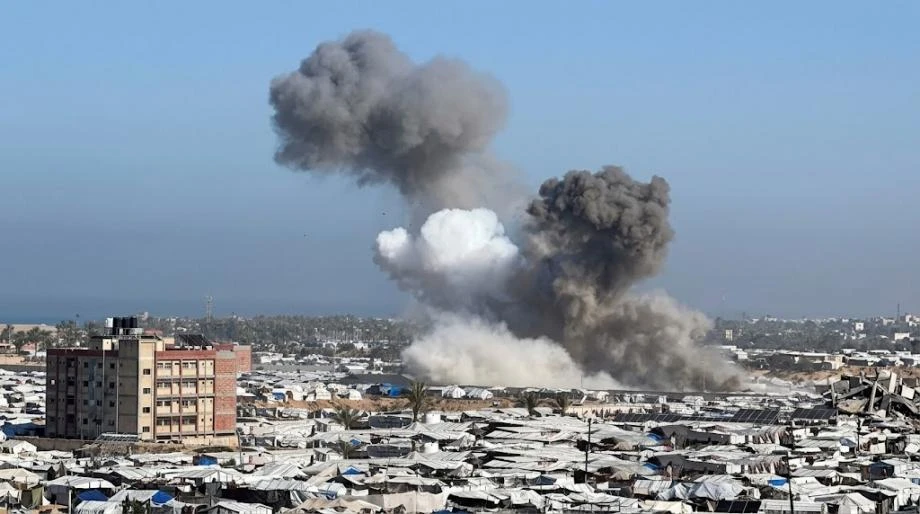
Displaced people in the Al-Mawasi area, west of Khan Younis in the southern Gaza Strip, no longer just fear bombings. They now dread the prospect of losing their tents for the second or third time, after the area, once designated as “safe,” became a site of repeated attacks, forcing thousands of families into an endless cycle of displacement. Each airstrike not only leaves behind martyrs and wounded, but also obliterates what little shelter and belongings the displaced have left, beginning a new journey of displacement amidst the rubble of burned tents.
According to documentation from the Government Media Office in Gaza, Al-Mawasi area has been targeted more than 241 times since the start of the war of extermination. Meanwhile, the Israeli enemy continues to target camps overcrowded with displaced people, despite these camps housing hundreds of thousands of civilians who sought refuge there after repeated evacuation orders.
In one of the most devastating attacks, on June 29, 2026, the Israeli enemy bombed a shelter housing approximately 350 families, burning and tearing apart more than 130 tents. Dozens of families were left without shelter, belongings, or even basic necessities.
Displaced person Raafat al-Maghari described that night to the newspaper Falastin as “the night of losing everything.” He explained that the families received an evacuation warning only 15 minutes beforehand, and everyone fled, leaving behind everything they owned.
He said that the missile ignited dozens of tents in moments, turning years of struggle to survive to ashes. He lost his two tents and his stall, which was his only source of income.
The following morning, nothing remained but tattered tents, scattered belongings, and the remnants of food that had burned in the flames. Despite the scale of the destruction, most families found nowhere else to go, so they re-erected new tents on the same ground, awaiting further bombing.
The losses were not limited to shelter. One-year-old Suwar Abu Daraz and her mother were killed in the bombing while visiting the camp, a scene that vividly illustrates the heavy human toll civilians pay in areas supposedly meant to protect them.
Residents believe that the Israeli enemy has adopted a recurring pattern of targeting locations within or adjacent to displaced persons camps after issuing short evacuation orders. This leads to successive waves of displacement and widespread destruction of tents and belongings.
This pattern was also evident in the bombing of the Zaarab family home on June 8, 2026. The blast’s effects extended to dozens of surrounding tents, causing extensive damage in camps housing large numbers of displaced people.
Even Al-Mawasi beach, where displaced people sought refuge from the heat of the tents, was not spared from the bombing. Israeli enemy forces targeted the intersection of Al-Nas Street and then a seaside rest area crowded with civilians, resulting in martyrs and wounded.
Displaced person Mahmoud recounts the details of his and his children’s survival from one of the raids, saying that he rushed back to his tent after hearing the explosion, believing his children had been killed, only to find them alive but in a state of shock. He then participated in rescuing the wounded amidst scenes he described as “unforgettable.”
The massacre of July 13, 2024, remains etched in the memory of the residents of Al-Mawasi, after the targeting of a house surrounded by camps for displaced people led to the martyrdom of more than one hundred Palestinians and the wounding of hundreds more, in one of the deadliest attacks on the area.
Displaced person Maha Nabhan says that the sea, to which she sought refuge for safety, is no longer different from the tents, emphasizing that fear accompanies them everywhere, whether from drones, tanks, or warships.
For his part, human rights activist Raed al-Barsh asserts that the repeated targeting of al-Mawasi effectively undermines claims that it is a safe zone. He points out that international humanitarian law prohibits targeting civilian areas, particularly gatherings of displaced persons, and that shelters and civilian facilities are protected objects.
He adds that targeting these sites constitutes a grave violation of the Geneva Conventions and amounts to a war crime under the Rome Statute of the International Criminal Court, given the direct targeting of civilians and their places of refuge.
The question now being asked by the displaced people of al-Mawasi is no longer: Where will we flee to? Rather, it is: Is there any place left in Gaza that is not engulfed by fire? With every tent burned, a new displacement begins, and safety becomes a deferred promise, while the circle of displacement widens within an area that shrinks day by day for its inhabitants.