
Hezbollah Secretary-General: Resistance continues, Palestine is our compass, & we demand freezing direct negotiations
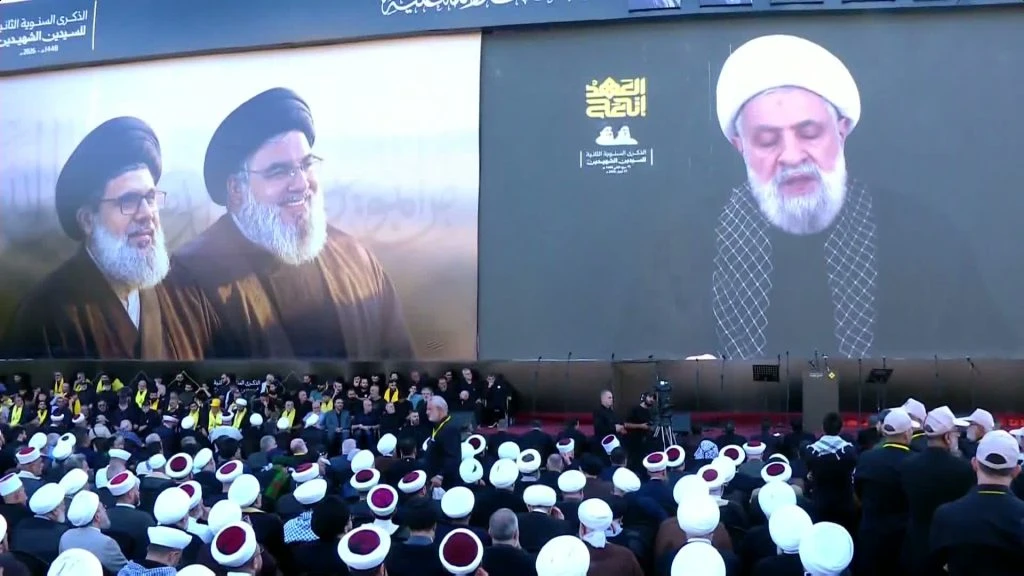
This came in a speech delivered by Sheikh Qassem on Sunday on the second anniversary of the martyrdom of the former Hezbollah Secretary-General Sayyid Hassan Nasrallah and the former head of the Executive Council Sayyid Hashem Safi al-Din, during which he addressed the march of the resistance and developments in Lebanon and the region.
Qassem explained that Hezbollah is committed to the covenant with the martyrs, noting that the party’s leadership, the resisters, and the people are continuing to carry the trust and pursue the path on which the resistance was founded.
He said that Hezbollah named the phase that began with the “Uli al-Ba’s” battle in September 2024 the phase of “We are upon the covenant,” affirming that the martyrdom of leaders and resisters “did not stop the march, but gave it momentum, capability, and determination.”
He stressed the continuation of resistance against the Israeli enemy until its withdrawal from Lebanese territory and the achievement of complete liberation, affirming that the resistance will continue to support Palestine and work for the liberation of the land.
Qassem reviewed the journey of a number of Hezbollah leaders and mujahideen who were martyred during the confrontations, praising their roles in building and leading the resistance, and extended greetings to the families of the martyrs, the wounded, the prisoners, and the displaced.
He pointed out that the “Uli al-Ba’s” battle resulted in the martyrdom of 3,400 people and the injury of 14,600 others among resisters and civilians, affirming that the sacrifices made during it will remain witness to steadfastness.
On the Lebanese issue, Qassem affirmed that “Lebanon without resistance will vanish,” stressing that Lebanon’s survival is linked to the liberation of its land, its unity, and the cooperation of its components, and affirming that the Lebanese Army is a national army and that the Lebanese are capable of understanding among themselves.
He said that the Israeli enemy seeks to consolidate its presence and establish settlements in Lebanon, affirming that the resistance confronted the Israeli enemy forces and prevented them from achieving their goals.
He explained that the resistance’s method in confrontation relies on hit-and-run according to the nature of the field, noting that the party’s fighters confronted the Israeli enemy forces in a number of southern areas, including Bint Jbeil, Al-Khiyam, Aita al-Shaab, Al-Naqoura, Al-Bayada, and Ali Al-Taher.
He affirmed that the resistance is working to inflict losses on the Israeli enemy forces and prevent them from consolidating their presence, stressing that its ultimate goal is the liberation of the land.
On the political file, Qassem described the framework agreement as a “concession” of the power cards that Lebanon possesses, calling for putting an end to concessions and reviewing and correcting the negotiation path.
He demanded freezing direct negotiations and moving to indirect negotiations, calling on the Lebanese authorities to adhere to the country’s sovereignty and not make concessions in negotiations.
He affirmed Hezbollah’s readiness for internal dialogue, calling for providing premises that help bring viewpoints closer between the Lebanese parties, and stressing the necessity that the President of the Republic be “an arbiter and unifier and not a party.”
On the reconstruction and sheltering file, Qassem held the Lebanese government responsible for reconstruction and addressing the repercussions of the war and the economic and living conditions, calling on the state to carry out its duties toward the affected and displaced.
He announced that Hezbollah will reveal “very soon” the details of its contribution to a shelter project, affirming the party’s commitment to securing shelter, restoration, and reconstruction within available capabilities and donations, along with encouraging countries and organizations to provide assistance.
He said that the party will continue working despite the siege and restrictions, affirming the necessity of helping the residents whose homes and areas were damaged by the war.
He also affirmed the right of the Lebanese to demonstrate, sit in, and express their demands by legitimate means, calling on the government to address economic files, foremost among them the high cost of living, the decline in the value of the currency, public services, and depositors’ funds.
On the regional issue, Qassem warned of the widening dangers facing the region, pointing out that the United States seeks to impose its influence on the countries of the region and control their capabilities.
He affirmed Hezbollah’s continued support for Palestine, stressing that the Palestinian people are “the owners of the land,” and extended greetings to Iran and Yemen, appreciating their positions in support of regional causes.
He praised the Yemeni position toward Palestine, affirming that the Yemeni people “are working for liberation from economic and political pressure,” and wishing them strength and steadfastness.
Qassem stressed at the conclusion of his speech that the future belongs to the peoples of the region, considering that the sacrifices of the martyrs opened the way for a greater and broader victory, calling for patience and continuing to confront challenges.