
Economy ministry holds press conference, photo exhibition on economic losses resulting from Saudi blockade
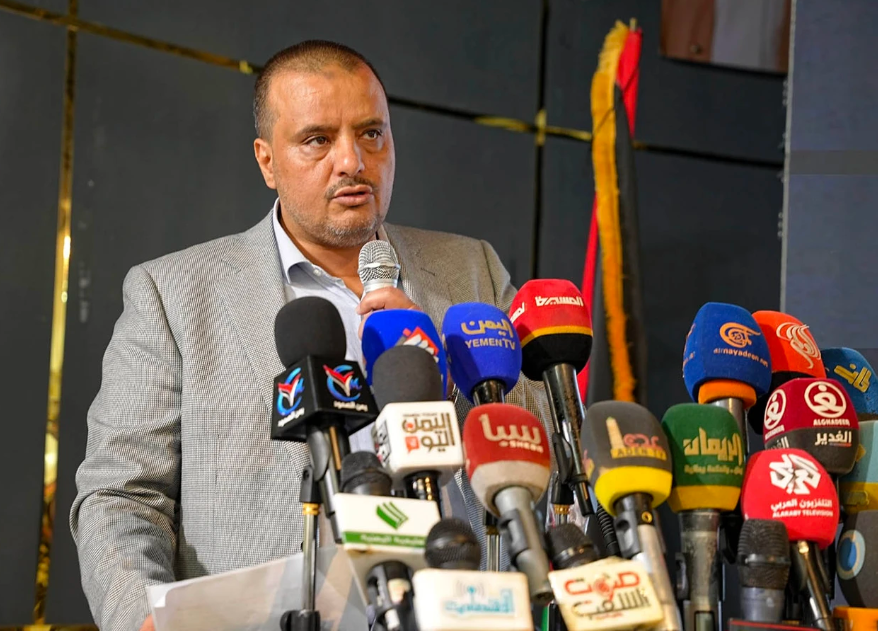
The Ministry of Economy, Industry, and Investment held a press conference on Sunday entitled “The Yemeni Economy: 12 Years Under the Saudi Blockade – Indicators and Figures,” and inaugurated a photo exhibition on “The Blockade and Losses.”
The conference and exhibition are part of a series of events being held at “Al-Aqsa Flood” Hall at Sana’a University, including seminars and lectures from Sunday, 19-21 Safar 1448 AH, on the damage inflicted on the Yemeni economy by the Saudi-American aggression and blockade, and their humanitarian repercussions.
At the press conference, which was attended by the Minister of Transport and Public Works, Mohammed Qahim, the Minister of Oil and Minerals, Dr. Abdullah Al-Amir, the Acting Minister of Agriculture, Fisheries, and Water Resources, Ammar Al-Karim, and the Chairman of the Industry and Trade Committee in the House of Representatives, Qasim Al-Haza, the Acting Minister of Economy, Industry, and Investment, Sam Al-Bashiri, explained that the losses to the Yemeni economy as a result of the Saudi-American blockade exceed $1.13 trillion.
He said, “This event represents a scientific and documentary effort to monitor one of the most impactful periods in the history of the modern Yemeni economy, and it is based on official data and statistics.”
He added, “The report documenting the staggering damage to economic sectors is not merely a presentation of figures and a tally of material losses. Rather, it is a historical testament documenting the systematic destruction and blockade inflicted on the Yemeni economy by the Saudi enemy over the past 12 years. This blockade has affected people, land, infrastructure, state resources, and its productive and service sectors, resulting in profound consequences for the Yemeni people.”
Al-Bashiri explained that the losses were not limited to a specific sector, but encompassed all vital sectors. Foreign trade losses exceeded $111 billion, industry $82.5 billion, agriculture and livestock $111 billion, and oil and minerals $57 billion. In addition, there were significant losses in the transportation, energy, tourism, fisheries, communications, health, and water sectors, reflecting the magnitude of the impact on the entire structure of the national economy.
He addressed the extent of the destruction inflicted on the economic infrastructure, including airports, ports, roads, factories, commercial establishments, power plants, water facilities, health, educational, and telecommunications infrastructure. This targeting and destruction has disrupted production, increased transportation and trade costs, led to a decline in investments, and resulted in the loss of hundreds of thousands of jobs. This has directly impacted the lives and living standards of Yemeni citizens, with more than 31 million now facing the threat of famine.
The Acting Minister of Economy affirmed that the Yemeni people will not remain silent or relinquish their legitimate rights. They will stand with the leader of the revolution, Sayyid Abdul-Malik Badr al-Din al-Houthi, and the Yemeni Armed Forces to impose a “siege for siege” strategy and secure all their legitimate rights.
He expressed his hope that this event would serve as a platform for informed and responsible dialogue, an opportunity to exchange visions and ideas on addressing the consequences of these losses, and to strengthen cooperation among various national institutions, thus serving the future of the Yemeni economy and enhancing its capacity for recovery and growth.
During the opening ceremony, which was attended by Deputy Minister of Electricity, Energy, and Water Adel Bader, Undersecretary of the Ministry of Economy for Policies, Studies, and Planning Fouad Al-Junaid, Chairman of the General Investment Authority Mohammed Ishaq, and Ansar Allah Political Bureau member Dhaifallah Al-Shami, researcher in Quranic culture Yahya Abu Awada reviewed the repercussions of the aggression and blockade on Yemen, and the Saudi enemy’s refusal to back down from its intransigence and insistence on harming the Yemeni people.
He pointed to the unprecedented million-person marches that took place in the capital, Sana’a, and other governorates to declare the mandate given to the leader of the revolution to take the necessary decisions to break the blockade, impose a “blockade for blockade” equation, and prepare for a comprehensive escalation.
At the opening ceremony, which included the presentation of human interest stories and a film about the losses suffered by the Yemeni economic sectors as a result of the Saudi blockade, economist Salim Al-Ja’dabi presented the event’s press release and outlined the most prominent figures and indicators regarding the direct and indirect losses and damages inflicted on the national economy, and the resulting catastrophic humanitarian consequences.
The Ministers of Transport, Public Works, Oil and Minerals, the Acting Ministers of Economy, Industry, Investment and Agriculture, and the Deputy Minister of Electricity, Energy and Water, were briefed on the contents of the photo and art exhibition about the siege and losses.