
Entesaf Organization issues Human Rights report “Blood Without Justice” at Sana’a press conference
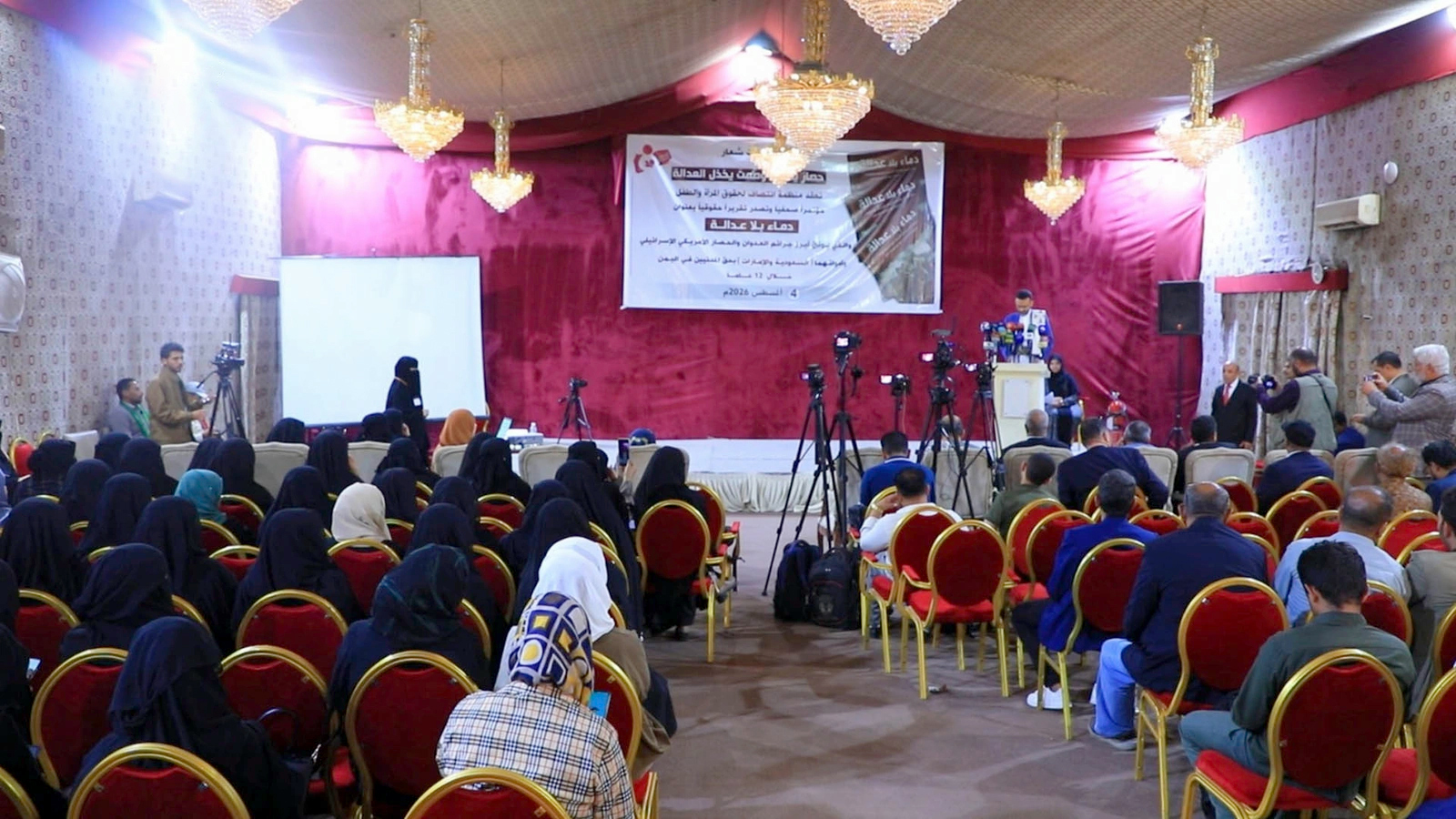
Yemen’s Entesaf Organization for Women’s and Children’s Rights released a human rights report titled “Blood Without Justice” during a press conference held in Sana’a on Tuesday.
The report documents what it describes as the most significant crimes committed against civilians in Yemen over 12 years of the U.S.-Israeli aggression and blockade, along with their allies, Saudi Arabia and the UAE.
Held under the slogan “A Blockade That Kills and Silence That Betrays Justice,” the conference featured remarks by Deputy Minister of Justice and Human Rights Judge Ibrahim Al-Shami, who praised the organization’s efforts in documenting violations against women , children and highlighting the humanitarian consequences of the U.S.-Saudi-UAE aggression and blockade on the country’s most vulnerable groups.
Al-Shami commended the organization’s reports and documentation for preserving evidence and victims’ testimonies, raising awareness locally , internationally, and countering attempts to conceal the facts. He described the initiative as a model of comprehensive human rights work that deserves official support and coordination to strengthen accountability, justice, and reparations.
“The figures presented in official and independent national reports on civilian casualties, as well as indirect deaths caused by the blockade, collapsing services, shortages of food and medicine, are not merely statistics,” Al-Shami said. “They represent an ongoing humanitarian tragedy that has affected the Yemeni people’s lives, health, food security, education, safety, and future.”
He added that, despite their catastrophic scale, the figures still fail to capture the full extent of the suffering or the countless personal tragedies behind them, while exposing what he described as crimes committed against the Yemeni people over the past 12 years.
Al-Shami stressed that the devastation inflicted on Yemen was not the result of isolated incidents or accidental mistakes, nor were civilian casualties merely “collateral damage” as, he said, the aggressors and their supporters claim. Instead, he described it as a systematic , sustained campaign directly targeting civilians and the foundations of their lives.
He firmly rejected attempts to describe what happened in Yemen with softened terms such as “collateral damage” or “operational mistakes,” stressing that the violations committed against Yemen and its people constitute acts that warrant investigation , accountability , based on the available evidence , legal elements, amount to war crimes and crimes against humanity.
He noted that the repeated nature of the violations, their wide scale, and the similarity of their methods and consequences indicate an organized pattern requiring the identification of all those involved in planning, incitement, facilitation, support, cover-up, or concealment of the facts.
The deputy minister condemned what he described as Saudi Arabia’s attempts to evade responsibility for its military campaign and blockade imposed since March 2015, while portraying itself to the international community as a “neutral mediator,” believing this would absolve it of responsibility for its actions.
Addressing the Saudi leadership, he said: “The protection of your people and your land and maritime interests depends entirely on immediately ending your hostile policies toward Yemen and improving relations with it, as this is the only path to your security, stability, to strengthening peace and stability across the region.”
He added that the silence of the United Nations and many international institutions, or their selective approach to violations in Yemen, does not diminish their gravity but exposes a deep crisis in the credibility of the international human rights system, particularly as some institutions have gone beyond silence to justify the aggression, downplay its crimes, or equate the victim with the aggressor.
Judge Al-Shami also affirmed the ministry’s support for professional monitoring and documentation efforts, the development of accurate national databases, the preservation of evidence and chain of custody. He expressed the ministry’s readiness, through the National Human Rights Authority and judicial bodies, to strengthen cooperation with human rights organizations in building the capacities of personnel involved in monitoring, documentation, investigations, and in transforming reports into legal case files for presentation before competent national and international courts. The aim, he said, is to unify methodologies, integrate data, protect witnesses , information, and build a comprehensive national case file that safeguards victims’ rights and prevents impunity.
He called on international and human rights organizations to take reports issued from Sana’a seriously, conduct independent professional verification of their findings, and launch transparent investigations to determine the causes and responsibilities, rather than merely describing the situation as a humanitarian crisis detached from its root causes.
The deputy minister also called for an end to the military campaign, the lifting of the blockade, the cessation of measures affecting civilians, the restoration of the Yemeni people’s access to their resources , economic rights, justice and compensation for victims.
He renewed full support for the revolutionary and political leadership and the armed forces in what he described as their legitimate options and measures to restore usurped rights, end the military campaign , blockade, and liberate all occupied territories, citing the Yemeni people’s right under international law to defend their sovereignty, wealth, and national resources.
At the press conference, attended by Chairman of the National Human Rights Commission Ali Taysir and Shura Council member Noor Baabad, Secretary-General of the Supreme Council for Motherhood and Childhood Akhlaq Al-Shami praised the Entesaf Organization’s efforts in documenting alleged violations committed during the conflict, stressing that such crimes are not subject to any statute of limitations.
She said the Saudi campaign against the Yemeni people had failed due to Yemenis’ awareness, resilience, and steadfastness, adding that they recognized there was no alternative to dignity except humiliation.
Al-Shami added that the victories, strength, dignity, and resilience demonstrated by the Yemeni people were the result of their awareness and perseverance in confronting the conflict.
For her part, Entesaf Organization Chairwoman Sumaya Al-Taifi highlighted the importance of the report, describing it as comprehensive documentation of part of the impact of the conflict and blockade through recording attacks on civilians, essential infrastructure, and public facilities, as well as cases of abduction and detention.
She said the report goes beyond presenting statistics by providing documented evidence of the humanitarian and material losses caused by the conflict and blockade over the past 12 years, while illustrating their impact on all aspects of life in Yemen, particularly for women and children.
Al-Taifi noted that the report serves as a legal and human rights document that can support demands for accountability, justice, reparations, prosecution of those responsible for alleged crimes and violations, the lifting of the blockade, and an end to impunity.
Meanwhile, the organization’s head of human rights reporting, Faten Sharaf Al-Din, presented a summary of the report, Blood Without Justice, which documents 750 alleged violations. She said civilian casualties recorded from the beginning of the conflict through July 30, 2026, exceeded 61,012, including 24,728 fatalities and 36,284 injuries.
She added that casualties from cluster munitions and landmines totaled 10,689, including 3,952 fatalities and 6,737 injuries.
The report also addressed the impact of the conflict and blockade on displaced persons, people with disabilities, child labor, as well as the consequences of relocating the Central Bank’s functions to Aden, in addition to psychological, health, educational, economic, agricultural, and fisheries-related impacts.
In its recommendations, the report affirmed what it described as Yemen’s right to self-defense under Article 51 of the UN Charter and called for an end to the conflict and blockade. It also called for the withdrawal of all Saudi, Emirati, U.S., British, and Israeli coalition forces from Yemeni territory, islands, and territorial waters, describing their presence as unlawful occupation and a violation of Yemen’s sovereignty.
The report further called for the removal of all restrictions on airports and ports, the cancellation of what it described as unilateral and unlawful measures targeting the national economy, the immediate release of revenues from seized oil resources to pay public sector salaries, and an end to the use of economic and financial measures as a means of pressure against Yemenis.
It also urged the establishment of independent international and national investigative committees to document alleged crimes, acts described as genocide, and serious violations against civilians and infrastructure attributed to the coalition and its allied forces.
The recommendations called for legal proceedings before competent national and international courts to prosecute military , political leaders allegedly responsible for ordering , carrying out the conflict and blockade, describing them as war crimes not subject to statutory limitations.
They also called for imposing an international legal obligation on states participating in the conflict to provide full compensation for damage to infrastructure and the economic and environmental sectors during the years of war.
Finally, the recommendations urged resolving the prisoner issue and ending the suffering of families awaiting the return of their relatives from all sides.