
Equation of maritime deterrence: Yemeni blockade encircles Saudi economy
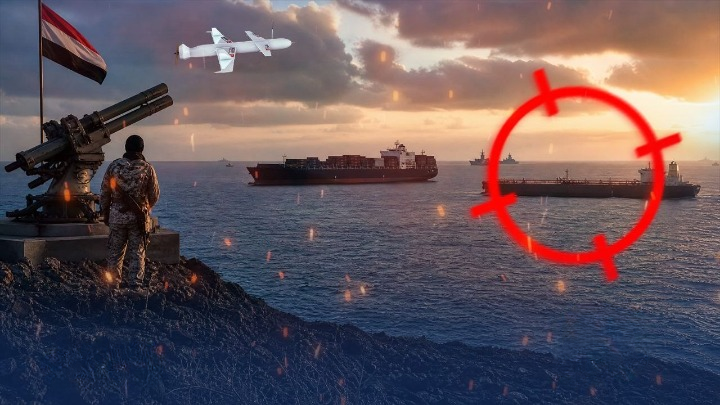
The qualitative development of the Yemeni armed forces has shifted the battle from the confines of tactical defense on the home front to the ability to carry out long-range strategic strikes targeting the economic and military heartland of the adversaries, and to impose a maritime blockade on waterways of vital importance to global trade, such as the Red Sea, the Gulf of Aden, and the Bab al-Mandab Strait.
The on-the-ground effects of the Yemeni blockade on Saudi ports have manifested in the diversion of numerous cargo ships and oil tankers bound for Saudi ports via the Cape of Good Hope, inflicting heavy losses on the Saudi enemy as a result of increasing voyage times by 10 to 14 additional days.
According to economic observers, the Yemeni maritime blockade has caused a sharp increase in insurance premiums for Saudi ports, from 0.1 percent to levels ranging between 0.7 percent and 1.0 percent of the ship’s value, effectively increasing insurance costs seven to tenfold.
The Yemeni maritime blockade has also led to a reduction in cargo and container handling at Saudi ports on the western coast, such as Jeddah, Yanbu, and Jizan, by between 20 and 50 percent, depending on periods of heightened tension.
The movement of oil and petroleum products through the Bab al-Mandab Strait, which normally sees 4.8 million barrels pass through daily, has been affected. Tanker charter and shipping costs have increased by between 40 and 60 percent due to the risks associated with longer transit times or detours.
Shipping and logistical pressures have impacted Saudi Arabia’s economic plans, particularly Vision 2030 projects in the western region, most notably the NEOM project and tourism projects on the west coast. Delays in the supply chains of building materials and various technical equipment have increased implementation costs and slowed down some timelines.
Furthermore, efforts to transform the Kingdom of Saudi Arabia into a global logistics hub have faced significant challenges due to the Red Sea being classified as a high-risk area by international shipping and insurance companies, in addition to increased military and security spending to protect facilities and waterways.
In this context, the warnings of the leader of the revolution, Sayyed Abdulmalik Badr al-Din al-Houthi, confirm that the continuation of the aggression and blockade will only be met with further escalation and economic pressure.
He has emphasized this in more than one speech, stating that “whoever wants security for their shipping lanes and economy must lift their blockade and aggression against the Yemeni people, and that the equation of blockade for blockade has become an inevitable option from which there is no turning back until the Yemenis obtain their full legitimate rights.”
The counter-blockade has created a direct link between maritime security in Yemen and the stability of Saudi maritime navigation and the Saudi economy. This makes lifting the restrictions and blockade on Yemeni ports a prerequisite for restoring the regularity of supply chains and international trade through the Red Sea.
In short, the Yemeni maritime blockade model has demonstrated that maritime security and the economy in the Red Sea are inextricably linked. Continued restrictions on Yemen translate into economic costs and ongoing logistical drain on the Saudi side, making lifting Saudi control over Yemeni ports and airports the only viable option for securing Saudi shipping lanes.