
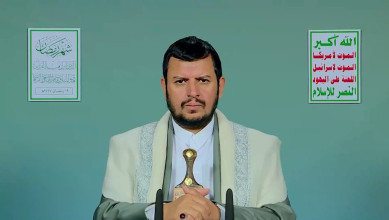
Nineteenth ramadan lecture of Sayyed Abdulmalik Badr al-Din al-Houthi 1447 AH
I seek refuge in Allah from Satan, the outcast.
In the name of Allah, the Compassionate, the Merciful.
Praise is to Allah, Lord of the Worlds. I believe that there is no god but Allah, the Sovereign and the Manifest Truth, and that our master Muhammad is His servant, Messenger, and Last Prophet.
O Allah! Confer Your salat and blessings upon Muhammad and the Family of Muhammad as You conferred Your salat and blessings upon Ibrahim and the Family of Ibrahim. You are Owner of Praise, Owner of Glory! And be pleased with Muhammad’s good companions and all Your righteous servants and mujahidin.
O Allah! Guide us and grant us acceptance, for You are the Hearing, the Knowing; accept our repentance, for You are the Relenting, the Merciful.
Brothers and sisters, peace be upon you and the mercy of Allah and His blessings.
In the previous lecture, we discussed the agreement reached between Prophet Musa (PBUH) and the righteous old man in Midian. We also reflected on the significant outcomes that Allah (Glory be to Him) granted Musa through this agreement, which was crucial for his stability in Midian and provided him with security and peace of mind. Through that employment agreement, lasting between eight and ten years depending on which of the two terms was fulfilled, Musa enjoyed a new stable life with a home, a family, work, the essentials of living, and other such blessings besides. At the same time, he also undertook the duty and responsibility of caring for the affairs of that noble family.
We also discussed some of the lessons connected to this, particularly with regard to Musa’s work as a hired worker during those years, and the importance of work and striving to earn a lawful livelihood. Quranic and Islamic teachings promote a culture of work and do not condone idleness, negligence, or laxity.
Believers at the individual and collective level need work in many respects: work as a necessity for providing life’s basic needs and for fulfilling mankind’s stewardship on the earth in its true meaning, which involves building this life according to Allah’s guidance and commands and striving for the Ummah to become a strong ummah, furnished with the resources necessary for its strength so that it can fulfil its great mission: to uphold equity, to strive in the cause of Allah, and to establish the religion of Allah in all aspects of life.
Human beings were fundamentally created to work, as Allah (the Almighty) says, {‘[in order to test which of you is best in deeds‘}[Al-Mulk 67:2]. This means that our roles, including our preparation and the characteristics Allah has given us, along with the energies and abilities we possess, all prepare us for work, with each person having different roles and tasks according to the wise divine plan. Indeed, Allah enabled us to complement one another through the talents, gifts, and capacities He granted us in the diverse journey of life. This allows people to complement each other in their talents, energies, abilities, and fields of work, among other things.
Islam strongly disapproves of idleness, aimlessness, and voluntary neglect, where a person drifts aimlessly, despising work and avoiding his duties, from which certain responsibilities arise. In fact, a hadith states, ‘It is enough of a sin for a person to neglect those he is responsible for or to be a burden on others.‘ That is, to neglect one’s own responsibilities towards his family and become reliant on others due to negligence, laziness, aversion to work, or lack of practical spirit. Musa (PBUH) did not shy away from the nature of the tasks and activities he undertook while caring for that family.
In the previous lecture, we also discussed the significance of work that demands physical effort, such as agriculture, livestock care, and industrial labour. We also addressed the widespread negative mindset that arises from a spirit of laziness among many people who avoid any work that requires physical effort, preferring instead office and administrative jobs that involve no physical effort. Yet, such jobs cannot accommodate everyone, nor can they alone build life. People need practical efforts and a practical spirit that yields results in various aspects of life. This is one of the essential lessons from the story of Musa (PBUH).
As part of his preparation, Prophet Musa (PBUH) benefited from his migration, where he attained security as part of Allah’s wise plan. In Midian, he found security and reassurance for his life, escaping the constant danger and pursuit he had faced in Egypt and being relieved from the pressures of its oppressive environment. This allowed him to reflect and think in a peaceful and stable setting. However, in Egypt, he had lived, amidst the suffering of the oppressed, in a constant state of pressure, anxiety, and mental strain. Thus, the environment in Midian was perfectly suited to further preparing him and readying him for his great and sacred mission. Furthermore, it is possible that during the time Musa (PBUH) spent in Midian, Allah was orchestrating changes in Egypt to later enable him to carry out his prophetic mission and his great task of saving an oppressed people.
This also highlights the importance of migration for the sake of Allah (Glory be to Him). There are people whose circumstances necessitate migration, for they cannot fulfil their faith-based responsibilities or maintain a state of uprightness and obedience to Allah (Glory be to Him) in their own regions. This is due to the prevailing conditions in their lands—the dominance of tyrants, criminals, oppressors, and those who lead others astray. The situation may be one of severe oppression, where they cannot act freely or undertake anything that can yield real impact and tangible results. In such a case, the solution is migration to places where they can live in conditions that enable them to obey Allah, remain upright on the basis of His guidance, and respond to His call.
This is why the Holy Quran states, {‘Whoever emigrates in the cause of Allah will find enough room and bountiful resources throughout the earth‘}[An-Nisa 4:100]. Migration in the Holy Quran is consistently—apart from exceptional cases like the temporary situation of Musa (PBUH)—presented within the context of forming a community. A community gathers in a prepared region, a supportive environment, and through this gathering, seeks to build strength. It then mobilises as a believing and striving community to rise to its sacred and great duties. In this way, migration carries this immensely positive outcome, contributing to the formation of a believing community. This is precisely what occurred in the migration of the Messenger Muhammad (PBUH&F) from Mecca to Medina. That migration resulted in the building of a believing community in a supportive environment that upheld the divine message. From that there emerged major outcomes in establishing the religion of Allah and in the triumph of the great Islamic mission.
For this reason, the Holy Quran contains many verses addressing this matter, including the saying of Allah (Glory be to Him), {‘O My believing servants! My earth is truly spacious, so worship Me [alone]‘}[Al-‘Ankabut 29:56]. This is because some people may find themselves in a situation where they experience oppression and subjugation to other than Allah. To illustrate, their situation—whether in their region or their country—may become extremely difficult, as tyrants, oppressors, unjust rulers, misguiders, and corrupters hold power and compel them to submit to falsehood and to obey the authority of taghut above the command of Allah (Glory be to Him). Yet some individuals may have the opportunity to relocate to another place where conditions are different, enabling them to turn to Allah in obedience and worship and to free themselves from that situation.
The Holy Quran also acknowledges an excuse for those who are truly unable to leave such situations. This is stated in the blessed Quranic verse that we have mentioned earlier: {‘Except helpless men, women, and children who cannot devise a plan nor afford a way out—it is right to hope that Allah will pardon them‘}[An-Nisa 4:98-99]. That is, they have their excuse before Allah (Glory be to Him).
Another example appears in the words of Allah (Glory be to Him), {‘Say [O Prophet, that Allah says], “O My servants who believe! Be mindful of your Lord. Those who do good in this world will have a good reward. And Allah’s earth is spacious”‘}[Az-Zumar 39:10]. In this verse, we encounter the expression, {‘And Allah’s earth is spacious‘}, and the previous verse states, {‘My earth is truly spacious‘}. Indeed, Allah has made the earth spacious; it is not confined to that particular region or country where a person may be living under oppression and subjugation to other than Allah. {‘Indeed, the patient ones will be rendered their reward in full without measure‘}[Az-Zumar 39:10]: The matter may require patience in undertaking emigration and relocating to a situation where a person can live within a believing, striving community, in a condition of stability and dignity.
As we read in the blessed verses concerning the Prophet Musa (PBUH), he found himself in circumstances that enabled him, even if only for a temporary period, to leave that situation of pressure. During that period, his development also occurred within a different environment that differed in many respects. There, he lived in conditions different from those he had experienced in Egypt. He lived as a hired worker—labouring, striving, and working in an environment that may have been economically difficult, very different from the living conditions he had in Egypt—perhaps very different indeed. Yet it was an atmosphere that helped build him. It helped him develop the ability to endure various hardships and diverse difficulties of life and become accustomed to them. It also accustomed him to the hardships of being away from his family: his mother and his siblings—his brother and sister. It was a state of estrangement, hardship, and toil, within a particular environment that also helped shape him strongly in enduring hardships and difficulties, training him in that, and making him accustomed to it.
He remained there for that period. In the blessed Quranic verses, it is mentioned, {‘When Musa had completed the term‘}[Al-Qasas 28:29], which means that he finished the agreed-upon period. After completing it, he decided to travel and return to Egypt. {‘When Musa had completed the term and was travelling with his family, he spotted a fire on the side of Mount Tur. He said to his family, “Stay here, [for] I have spotted a fire. Perhaps from there I can bring you some directions or a torch from the fire so you may warm yourselves”‘}[Al-Qasas 28:29].
The Prophet of Allah Musa (PBUH&F) certainly benefited from that agreed-upon period, during which he was prepared, protected, and cared for within the framework of the divine plan, while circumstances were being prepared and changes taking shape, even in Egypt. The mission of Musa (PBUH) was difficult, considering that he was to confront the tyrants of the earth and to liberate a nation from its captivity. Moreover, he would have to remove the effects of cultural enslavement and the impact of policies of oppression and humiliation from the souls of that oppressed nation. For this reason, he found himself in circumstances that kept him away from that intense pressure and those grave dangers during that stage of his preparation and development. When the time came and Musa completed the agreed-upon term, he resolved to return to Egypt with his family, taking his family with him. During that period, he had already been blessed with children with his wife.
It is noteworthy that Musa (PBUH) made the decision to return to Egypt even though the dangers were still present and his problem—the one that caused him to emigrate when it occurred—had not yet been resolved. However, this was within Allah’s management; it was part of the divine plan. For this reason, the blessed verses later mention that when divine revelation came to him—when he was commissioned with the message while on his way back to Egypt—Allah said, {‘Then you came here as pre-destined, O Musa!‘}[Taha 20:40]
As we mentioned, his return under those circumstances—his journey from Midian to Egypt—came while he was still facing dangers: the danger of being targeted. He was still being pursued by his enemies; they sought to kill him, and orders had been issued for his execution. Thus, it was a return marked by fear and anxiety. Perhaps these circumstances also prompted him to remain attentive on his way to Egypt, seeking information and asking about the situation there wherever he stopped. He would inquire from those who knew news about Egypt and about the road itself. In addition, he would be careful to proceed towards Egypt in a calculated manner— carefully considering the most suitable route, the best times for travel, and the right moment to enter Egypt, perhaps also thinking about how he might do so without being noticed.
In this context, he was also keen to ask and inquire about the situations, focusing on choosing the time that would be most secure for movement.
Here, Allah (Glory be to Him) says, {‘he spotted a fire on the side of Mount Tur‘}. That happened when he reached Sinai while returning from Midian on his way to Egypt. The Tur is a mountain, one of the mountains of Sinai. It is the particular mountain at which this sacred and blessed event occurred—when the divine revelation descended and the prophetic mission was bestowed. Thus, it acquired its blessed status and became a sacred mountain. In addition, the Prophet of Allah Musa (PBUH) was near the mountain—perhaps not very close, but close enough to observe what was taking place there, such as the fire he saw on the side of Mount Tur. Most likely, he saw it at the foot of the mountain on a cold, dark night, near the blessed mountain, Mount Tur, in Sinai. There, he witnessed this remarkable and striking scene at a time when he needed warmth for his family, as well as information about the road and the conditions along the route ahead of him.
For this reason, what Musa (PBUH) saw regarding that fire caught his attention. The Quranic expression here states, {‘He spotted a fire on the side of Mount Tur.‘} Some exegetes say that expression {‘He spotted‘} means that he saw that fire. The [Arabic] term is also used for something whose sight brings comfort and reassurance—something that pleases you when you see it. Indeed, he saw it from a distance. {‘He spotted a fire on the side of Mount Tur‘}—the mountain is called Tur, and that mountain itself is one of the mountains of Sinai along the route to Egypt.
When Musa (PBUH) saw that fire, he felt reassured by it. He naturally assumed that where there was a fire, there would be people who had lit it. He therefore hoped to obtain information from them about the path. Some exegetes suggest that he needed guidance regarding the route itself, while others say he may have sought broader information about what lay ahead and the conditions along the way. This is because, as we have mentioned earlier, he harboured fears about what might await him from his enemies on the journey ahead. The information a traveller needs about a road can often be varied: its security conditions, the general circumstances along it, and other considerations that people usually take into account during travel. For this reason, Musa hoped the fire would lead him to someone who could help. Allah says, {‘He said to his family, “Stay here, [for] I have spotted a fire. Perhaps from there I can bring you some directions or a torch from the fire so you may warm yourselves”‘}[Al-Qasas 28:29]: He hoped to bring news about the route, which he urgently needed, or {‘a torch‘}—that is, a burning piece of wood—so that they could warm themselves. He was concerned for his family and what they were enduring from the cold, wishing to bring them warmth.
Musa (PBUH) then set out towards that fire on that dark, cold night, heading in the direction of Mount Tur. {‘But when he came to it‘}[Al-Qasas 28:30], he encountered a remarkable sight. According to various narrations, two striking observations are reported when he arrived. First, he found no one around the fire. This was unusual: a blazing fire, yet no one was nearby. Second, the fire itself appeared in an extraordinary form: It was burning within a tree, yet the tree was not consumed. This was striking—a green tree ablaze with light and radiance, spreading warmth throughout the area.
It was indeed a remarkable sight. At that moment, he may well have wondered about the reason for that fire and why it appeared as it did. He began to sense that he was in a situation unlike anything ordinary. In other words, this was not a fire kindled by people, nor were there any individuals present who could provide the information he sought about the road or assist him that night with his family. Rather, the scene appeared to be of an entirely different nature.
{‘But when he came to it}—finding no one there and, instead, encountering that extraordinary sight we have described—{he was called from the tree in the blessed spot to the side of the auspicious valley: “O Musa! It is truly I. I am Allah, the Lord of all worlds‘}[Al-Qasas 28:30]. That is, the great call reached him—the call of Allah (Glory be to Him). It was a moment whose majesty, awe, and sanctity surpass our imagination: a moment of immense holiness, grandeur, and magnificence, beyond the limits of our perception and understanding. Musa (PBUH) was honoured with this call from Allah (Glory be to Him).
At first, when he heard the call addressing him by name—{‘O Musa! ‘}[Al-Qasas 28:30]—he might well have been surprised as to who was calling him by name and knew him, especially in that desolate land where he would not expect anyone to recognise him. Then came the declaration from Allah (Glory be to Him), making it clear that it was Allah Who was speaking to him: {‘O Musa! It is truly I. I am Allah—the Lord of all worlds‘}[Al-Qasas 28:30]. Allah (Glory be to Him), as He spoke to His servant and Prophet Musa (PBUH), caused that call to occur in the manner described in this blessed verse: {‘He was called from the tree in the blessed spot to the side of the auspicious valley‘}[Al-Qasas 28:30]. In other words, Allah caused the call that Musa (PBUH) heard to come from that tree. This may be compared, in a simple way that helps us understand, to how we hear sound coming from a radio in our everyday experience. The call that Musa heard issued from the tree in a sublime and awe-inspiring voice, in a manner befitting the holiness and majesty of Allah (Glory be to Him), according to the measure that Allah (Glory be to Him) had decreed.
This tree was located in {‘the blessed spot‘}[Al-Qasas 28:30], referring to the place where the tree stood—a location distinguished from the surrounding land by being elevated above the rest of the valley. This spot was on {‘the side of the auspicious valley‘}[Al-Qasas 28:30]—that is, along the side of the valley itself. The valley is named in other Quranic verses as {‘Ṭuwa’} [Taha 20:12], and it lies beside Mount Tur.
The Quranic verse identifies this location with great precision, describing even that particular spot. First, it refers to {‘the side of the auspicious valley‘}[Al-Qasas 28:30]. There are also blessed verses in the Holy Quran that highlight the sanctity of the mountain itself—Mount Tur—where Allah spoke to Musa. We also find that this sanctity extends to the valley itself, as indicated in the phrase, {‘to the side of the auspicious valley‘}[Al-Qasas 28:30], which is said to be associated with blessing and auspiciousness. Likewise, the spot itself is described as {‘the blessed spot ‘}[Al-Qasas 28:30].
This great moment—when Allah called His servant Musa (PBUH), commissioned him with the message, and entrusted him with a great and sacred mission—is mentioned in the Holy Quran in several blessed surahs. Within those surahs, the account is presented in ways that correspond to the particular context being addressed. For example, in Surah An-Naml, Allah (Glory be to Him) says, {‘But when he came to it, he was called [by Allah], “Blessed is whoever is in the fire and whoever is around it! Glory be to Allah, the Lord of all worlds”‘}[An-Naml 27:8]. In this verse, Allah (Glory be to Him) clarifies that He sent down blessings upon that sacred place and upon that great moment on that blessed night—upon Musa and upon the angels of Allah who were present there. It was a moment in which revelation and divine command descended, through which the greatest transformation on the global stage at that time would unfold: the downfall of the greatest tyrant on the earth, the rescue of an oppressed nation, and the restoration of humanity’s connection with Allah’s revelation and His direct guidance.
The immense sanctity of the divine message is—as we mentioned—beyond our imagination, beyond our knowledge, and beyond our perception; it is sanctity of the highest degree. For this reason, even the prophetic commission of the message takes place within an atmosphere of profound sanctity and great majesty, accompanied by descending blessings. This sanctity extends to the very time and place of its occurrence. It is also reflected in this blessed verse that contains the glorification of Allah: {‘Glory be to Allah, the Lord of all worlds‘}[An-Naml 27:8].
We shall conclude with this for now and resume, Allah willing, in the next lecture.
We ask Allah (Glory be to Him) to grant us success in seeking what pleases Him. O Allah, have mercy on our virtuous martyrs, heal the wounded among us, set free our captives, and grant us victory. You are the Hearer of Prayer!
Peace be upon you and the mercy of Allah and His blessings.