
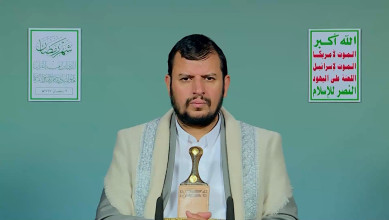
Ninth ramadan lecture of Sayyed Abdulmalik Badr al-Din al-Houthi 1447 AH
I seek refuge in Allah from Satan, the outcast.
In the name of Allah, the Compassionate, the Merciful.
Praise is to Allah, Lord of the Worlds. I believe that there is no god but Allah, the Sovereign and the Manifest Truth, and that our master Muhammad is His servant, Messenger, and Last Prophet.
O Allah! Confer Your salat and blessings upon Muhammad and the Family of Muhammad as You conferred Your salat and blessings upon Ibrahim and the Family of Ibrahim. You are Owner of Praise, Owner of Glory! And be pleased with Muhammad’s good companions and all Your righteous servants and mujahidin.
O Allah! Guide us and grant us acceptance, for You are the Hearing, the Knowing; accept our repentance, for You are the Relenting, the Merciful.
Brothers and sisters, peace be upon you and the mercy of Allah and His blessings.
In yesterday’s lecture, the closing discussion centred on a blessed Quranic verse from the story of the Prophet of Allah Musa (PBUH), in Surah Al-Qasas. It focused on the words of Allah (Glory be to Him), {‘Thus did We return him to his mother so that she might delight her eyes [with him], and not grieve, and that she would know that Allah’s promise is [always] true. But most people do not know‘}[Al-Qasas 28:13].
We spoke about how the care of Allah (Glory be to Him)—as made clear in the blessed verse—embraced the psychological state of Musa’s mother. Thus, her anxiety and inner turmoil were replaced by joy; her grief gave way to relief, happiness, and reassurance. Furthermore, there was also a profoundly important dimension of care relating to her faith, mentioned [in the same surah] before that verse, when Allah says, {‘And the heart of Musa’s mother ached so much that she was about to disclose his case, had We not reassured her heart in order for her to be among the believers‘}[Al-Qasas 28:10]. Here, we observe how this divine care continued as Allah granted her steadfastness and preserved her faith.
Among the most significant dimensions of divine care are when Allah grants you success and makes you steadfast during perilous stages, sensitive circumstances, and intense psychological pressure. Indeed, certain psychological pressures and the situations one encounters at particular stages of life—particularly during periods of challenge and hardship—can pose a real danger to one’s faith. It is at such moments that the care of Allah (Glory be to Him) becomes manifest in strengthening the heart, in sending down tranquillity upon a person, and in granting steadfastness in faith.
One of the most significant aspects of divine care is that it comes at a critical stage, in circumstances that are profoundly dangerous for a person. In fact, if a person were to lose his faith, that would be the greatest loss—one that no moral or material gain could ever compensate for. If the price to be paid is the loss of one’s faith, then it becomes a matter of the utmost gravity for him.
Thus, the care granted to Musa’s mother lay in Allah preserving her faith, making her steadfast, and strengthening her heart with what would enable her to remain firm. This stands among the greatest forms of divine care that Allah bestows upon His believing servants, including believing women as well. When he says, {‘in order for her to be among the believers‘}, this is a designation that encompasses both believing men and believing women.
Here, He says, {‘and that she would know that Allah’s promise is [always] true‘}[Al-Qasas 28:13]. Allah (Glory be to Him) gave her a tremendous and significant promise, saying to her, {‘We will certainly return him to you and make him one of the messengers‘}[Al-Qasas 28:7]. Among the outcomes of this divine promise being fulfilled for her—indeed, fulfilled at an early stage, before she would suffer further harm or be more deeply affected—was her steadfastness in faith regarding the fulfilment of Allah’s promise, firmly believing it to be true and unfailing.
Then the blessed verse ended by His saying, {‘But most people do not know‘}[Al-Qasas 28:13], in order to draw our attention to this important reality and to how most people remain ignorant of it, whether in that era, in the generations that followed, or even in our own time, including within the reality of the Muslim Ummah. This is something truly regrettable. They do not know this reality. Their stance and condition towards it reach the level of ignorance, not merely weak faith in it or even the absence of faith, but complete ignorance. This is because most people look at matters superficially and assess situations according to purely material standards. When they observe the oppressive, arrogant, and criminal forces of taghut—with their military and economic power, their firm political control, and their powerful media apparatus, including intense propaganda and fierce psychological warfare, and so on—they find themselves in a state of despair. Indeed, this is a very strange condition. As we mentioned, it reflects a deficiency in true knowledge of Allah (Glory be to Him)—a serious deficiency—and consequently a deficiency in faith. It also demonstrates ignorance of Allah’s established laws and ignorance of historical events.
Throughout history, there were empires and arrogant, oppressive powers—highly entrenched and formidable—that possessed overwhelming military strength, vast economic resources, influence, and far-reaching political, media, and social influence. Despite their injustice, tyranny, transgression, and corruption and despite mobilising all their capabilities to obstruct the path of Allah, to wage war against truth and justice, to persecute people, and to practice the most abhorrent forms of oppression—they ultimately collapsed. This happened even though the people of that time, especially those who experienced the height of their dominance, imagined it impossible for such a state, empire, kingdom, or entity—whatever the name—to ever fall.
This condition persisted, even into historical periods relatively close to our own time. For example, during the days of the British Empire, it was described as ‘the empire on which the sun never sets‘, because of the vast number of territories it controlled across different continents. Some imagined that such dominance would continue until the end of history, until the very last day of life on the earth. Yet, in reality, it came to an end.
Historical lessons carry moral guidance for people, and the important truths that must become firmly rooted within us are of great significance for our stances, our faith, and our daily lives. They even influence the extent to which people respond to Allah (Glory be to Him).
In fact, we have discussed divine promises referring to examples mentioned in the Holy Quran—promises that are revelation from Allah (Glory be to Him) and are firmly affirmed in His holy book. We also discussed the general reality of Muslims in general, in relation to those promises that Allah has set forth in the Holy Quran. Indeed, many people are unaware of these promises, while many others imagine that they belong to a past, bygone era, as if these Quranic promises were canned goods bearing a date of expiration—as if they were labeled, for example, that they were valid for two or three years from the date of production or that they expired on a specific date.
Among these promises is this divine statement: {‘O you who have attained faith, if you stand for Allah, He will grant you victory and strengthen your foothold‘}[Muhammad 47:7]. Another example—one related to our conflict with the Israeli Jewish Zionist enemy—is the blessed Quranic verses at the beginning of Surah Al-Isra, which are clear and explicit, reflecting a constant divine law concerning their transgression, arrogance, pride, and corruption on the earth. Allah (Glory be to Him) declares at the conclusion of those blessed verses, {‘But if you return, We will return‘}[Al-Isra 17:8].
{‘But if you return, We will return‘}[Al-Isra 17:8]: It is a continuous and established divine law. Whenever they return to their arrogance, pride, tyranny, and widespread corruption on earth, Allah will respond and bring them under subjugation, employing His divine plan to undermine their power and influence, topple their strength and arrogance, and bring an end to their dominance.
This is the true promise, which must be believed in with certainty, and then acted upon accordingly by responding to Allah (Glory be to Him) and moving correctly and appropriately to confront them.
Coexistence with them is impossible. Thus, what most Arab regimes are doing—by attempting to impose their misguided course under the banner of peace and normalisation—only inflicts further injustice upon these peoples. This further enables this very enemy to achieve its aims in wronging this Ummah, persecuting it, and committing the most heinous crimes against it. As a result, the price becomes extremely heavy until the time comes for their eventual downfall.
Their downfall is inevitable—one of the certainties affirmed in the Holy Quran. However, the cost will be exceedingly great if their end is delayed, especially under this blind policy pursued by governments and regimes and the peoples’ compliance with that policy. In other words, although the downfall of the Israeli enemy—with its tyranny, arrogance, transgression, and occupation of Palestine and the holy sites—is inevitable, the prevailing stance of the Ummah plays a decisive role in whether this promise is realised sooner or postponed, bringing enormous costs and grave consequences. Thus, shortening the duration and reducing the cost—or prolonging it and magnifying the price—depends entirely upon how the Ummah responds.
The costs we are speaking of mean that countless members of this Ummah—its children, its women, and its men—will be killed in the most heinous crimes committed by the arrogant Jewish, Zionist enemy, the corrupter on earth, the tyrant and oppressor. This is not to mention the various crimes it perpetrates against this Ummah. The Ummah may end up losing much of its homelands and its wealth, forfeiting its dignity, its freedom, its sanctities, and even its religion, and falling into despair over the viability of this misguided and deviant course. This course stands in direct contradiction to the book of Allah (Glory be to Him), and it serves only the enemies and fails to protect the Ummah, safeguard its legitimate rights, or repel the harm of its enemies. This is truly tragic. For this reason, as Muslim peoples and as a Muslim ummah, we must reform and realign our relationship with the Holy Quran and its truths: to believe in them as truths in the fullest sense of the word and to view reality through their lens.
When we reflect upon reality, the picture is plain. The Israeli enemy stands as a clear and unequivocal enemy in all respects: It openly declares its aggressive and expansionist intentions to dominate a vast geographical area within this Ummah. It is intent on controlling the region more broadly and asserting dominance across all spheres—political, economic, and beyond—at every level. It shows enmity towards Islam, the Quran, the Messenger (PBUH&F), and the sanctities and principles of Islam.
Likewise, in its culture, its Talmud, and what it presents through its schools, universities, research, and broader intellectual activity, its enmity towards Islam and Muslims is plainly evident. This can also be seen through its criminal practices—among the most appalling imaginable—and what it perpetrated in the Gaza Strip during the two-year period. In fact, it continues its crimes against the Palestinian people in every form and with extreme brutality.
The Israeli enemy now boasts about owning the largest medical skin bank in the world. But where does it come from? It comes from the skins of the Palestinian people. Alongside its relentless killings and the genocide of children, women, the elderly, and the young, it also steals their organs—hearts, livers, lungs, kidneys—and even their skins.
They have reached this level of tyranny, aggression, and criminality. The Israeli enemy’s leaders—whether high-ranking officials like ministers, religious figures such as rabbis, or individuals in social and economic positions—are explicit in their statements about their beliefs, which are derived from the Talmud, their altered texts, and their broader culture. They do not consider Arabs, Muslims, or others as human. Yet, they regard themselves as the only true humans, while viewing other people as animals in human form, and they harbour towards them the deepest hatred and the worst imaginable levels of contempt. Their souls are malicious, corrupt, filled with deep hatred, and entirely devoid of any trace of humanity. As a result, their aggression, combined with their hatred and greed, reaches a terrifying level beyond imagination. They hold the strongest enmity towards this Ummah, with deep malice and a total detachment from all human values.
What they commit against the Lebanese people and their continual targeting of Hezbollah in Lebanon are aimed at stripping Lebanon of every means of strength and protection. And then what follows? Then, they will seek to realise their openly declared objectives of taking control of it—not as some naive and foolish individuals imagine that it is for the genuine pursuit of peace or for protecting the Lebanese people from harm. The same pattern applies to the rest of the Arab region and the whole Islamic world. They are clear and an outright enemy.
Their pattern of corruption and tyranny will not change through agreements; reality itself proves this. How many agreements has the Palestinian Authority signed with them? And what are they doing now in the West Bank? Will statements of condemnation—such as fourteen Arab states issuing a declaration against the annexation of the West Bank—bring any benefit to the Palestinian people? Or a joint statement with European countries? These are mere words that avail nothing. They carry no value, no importance, and no real effect. Meanwhile, far more is offered to the Israeli enemy: Statements are given to the Palestinian people merely to deflect criticism, while money is given to the Israeli enemy and relations are strengthened with it at every level. How, then, could such statements—issued only to appease public opinion—hold any value, significance, or constitute any meaningful pressure?
In general, our Islamic Ummah faces grave danger and is paying a heavy price in critical matters whose consequences are severe and whose effects are far-reaching. This is because it fails to grasp this truth: {‘Allah’s promise is [always] true‘}[Al-Qasas 28:13]. It must return to faith in Allah’s true promise and act in accordance with it—with hope, trust in Allah (Glory be to Him), and awareness and insight drawn from the Holy Quran, from evident reality, and from the daily events unfolding before us. At the same time, it must adopt practical means, for practical measures are indispensable; this is of the utmost importance.
{‘But most people do not know‘}[Al-Qasas 28:13]. It is deeply regrettable that the majority of our Islamic Ummah remain unaware of this truth, despite the Holy Quran, the lessons of history, the clarity of present realities, and the daily events before them. This is truly unfortunate.
Returning to the blessed verses concerning the story of the Prophet of Allah Musa (PBUH), Allah says, {‘This is how We returned him to his mother‘}[Al-Qasas 28:13]. Allah’s returning him to his mother meant he would grow up in safety and receive a righteous upbringing within the framework of divine preparation. Allah (Glory be to Him) Himself undertook his care, preparing and equipping him for his great and sacred mission, as He said, {‘so that you would be brought up under My [watchful] Eye‘}[Taha 20:39]. Thus, Musa (PBUH) grew up and spent his childhood in complete safety and strong protection, even as Firaawn’s people and their brutal guards were slaughtering infants in an attempt to prevent the coming of this very child.
Alongside this secure upbringing, Musa (PBUH) was raised with dignity, shielded from the humiliation and oppression that crush the human spirit and leave lasting marks upon the psyche. His inner being was not shaped by the prevailing conditions endured by the oppressed at that time—a reality defined by severe humiliation, extreme repression, and crushing subjugation. He was protected from being moulded by such circumstances, yet at the same time, he remained fully aware of the world around him and felt the injustice that weighed upon the oppressed.
Thus, he stood between two contrasting realities without being shaped by either of them, for Allah (Glory be to Him) had undertaken his care, preparing and equipping him for his great mission: On the one hand was the reality of Firrawn’s oppressive tyranny, arrogant injustice, systemic criminality, and the corrupt policies practised by Firrawn, his minister Haman, and their soldiers—characterised by profligacy, haughtiness, and corruption. On the other hand was the reality of the oppressed people, marked by repression, humiliation, enslavement, and every form of persecution.
Yet he was not affected by any of that. Although he was associated with the palace in his early childhood, he did not grow up indulgent, arrogant, or indifferent to the suffering of the oppressed. Nor was his spirit affected by the degraded conditions they endured, as his sense of dignity or his inner resolve stayed resolutely intact. Rather, under Allah’s special care, he grew up in complete contrast to the people of Firrawn: He was benevolent, compassionate towards the oppressed, and committed to establishing justice and truth to the best of his ability. In other words, he received attention from the people of Firrawn’s palace and great affection from Firrawn’s wife, who regarded him as a son and cared for him with a mother’s devotion; nevertheless, he was raised in the embrace of his own mother and within the care of his family.
How, then, did he perceive himself and those around him during his upbringing in the palace? Did he say, for example, ‘Praise be to Allah that I am safe in this palace, while others are being slaughtered,’ remaining indifferent to their suffering and unmoved by their plight? On the contrary, he was deeply concerned for others, showing utmost care for the oppressed: He bore their pain and suffering within the depths of his heart. The material comfort that surrounded him, the attentive care he received, the security he enjoyed, and the elevated status he held—indeed, even the high social standing he enjoyed by virtue of being raised under the care of Firaawn’s people—meant absolutely nothing to him in the face of the injustice inflicted upon the oppressed and the tyranny and arrogance he witnessed in Firaawn’s rule.
Thus, in his upbringing and in the divine preparation ordained for him, all his attention was devoted to caring for the oppressed. Allah (Glory be to Him) says, {‘And when he reached full strength and maturity, We gave him judgement and knowledge. This is how We reward the good-doers‘}[Al-Qasas 28:14]. Childhood came to an end, and he outgrew it within this sheltered upbringing, yet, as we have said, within the sphere of divine preparation and nurturing: Allah says, {‘so that you would be brought up under My [watchful] Eye‘}[Taha 20:39]. He fully entered the prime of his youth. {‘He reached full strength‘}[Al-Qasas 28:14]—this signifies the perfection of his youth and the full development of his physical power. He had entirely passed beyond childhood, and all his faculties—mental, intellectual, emotional, and spiritual—had reached maturity, distinguished by sound judgment, keen awareness, intellectual depth, and profound understanding.
{‘We gave him judgement and knowledge. This is how We reward the good-doers‘}[Al-Qasas 28:14]. Reaching the perfection of youth—the full development of his mental and physical powers and the maturity of all his faculties—was among the essential qualifications for the important role he was to fulfil. Allah (Glory be to Him) also endowed him with judgment and knowledge.
At the end of the verse, Allah says, {‘This is how We reward the good-doers‘}[Al-Qasas 28:14]. Here, as conveyed to us by the blessed Quranic verses, we see how Musa (PBUH) was in his youth—having completely transcended the stage of childhood and also before the commencement of his prophetic mission. The stage of youth is an important phase in the life of Musa (PBUH); we shall discuss it, Allah willing, in the next lecture.
We ask Allah (Glory be to Him) to grant us success in seeking what pleases Him. O Allah, have mercy on our virtuous martyrs, heal the wounded among us, set free our captives, and grant us victory. You are the Hearer of Prayer!
Peace be upon you and the mercy of Allah and His blessings.