
Targeting horse stables: Deliberate Saudi strategy to erase Yemeni identity
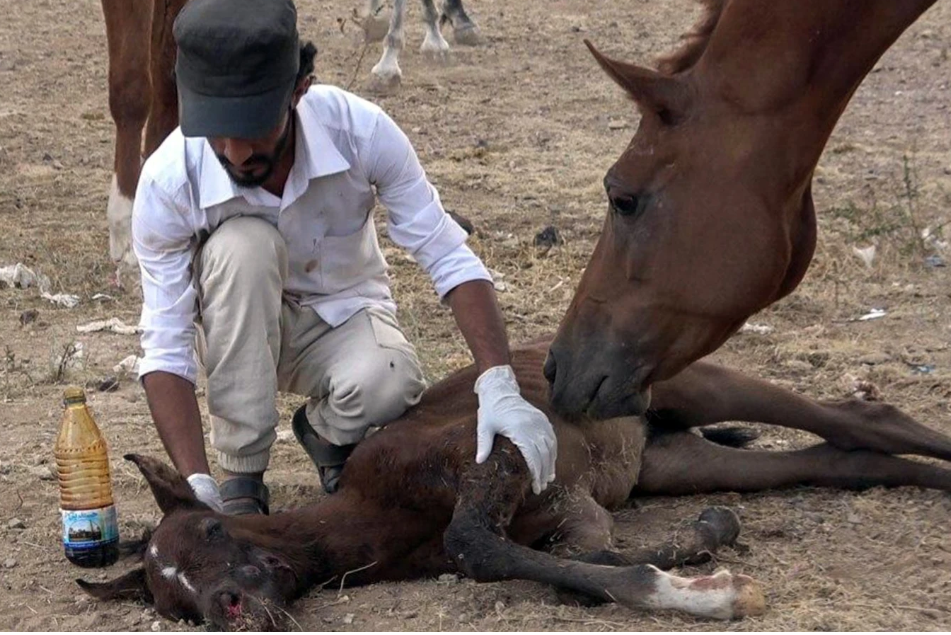
Adding a new crime to the Saudi regime’s 12-year-long bloody record, Saudi aggression aircraft launched five airstrikes last Tuesday against horse stables at the equestrian complex in Bani Al-Harith District of the capital Sana’a. The attack resulted in the killing of 31 horses and injuries to 30 others—all belonging to the finest purebred Arabian lineages—while causing extensive destruction to the complex’s facilities and equipment.
This marks the third such crime committed by the Saudi enemy against these horse stables. The same site was previously targeted in November 2020, an attack that resulted in the death of 30 purebred Arabian horses and the destruction of vital facilities—demonstrating a clear, persistent intent to finish off what remains of this rare animal heritage.
The targeting of horse stables brings to mind a history of repeated attacks by the Saudi-led regime on equestrian centers and stables—notably in the capital Sana’a, and the governorate of Hodeida in August 2016, as well as the 2020 bombing of the equestrian complex in Sana’a.
These assaults resulted in the killing of over 70 purebred horses and injuries to more than 100 others. One horse breeder was killed and two others were wounded, while stables, feed storage facilities, and equestrian amenities were destroyed—all amidst tragic scenes of wounded horses suffering beneath the rubble.
Horse stables were not the only targets; the Saudi-led aggression’s airstrikes also struck numerous youth and sports facilities across the capital Sana’a, and various governorates.
This confirms that the bombing of these sites was no accident; rather, it is part of a systematic policy aimed at destroying national infrastructure and assets, crippling the equestrian sector, and wiping out livestock of significant genetic value.
Observers of cultural and heritage affairs argue that the targeting of these stables goes beyond the mere destruction of a facility or a material loss. These horses are not simply animals kept in a stable; they represent a national treasure and an authentic heritage deeply intertwined with the history of Yemen and the Arab world throughout the ages.
The repeated crimes of the Saudi enemy reveal a persistent effort to obliterate and destroy an integral part of the historical identity, cultural heritage, and civilization of the Yemeni people—a people whose name has, since ancient times, been synonymous with the breeding and preservation of the lineage of purebred Arabian horses. This is a desperate attempt to erase the civilizational memory of Yemen, along with all its symbols and components.
This crime demonstrates that the Saudi regime holds no regard for the sanctity of human life, animals, or cultural and civilian property. It flagrantly disregards international charters and humanitarian laws that prohibit the targeting of civilian objects, sports facilities, livestock, and the cultural, civilizational, and historical heritage of Yemen.
Furthermore, the Saudi enemy’s deliberate extermination of Yemen’s livestock—specifically rare, purebred Arabian horses, which constitute an essential element of the Yemeni people’s cultural and historical identity—reflects a dangerous escalation in an aggressive campaign that strikes at everything representing life, beauty, and authenticity, revealing a complete abandonment of the most basic human values and principles.
In short, the targeting of stables housing purebred Arabian horses in Yemen will remain a living testament to the systematic destruction pursued by the Saudi enemy to erase everything connected to Yemen’s heritage, culture, and civilization. Yet, these crimes will never succeed in breaking the will of the Yemeni people or erasing an identity that is deeply rooted in the depths of history.