
Yemeni Analyst: Yemen Imposing New Reality, Revealing Collapse of US Power Tools
Military and strategic affairs expert Brig. Gen. Mujib Shamsan said that the Yemeni operations in the Red Sea have imposed “a new reality” that exposes “the biggest collapse in Washington’s traditional tools of power in decades.”
Speaking in interview with Al-Masirah TV, Shamsan stated that the scale of failures experienced by the US aircraft carrier in the Red Sea “was too large to hide,” prompting the US administration to release scattered reports alternately discussing aerial threats and financial losses.
He added that Washington’s “transparent contradictions” were an attempt to avoid acknowledging the real problem: the diminishing effectiveness of its power instruments in one of the world’s most strategic regions.
Shamsan explained that the United States has begun seriously searching for alternative energy sources after realizing that Gulf oil has become “outside the circle of control and influence,” due to the emergence of a Yemeni force overlooking critical maritime lanes and possessing missiles capable of reaching deep into energy-production zones. This, he said, drove Washington’s intense outreach to Venezuela in recent weeks.
According to Shamsan, the unseen losses for Washington are not measured in downed aircraft or missile costs, but in the collapse of “military prestige,” after five US aircraft carriers failed to break the blockade, protect themselves, or stop Yemeni operations — pushing the US military to consider reshaping its doctrine around lower-cost platforms such as drones.
He also addressed the US investigation into recent “friendly fire,” noting that the reported incidents illustrate the intense operational pressure the US forces faced under continuous Yemeni attacks around the clock. This pressure, he said, drove carrier crews to a point where they “lost the ability to distinguish between real threats and false alarms,” leading to repeated errors and operational chaos.
Shamsan pointed out that failures in identification systems, helicopter landing cycles, and shifts inside the combat information center all revealed weak US naval readiness — contrasted with the Yemeni Armed Forces’ prior and accurate knowledge of vulnerabilities within US warships, including the shutdown of an airborne command aircraft, which Yemeni leadership documented early in the confrontation.
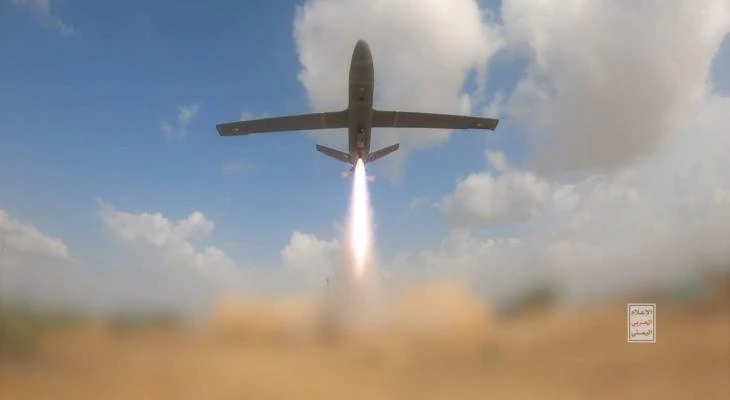
He noted that Yemeni Forces succeeded in pushing US fighter jets from offensive missions into solely defending the carrier itself, undermining Washington’s plans and causing widespread confusion and crew exhaustion. This was achieved, he said, through the Yemeni use of a “complex blend of high-speed missiles, cruise missiles, and drones” under tactics built on “temporal density” and sustained pressure.
Shamsan said that even allied destroyers — including a German vessel — were forced to fire at a US aircraft due to the operational confusion created by Yemeni actions, underscoring that the situation was “far beyond a simple friendly-fire scenario” despite Washington’s attempts to downplay it.
Regarding the Eisenhower carrier, Shamsan asserted that it experienced a “complete collapse in combat readiness,” and that the US fleet spent an entire month seeking alternatives before deploying the “Truman” carrier.
He added that US commentary about “malfunctions and psychological pressure” was an attempt to sidestep the fundamental reality: Yemen has imposed a new equation that reshaped the threat landscape in the Red Sea.
Shamsan concluded that the management of the military posture was not accidental but a “deliberate Yemeni decision,” whose results became clear when the Yemeni Armed Forces launched pre-emptive strikes that disrupted US preparations and demonstrated “Yemen’s intelligence superiority and its ability to strip Washington of the element of surprise” — marking one of the most significant military shifts in the region in decades.
The Red Sea has emerged as a pivotal front in the wider regional confrontation, where Yemeni naval operations have repeatedly challenged longstanding US maritime dominance. In response, Washington has deployed several carrier strike groups along key shipping routes in an attempt to restore deterrence and secure commercial navigation.
However, recent incidents — including US-acknowledged “friendly fire” mishaps and misidentification events — have exposed growing operational pressure within the US Navy. These developments underscore the strategic complexity of the Red Sea theater and the escalating risks surrounding US military involvement.