
Rodents & insects in Gaza Strip… Real threat of health & environmental disaster for residents
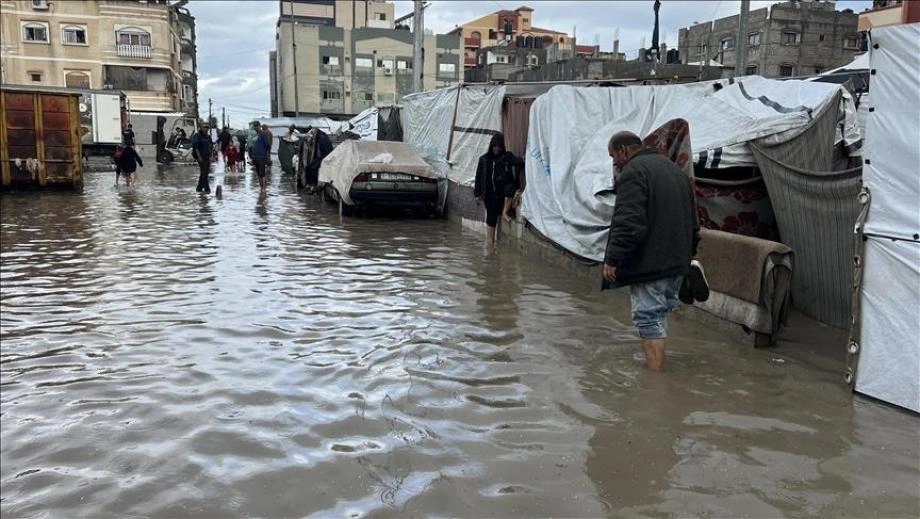
On a cold rainy night in one of the displacement camps in the Gaza Strip, while he was asleep, Abu Adam woke up to the screams of his infant son—loud screams he had never heard before.
When he saw his child, he was shocked to find blood covering his face due to a rodent—a “weasel”—that had bitten him.
Abu Adam recounts his son’s story, telling the Yemeni News Agency (Saba):
“We were sleeping at night, it was rainy, winter and cold. Suddenly I found the boy screaming. It was the first time I heard him scream like that. My wife and I got up and turned on my phone light on his face, and I found his face full of blood, and the bed full of blood, and we couldn’t do anything.”
He added: “My wife told me something big bit the boy. I moved my phone light and found a large ‘weasel’. I pulled it from under him and it went under the table, so I realized it had bitten the child. We ran with him in the rain to get him medical help.”
Amid the massive destruction in the Gaza Strip as a result of Israel’s genocide against the Palestinian people there over the past two and a half years, the spread of rodents has increased dramatically and unprecedentedly, becoming a dangerous phenomenon with severe consequences that threaten a health and environmental catastrophe in the Strip.
Rodents find the rubble of destroyed houses a suitable environment, and spread among displacement camps in search of food, putting the lives of young children at risk and contributing to the spread of diseases and epidemics.
An unprecedented disaster
In an interview with the Yemeni News Agency (Saba) on Monday, the spokesperson for Gaza Municipality, Husni Mahna, warned of a real disaster threatening the health and environmental situation in Gaza City due to the unprecedented spread of rodents and insects.
He pointed out that this spread is linked to several accumulated factors, most notably the widespread destruction of infrastructure, especially sewage networks, the accumulation of more than 25 million tons of rubble inside the city, creating a fertile environment for the breeding of rodents and insects, in addition to the accumulation of solid waste in streets and in the city center due to the disruption of collection services, with more than 350,000 tons piling up in Gaza alone.
Mahna noted that among the reasons for the spread of these rodents and insects is also the acute shortage of water and its irregular supply, as well as severe overcrowding in shelters and displacement camps.
He emphasized that all of these conditions have created an ideal environment for the uncontrolled reproduction of rodents and insects, amid a lack of necessary resources for control efforts, and the Israeli side’s refusal to allow the entry of the equipment and machinery needed for municipal work, in addition to materials and toxic baits used to combat these insects and rodents.
Health and environmental risks
Regarding the health and environmental risks resulting from the spread of rodents, the spokesperson for Gaza Municipality explained that their proliferation is not merely a nuisance, but has become a direct threat to public health. These creatures carry many serious diseases, such as bacterial infections like salmonella, as well as skin and respiratory diseases, and the potential transmission of epidemic diseases in crowded environments.
He pointed out that rodents contribute to the destruction of the limited food supplies available to residents of the Gaza Strip, contaminate water sources, and damage fragile infrastructure, especially sewage networks. He also noted that the World Health Organization has warned that rodents are among the most important disease carriers in environments suffering from weak sanitation and hygiene services.
Children the first victims
Mahna confirmed that actual cases of rodent attacks on displaced people have been recorded, especially children, inside tents and shelters.
He said: “However, in light of the missing materials needed to combat these rodents and insects, as a result of the Israeli blockade, the municipality is currently carrying out partial interventions to address exposed sewage hotspots, conduct maintenance work, and remove random dumps in some areas as much as possible. But these efforts remain very limited and do not match the scale of the disaster, due to the depletion of essential materials.”
He added that Gaza Municipality is suffering from a severe shortage of pesticides, materials, and toxic baits, a lack of fuel needed to operate machinery and vehicles, a scarcity of spare parts and oils. In addition, the Israeli side’s destruction of heavy equipment required for rubble removal has significantly hampered the municipality’s ability to respond effectively, making environmental crisis response extremely limited.
Urgent Needs
Mahna spoke about the needs of the Gaza Strip to be able to recover, most notably the removal of rubble exceeding 25 million tons in Gaza City alone and 70 million tons across the entire Strip. He also highlighted the rehabilitation of sewage, water, and road networks, the entry of heavy machinery and modern operational equipment suitable for the massive scale of destruction, as well as the continuous supply of fuel and oils alongside other consumables.
He stated that the Gaza Strip also needs the unrestricted entry of construction materials, the introduction of alternative energy systems such as electric generators or solar power systems, and financial and technical support for municipalities.
The spokesperson for the Gaza City Municipality emphasized that without these requirements, the city will remain in a cycle of environmental and public health risks.