
Sea of Gaza: From respite of life to hotbed of disease
After swimming, her son returned with a severe intestinal infection after swallowing seawater, while her young daughter developed rashes and swellings on her feet that later turned into painful wounds due to itching. At that moment, she realized that the sea, which was once a relief for Gaza’s residents, no longer holds anything but danger for them.
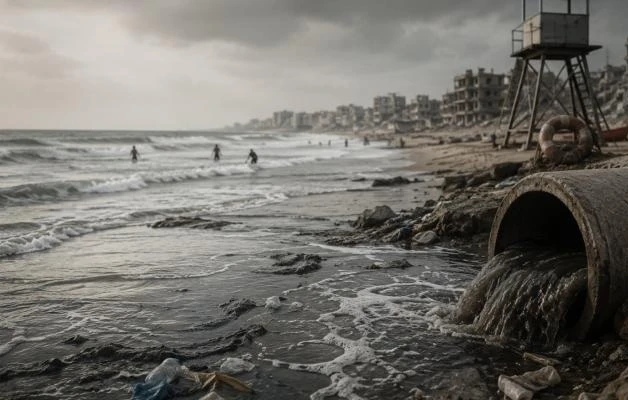
This story is not an exception; it reflects a reality experienced by hundreds of thousands of residents in the Gaza Strip, where an environmental and health catastrophe is worsening along the coastline. This is the result of the Israeli enemy’s destruction of sewage networks and infrastructure, and the continued flow of wastewater into the sea, while municipalities are unable to contain the crisis due to a lack of resources and equipment.
In the city of Khan Yunis in the southern Strip, the municipality confirms that seawater pollution is due to most sewage facilities being out of service after the destruction of pumping and treatment stations and main transmission lines, leading to the discharge of tens of thousands of cubic meters of raw wastewater into the sea daily.
The spokesperson for the Khan Yunis Municipality, Saeb Laqan, told the Palestinian Sama News Agency that approximately 85% of sewage facilities are out of service, causing about 60,000 cubic meters of wastewater to be pumped into the sea daily, in addition to large quantities of wastewater leaking into the ground, especially in the Al-Mawasi area, which shelters hundreds of thousands of displaced persons.
He added that the coastline is suffering from widespread pollution due to the shutdown of treatment plants, while the municipality has lost its ability to repair damage or operate facilities due to ongoing restrictions and a shortage of necessary equipment and materials. He warned that the continuation of this reality portends an escalating environmental and health catastrophe.
Despite residents’ awareness of the risks, many families have no alternative to the sea, whether to alleviate the summer heat or to wash clothes, in the absence of basic services and the cramped conditions of displacement.
Umm Abdo Al-Haj says her children were not the only victims, affirming that cases of skin and gastrointestinal diseases are recurring among children after swimming, as citizens watch the flow of sewage into the sea and the spread of waste along the shore.
She adds with sorrow: “The sea was our children’s only escape… today it has become a source of disease,” noting that her children can no longer swim as they used to.
The repercussions of the crisis are not limited to pollution, as local authorities face increasing difficulties in dealing with maritime incidents due to the severe shortage of rescue equipment and technical tools, increasing the risks threatening beachgoers, especially children.
Thus, the sea of Gaza no longer tells the stories of fishermen or carries the joy of children as it once did; it has become a witness to an environmental and humanitarian crisis that deepens with each passing day.
Between polluted waters, collapsed capabilities, and children seeking a moment of joy, the last resort for the Strip’s residents turns into a danger threatening their lives, in a scene that encapsulates the magnitude of the tragedy Palestinians are living in Gaza.