
Political, Military Analysts: Preemptive Yemeni Strikes Thwart Saudi Enemy’s preparations
Political and military analysts say recent preemptive operations by the Yemeni Armed Forces have disrupted Saudi enemy military preparations and undermined its plans for a renewed escalation against Yemen, arguing that Riyadh is repeating past failures by pursuing a military option instead of addressing Yemen’s demands.
Yemeni Deputy Foreign Minister for Political Affairs Abdullah Ali Sabri said Saudi Arabia had used the period of no war, no peace to build up large military forces at Al-Wadiah and other areas in preparation for a new confrontation.
He said precise preemptive strikes by the Yemeni Armed Forces destroyed those concentrations before they could be deployed, sending decisive military and intelligence messages that Yemen is determined to establish full sovereignty on land, at sea and in the air.
Sabri said Riyadh’s decision to escalate and reject genuine peace would lead to more painful stages, stressing that the era of Saudi tutelage over Yemen had ended.
Saudi plans disrupted
Military analyst Maj. Gen. Khaled Gharab said Saudi Arabia’s decision to commit its full weight to the escalation through its allies and mercenaries had exposed its plans to collapse under Yemeni strikes targeting command centers, field leadership, Saudi special forces and key supply routes from Al-Wadiah, which was reportedly targeted for the third time.
He said the Yemeni Armed Forces’ advanced aerial reconnaissance and precision targeting demonstrate a significant intelligence advantage, enabling them to track Saudi movements and disrupt its plans.
Military expert Brig. Gen. Omar Maarabouni said the Saudi decision to intervene directly in the conflict was a major strategic mistake, arguing that repeating previous approaches would produce similar results on a larger scale.
He said the Yemeni Armed Forces had evolved from strategic defensive operations to delivering strategic strikes, while developing significantly greater operational capabilities, intelligence and targeting precision.
The recent attacks on key Saudi logistical infrastructure, he added, could force Riyadh to reconsider its plans and undermine any future offensive operation against Yemen.
Growing military capabilities
Brig. Gen. Abed Al-Thawr said accurate intelligence had been central to the Yemeni strikes on Saudi command-and-control centers and major supply lines.
He pointed to the scale of explosions and the variety of weapons reportedly destroyed at military buildup sites, saying they reflected major advances in Yemen’s domestic military and industrial capabilities.
Writer and researcher Zakaria Al-Sharabi said the operations demonstrated close coordination between intelligence gathering and rapid military decision-making, including strikes on weapons shipments and command centers before they could support a new escalation.
Lebanese political analyst Khalil Nasrallah said the latest announcement by Yemeni Armed Forces spokesman Brig. Gen. Yahya Sare’e showed that Sana’a had seized the initiative and was shaping the course of the confrontation. He predicted further strikes deep inside Saudi territory.
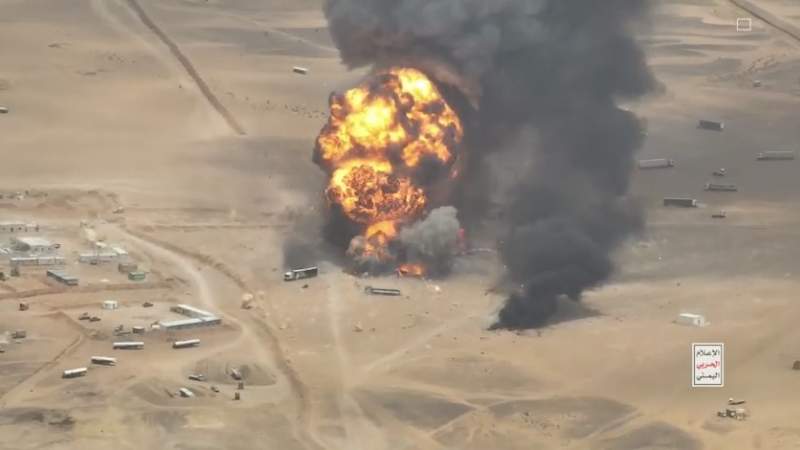
Yemeni Military Medie on Monday, September 7, 2026, released footage showing Yemeni Armed Forces strikes on trucks carrying military equipment from Saudi Arabia at Al-Wadiah Camp, using locally manufactured ballistic missiles.
The footage shows Yemeni forces conducting surveillance of Saudi military concentrations at the camp, where large numbers of trucks loaded with weapons and ammunition were reportedly gathered. It also shows explosions, burning weapons depots, thick smoke rising over the camp, and Saudi-backed fighters fleeing amid panic and confusion.
Yemeni Armed Forces repeatedly warning that Saudi military movements and buildups will be met with direct retaliation. Sana’a has framed its recent military actions as part of a broader strategy aimed at deterring further Saudi escalation and pressuring Riyadh to end its blockade and military campaign.