
Amidst rubble, darkness, Gaza students resist Zionist attempts to break their will
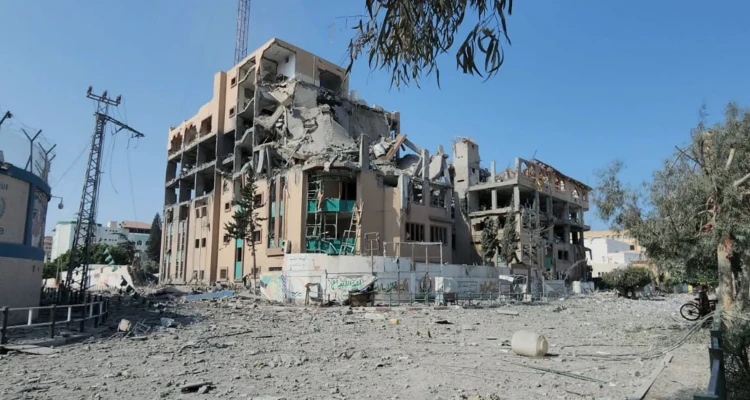
In a city accustomed to counting its losses every morning, universities were no exception. Buildings were reduced to rubble, laboratories were razed to the ground, and medical and engineering equipment lay buried under dust. Yet, amidst all this, students still open their books by dim light, writing their futures on ordinary paper after their laboratories were taken from them.
In the Gaza Strip, where estimates indicate that more than 80% of higher education institutions have been destroyed, thousands of students face a harsh educational reality no less bitter than displacement or living in tents. Scientific, medical, and engineering disciplines that rely on practical training are now taught only theoretically, threatening to graduate generations with degrees but without the skills required for their professions.
Baraa al-Dirawi, a nursing student at the Islamic University of Gaza, faces an uncertain professional future after his university was completely destroyed. He tells the Palestinian news agency Shihab that his specialization relies primarily on training with medical equipment and direct interaction with patients, but the laboratories have disappeared, and the equipment is no longer available.
“We read and memorize, but we can’t apply what we learn,” Baraa says with evident concern, wondering how he can become a nurse ready for the job market without ever touching or training on medical equipment. His fear, as he describes it, isn’t of graduating, but of graduating without experience.
Meanwhile, Mohammed Essam, a computer engineering student, faces a different but equally dilemma. After a two-year hiatus due to the Israeli war on Gaza, he says, “My studies were limited to online and theoretical learning after the laboratories and technical equipment were destroyed.”
Mohammed, who is nearing graduation, feels his degree is lagging behind him while his practical skills are still searching for an opportunity to develop. Therefore, he is trying to enroll in external training courses to make up for lost time, realizing that the job market demands more than just theoretical knowledge.
In another corner of the scene, Bader Daher, a software development student, sits with a notebook, scribbling down entire algorithms. The lab where he once dreamed of writing his first line of code is now in ruins, and the electricity he needs to power his computer is measured in minutes. He charges his device at commercial outlets and runs on a battery that barely lasts enough to complete a single idea.
Bader says the road ahead is longer for them compared to students around the world who study in modern labs with reliable electricity, but his passion hasn’t died. “Programming has taught me that every problem has a solution,” he says firmly, adding that “persistence has become more important than resources.”
For his part, academic Dr. Abdul Salam Salman confirms that what is happening represents “a true academic catastrophe,” explaining that practical specializations cannot be built on theoretical knowledge alone. The lack of practical training creates a dangerous gap between education and the job market, and weakens the preparedness of graduates in vital fields such as engineering, medicine, and technology.
Despite the ceasefire in October 2025, Israeli restrictions on the entry of essential equipment and materials continue to hinder the rehabilitation of universities and the equipping of laboratories, leaving the educational process trapped in a harsh reality.
Yet, this is not just a story of destruction, but one of resilience. Between notebooks and devices that charge by the minute, and books read without laboratories, Gaza’s students resist the idea of surrender. Buildings may be destroyed, but the spirit of learning remains.
In Gaza, the question is no longer: Will the students graduate? It is: How will they build a future from the rubble?