
Between water scarcity, epidemics: Thirst threatens lives of Gaza residents
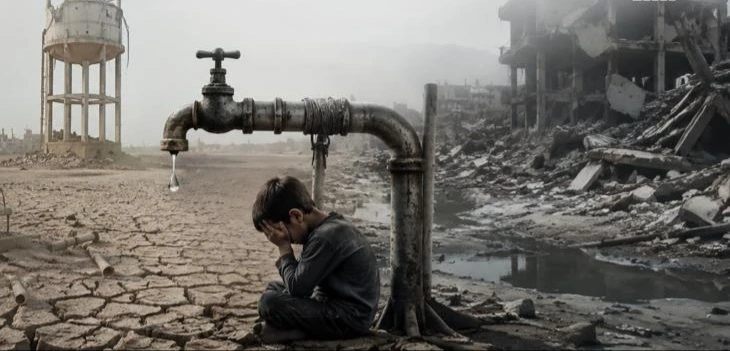
Between the long queues for limited quantities of water and the spread of diseases linked to its scarcity, the humanitarian catastrophe is widening, with children remaining the most vulnerable group.
The spokesperson for the Gaza Municipality, Hosni Muhanna, confirmed to Sanad News Agency that the war has rendered approximately 70% of the city’s water system inoperable, due to the extensive destruction of wells, desalination plants, and water networks.
He explained that the Israeli enemy destroyed 72 water wells, in addition to damaging approximately 150,000 linear meters of water networks, which has exacerbated the water crisis suffered by residents in various parts of the city.
He points out that the Mekorot pipeline is experiencing fluctuating supply, and maintenance and repair work is often impossible due to the targeting of eastern areas containing vital facilities and main wells, limiting the municipality’s ability to restore services to normal.
In the southern Gaza Strip, Salama Sharab, head of the Khan Younis Water Authority, reveals that all 40 of the municipality’s wells were rendered inoperable during the offensive, after having been the primary source of water supply.
Sharab explains that the municipality has managed to restart some wells, but their efficiency does not exceed 40%, with current production ranging between 4,000 and 5,000 cubic meters per day. He notes that water pumping sometimes stops due to resource scarcity.
He indicates that the total daily water supply, including water supplied via the Mekorot pipeline, Emirati supplies, and well production, does not exceed 15,000 cubic meters, distributed to approximately 600,000 residents in Khan Younis and Al-Mawasi.
He points out that desalination plants produce approximately 5,000 cubic meters of water daily, while the amount of water arriving via the Mekorot pipeline ranges between 7,000 and 8,000 cubic meters. However, the pipeline is frequently disrupted due to military operations, and repairs can take many days depending on the extent of the damage and the accessibility of the crews.
Sharap notes that the targeting of the water sector has not been limited to facilities but has also affected its workers. He explains that 15 sector employees have been killed while performing their duties or while traveling to work sites.
He indicates that the per capita share of water does not exceed 8 liters per day and does not reach all areas. He points out that large neighborhoods are suffering from a severe shortage, including northwest Khan Younis, the area surrounding the Asdaa Junction, parts of the humanitarian zone, and the eastern Jorat al-Lut area.
On the health front, Dr. Ahmed al-Farra, head of the pediatrics department at Nasser Medical Complex, warns that the water scarcity crisis in the Gaza Strip has become a serious health threat, given the decline in hygiene standards and the spread of infectious diseases.
Al-Farra explains that the average individual’s water share does not exceed 10 liters per day, including drinking water, water for personal use, and water for hygiene. He points out that this situation has led to a rise in infectious disease cases.
He notes the high number of cases of smallpox and bacterial infections, along with indications of a resurgence of hepatitis. He states that Khan Younis Governorate alone has recorded more than 10,000 cases of smallpox since the beginning of July.
He emphasizes that the continued water scarcity, the accumulation of waste, the disruption of sewage networks, and the reliance on unsafe water sources are all factors that increase the risk of disease outbreaks, especially among children.
As thirst spreads and disease cases increase, Gaza faces one of its most severe humanitarian crises. Access to clean water is no longer just a basic service, but a daily struggle for survival, amid warnings that the continuation of this situation could push the Gaza Strip into an even more dire health and humanitarian catastrophe.