
Fifth Ramadan lecture of Sayyed Abdulmalik Badr al-Din al-Houthi 1447 AH
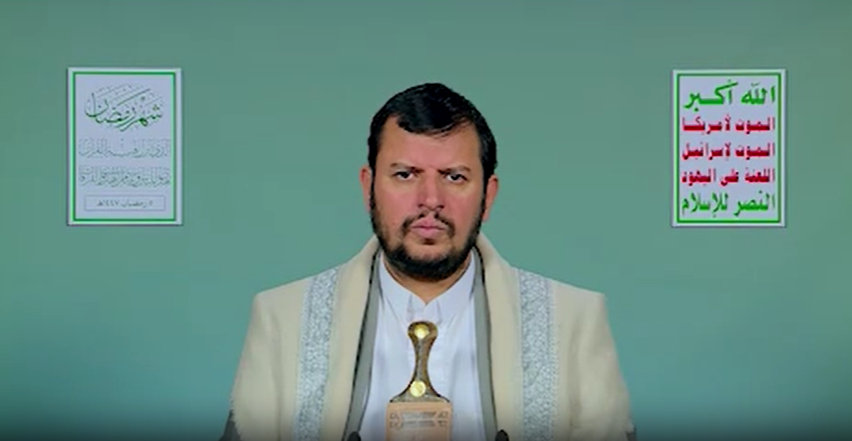
I seek refuge in Allah from Satan, the outcast.
In the name of Allah, the Compassionate, the Merciful.
Praise is to Allah, Lord of the Worlds. I believe that there is no god but Allah, the Sovereign and the Manifest Truth, and that our master Muhammad is His servant, Messenger, and Last Prophet.
O Allah! Confer Your salat and blessings upon Muhammad and the Family of Muhammad as You conferred Your salat and blessings upon Ibrahim and the Family of Ibrahim. You are Owner of Praise, Owner of Glory! And be pleased with Muhammad’s good companions and all Your righteous servants and mujahidin.
O Allah! Guide us and grant us acceptance, for You are the Hearing, the Knowing; accept our repentance, for You are the Relenting, the Merciful.
Brothers and sisters, peace be upon you and the mercy of Allah and His blessings.
Allah (Glory be to Him) says that the stories in the Holy Quran are presented {‘for a people who believe‘}[Al-Qasas 28:3]. These stories are not presented as merely historical events that have passed, nor for mere entertainment. Rather, these accounts are intended to provide us with guidance so that we may gain spiritual insight, strengthening our trust in Allah (Glory be to Him), enhancing our awareness, and deepening our understanding of divine laws—laws we must fully grasp and act upon in our lives and decisions.
{‘For a people who believe‘}—the fruit of their faith is their firm, unwavering confidence in Allah (Glory be to Him) and His true promise. This also manifests in their unshakable resolve, even in the toughest conditions and most difficult phases.
As a Muslim ummah facing oppression and targeting in this phase of our history, we witness the arrogant forces of tyranny and criminality clearly pursuing aggressive objectives through criminal and unjust practices. The roles have shifted: Those once oppressed, as we see in the story of Prophet Musa (PBUH) and his struggle with Firaawn, are now the very tyrants of our time, surpassing Firaawn in their criminality, cruelty, arrogance, and oppression. Allah has given us lessons from their history so that we may be sure that change is possible and that our trust in Him (the Almighty) is strengthened in these trials.
Despite the deceptive tactics our enemies use, such as Trump’s council, which they call ‘the Peace Council’, and the shiny, misleading language they associate with it, their actions are unmistakably clear: They commit daily crimes against the Palestinian people and escalate their assault on Islamic holy sites, with the Al-Aqsa Mosque at the forefront. Recently, they have introduced more restrictions, obstacles, and barriers, narrowing the space for worshippers and limiting access to the Al-Aqsa Mosque. They have even imposed a fixed limit—restricting the number of worshippers allowed to pray there. This is an extremely dangerous move, an outright act of hostility in every sense of the word. It is part of a broader trajectory to target the Al-Aqsa Mosque as one of the most sacred Islamic sanctities. One of the Zionists’ main objectives is to ultimately destroy the Al-Aqsa Mosque, erasing it as a prominent Islamic landmark and replacing it with their alleged temple. They proceed with gradual, conditioning steps to stifle any reaction from Muslims, aiming to render this Ummah indifferent to their actions, until something extremely dangerous occurs. At the same time, they extend the time frames for the Zionist settlers’ incursions into Al-Aqsa, continuing their desecration of the mosque.
The daily killings, bombings of buildings, starvation, and severe siege remain relentless in Gaza. Severe violations in the West Bank continue unabated. Intense air strikes and other forms of aggression against Lebanon continue. All of this takes place despite the agreements, guarantors, and commitments—repeatedly broken by the Israeli enemy and its American guarantor, who is a partner in all its crimes and aggressions, as well as in its objectives and conspiracies.
Recently, we heard a statement from the American ambassador to the Zionist Jews, who is a U.S. official representing his country’s policies and the direction of its administration, saying openly and clearly that it would be fine if Israel took the Middle East, for it has a biblical right to the land between the Nile and the Euphrates. He expressed this with complete frankness. In fact, he has made many statements in which he affirms this stance: the American position supporting the Israeli enemy in its efforts to take control of this region, its peoples, countries, and resources. It is the same region they often refer to as ‘ the Middle East’ or ‘Greater Israel’.
Therefore, we must be fully aware that we are a targeted Ummah and that we are confronting the Israeli–American–Jewish tyranny—a tyranny both deceptive and characterised by unmistakable criminal intent. Its objectives are unmistakably clear.
Hence, we are in need of a path to deliverance—and that path is clear. The only hope for this Ummah, and its way to salvation, lies in clinging firmly to Allah: {‘Whoever holds firmly to Allah is surely guided to the Straight Path‘}[Ali ‘Imran 3:101].
Other paths are merely wasteful and draining—a waste of time and effort when the Ummah stakes all its hopes on them. They are nothing but a mirage, [as explained in the Holy Quran,] {‘a mirage in an open land, which the thirsty perceive as water, but when they approach it, they find it to be nothing‘}[An-Nur 24:39]. Indeed, developments over the past decades have demonstrated this—even in the case of the so-called ‘Palestinian Authority’ and the expectations it invested in the Oslo Accords and subsequent agreements. What is happening in the West Bank? Every day brings the most heinous violations: displacement, destruction, plunder, and killing, alongside various other crimes, including the continuous seizure and control of lands, simultaneous expansion of settlements on the occupied lands in those regions, and other aggressive measures carried out by the Israeli enemy.
This enemy leaves the Ummah with no choice except to confront it and to strive to rid itself of it. But how is that? As we have said, this can happen when the Ummah clings firmly to Allah and returns to His guidance, to His blessed light. In His blessed light and magnificent guidance (the Holy Quran), Allah presents to us a complete picture of our enemies: who they are, what they are like, with a precise diagnosis of their psyches, their behaviour, their motives, their objectives, and even their criminal acts. We witness its manifestations and the clear evidence of it on the ground every day.
Therefore, we are called to return to Allah (Glory be to Him) sincerely, consciously, and practically—to act in accordance with His blessed guidance. Even the Quranic narratives are presented to us within the framework of His guidance, instilling in us the great truths—foremost among them that Allah (Glory be to Him) is Merciful to His servants and does not will that they be wronged. Rather, in His guidance, He provides what protects them from being subjected to injustice. He says,{‘And Allah wants no injustice to the worlds‘}[Ali ‘Imran 3:108], and says, {‘And Allah wants no injustice to His subjects‘}[Ghafir 40:31]. This is so for humanity in general, let alone His devoted servants and those who follow His religion. He does not will injustice for the worlds in general, and even when they are reduced to a condition of weakness and subjugation—a wronged, oppressed, and crushed nation—He grants them a path of deliverance from the reality in which they stand and the state they endure.
Furthermore, Allah (Glory be to Him) is the Almighty, the All-Wise, the All-Powerful, the Compeller. By virtue of His might, He does not leave the field open to tyrants without granting the oppressed a path to deliverance and rescue from the tyranny of tyrants and the arrogance of the arrogant. Injustice and transgression may intensify to a certain level—but Allah (Glory be to Him) is the One who has said about Himself, {‘Indeed, your Lord is in observation‘}[Al-Fajr 89:14]. He has set forth the examples and the proofs: {‘Did you not see how your Lord dealt with ‘Aad of Iram, who had lofty pillars, the likes of whom had never been created in the land; with Thamud who carved [their homes into] the rocks in the [Stone] Valley; and with the Firaawn of mighty structures? They [all] transgressed throughout the land and spread much corruption there. So your Lord unleashed on them a scourge of punishment. Indeed, your Lord is in observation‘}[Al-Fajr 89:6-14]. Firaawn, despite his tyranny and despotism, was destroyed by Allah (Glory be to Him), and He delivered the oppressed from him. And how did that come to pass? Within it are lessons of profound significance.
The divine plan for the deliverance of the oppressed—as we have explained in the light of the blessed verses in the story of the Prophet Musa—comes into the lived reality of people and unfolds through their hands, within the framework of the divine law established by Allah (Glory be to Him). According to this divine law, Allah prepares for them someone through whom deliverance will take place—one of His devoted and guided servants, who walk upon His guidance, act according to His teaching, and proceed in a practical manner. In other words, the rescue of the oppressed from Firaawn did not occur in such a way that they went to sleep one night and awoke the next morning to find that Firaawn, his soldiers, his ministers, and his aides had perished, and that the crisis had simply disappeared. Nor did they merely pray against Firaawn, his supporters, and his soldiers, asking Allah to destroy them, bring the crisis to an end, and grant them relief. Rather, it was a practical course of action—a divine arrangement brought into practical effect. Allah prepared the one through whose hands deliverance would occur. Thus, it unfolded in accordance with divine guidance and teachings, through a long practical process.
This also falls within the framework of the sacred and great responsibilities of carrying Allah’s message. That is, the oppressed move forward while bearing a divine, sacred, and great project—one aimed at establishing equity and justice and upholding truth. Falsehood and tyranny are grounded in a misguided vision, from which criminal practices emerge. Therefore, in the arena of struggle, they are confronted by truth—through which life is set right and people’s lives are made upright. In contrast to the oppression and criminality practised by tyrants stands justice. Indeed, within the context of struggle, there exist what can be called beliefs, foundations, cultures, and ideas—the underlying frameworks upon which each side acts and advances.
Deliverance came to the oppressed—those whom Firaawn had oppressed through his tyranny—at the hands of the Prophet of Allah Musa (PBUH), within the framework of his sacred prophetic mission. Among the most prominent aims and responsibilities of that mission were the rescue of the oppressed, the establishment of proof against Firaawn and his people, and the presentation of guidance to them. He offered guidance and presented the path of deliverance, righteousness, and success—even to Firaawn himself. At the same time, he worked to mobilise those oppressed people as they had believed in that message, clarifying for them the practical commitments and sacred responsibilities it entailed. Indeed, this struggle had a clear purpose, clearly defined roles, and a connection to a greater cause. Those oppressed people were given a sacred and momentous cause—through which they would act and their own deliverance and relief would be realised. That cause was a message they were to carry and sacred responsibilities they were to uphold. The Quran portrays their condition—both before and after deliverance—showing the level of their commitment to that message after Allah saved them from oppression, persecution, and injustice. It also describes their journey as followers of that message, the divine care they received, and the punishments and afflictions that befell them in moments of deviation. All of this is related in Quranic verses of different surahs, containing lessons and profound insights for our Islamic Ummah. In this way, Allah has presented to us—as a Muslim Ummah—a comprehensive and extended example of a nation across its different circumstances and stages.
Returning to the story of the Prophet of Allah Musa, we concluded yesterday’s lecture by reflecting upon the blessed Quranic verse, {‘We revealed to Musa’s mother, “Nurse him, but when you fear for him, cast him into the sea, and do not fear or grieve. We will certainly return him to you and make him one of the messengers”‘}[Al-Qasas 28:7]. We also reflected on how the divine plan surpassed all the precautionary measures put in place by Firaawn and his soldiers—their determined efforts to prevent the birth of this child, as well as the utterly horrific crimes they committed in pursuit of that objective.
Divine care extended to the mother of Musa herself, and she received Allah’s instructions, through which this newborn child would be saved. She was in urgent need of such guidance from Allah (Glory be to Him), and these instructions came by way of revelation so that she could act with complete confidence and reassurance. That is because the practical step required of her—being a mother filled with maternal emotion, tenderness, and compassion—was to cast her own infant into the river: {‘But when you fear for him, cast him into the sea.‘} To undertake such a task in that manner towards her nursing child required unequivocal instructions in which she could place her trust and find reassurance. Thus, revelation came.
Yesterday, we mentioned the confusion raised by some commentators who interpret the Holy Quran, questioning how revelation could come to her even though she was not a prophet and no women were sent as prophets. We also discussed that similar instances occurred in the prophets’ sphere, within the broader context of the prophetic mission itself. We cited the story of the truthful and pure Mariam (PBUH), to whom Allah revealed in clear and explicit terms. The angels called out to her and addressed her in the very words mentioned in the Holy Quran, {‘And [remember] when the angels said, “O Mariam! Surely Allah has selected you, purified you, and chosen you over all women of the world”‘}[Ali ‘Imran 3:42]. Likewise, she was given glad tidings of her son, the Prophet of Allah Isa (PBUH), and the verse concerning this is equally explicit: {‘[Remember] when the angels proclaimed, “O Mariam! Allah gives you good news of a Word from Him; his name will be the Messiah, Isa son of Mariam; he is honoured in this world and the Hereafter, and he will be one of those nearest [to Allah]”‘}[Ali ‘Imran 3:45]. Indeed, Surah Mariam provides further clear details on this matter.
Musa’s mother was in need of instructions in which she could place her trust and find reassurance, given the gravity of the practical step she was being asked to undertake. This, too, required faith—real faith—and she was indeed a believer. Otherwise, how could she possibly proceed with such an act: placing her tiny nursing infant in a wooden chest and casting him into the river, where the waves would toss him about, exposing him to the danger of drowning and of the sea creatures?! After that, there was the further fact that the waves would carry him to the shore—only for him to be taken by the very enemy who sought to kill him and bring about his destruction. Such a matter demands faith. Faith in Allah’s true promise is essential in overcoming dangers and in undertaking sensitive and difficult practical steps during the most challenging circumstances and critical phases.
Therefore, the more deeply faith takes root within a person—in his trust in Allah (Glory be to Him) and in his conviction in His true promise—the more capable he becomes of undertaking great and momentous responsibilities. This was indeed an immense task that she carried out, particularly from her position as a mother. For a mother, with all her tenderness and natural apprehension for her infant child, such a step is profoundly difficult. Yet she fulfilled this mission: taking her son and casting him into the sea, after completing a certain stage of nursing and caring for him.
In this story, we also find the divine providence granted to this infant and to his mother, and how instructions came to her from Allah. She received glad tidings and reassurance, and was shown the means of his deliverance and safety. At the same time, the child remained under divine protection, despite his state of utter vulnerability: a nursing infant unable to do anything for himself. In this lies an important and instructive lesson.
Allah (Glory be to Him) says to her, {‘Nurse him‘}[Al-Qasas 28:7], so that he may receive sufficient nourishment to meet his essential needs and endure the stage during which the divine plan unfolds. She is not to take him to the river while he is hungry or in need of feeding; rather, she is to nurse him until he is fully satisfied. Then, at the moment of danger— when she senses a threat to him—she is to proceed with this task. Thus, these instructions from Allah (Glory be to Him) ensure that the infant receives nourishment, protection, and full motherly care.
For this reason, one may express reservations about what some historians report in the Prophetic biography concerning the Messenger of Allah, Muhammad (PBUH&F), namely that he faced a difficulty in obtaining suckling and endured prolonged and severe hardship as a result. It is possible that such accounts contain exaggerations and inaccurate additions.
Then He says, {‘but when you fear for him, cast him into the sea‘}[Al-Qasas 28:7]. She had sought to conceal him while caring for him and nursing him; yet, under the intensity of Firaawn’s surveillance and intelligence monitoring, she sensed the threat that his presence might soon be discovered; consequently, she proceeded to carry out the divine command. This was truly an extraordinary manifestation of Allah’s (Glory be to Him) providence in securing the deliverance of that infant from the enemy’s danger: deliverance achieved by passing through two immense perils—indeed, by going directly into peril itself, yet in a manner marked by divine care, a truly marvellous care. For this reason, when Allah later addressed Musa (PBUH) after his prophethood, He reminded him, {‘When We revealed to your mother this: ‘Put him into a chest}[Taha 20:38-39]—a small wooden chest which she had prepared for him and placed him inside—{then put it into the river. The river will wash it ashore, and he will be taken by [Firaawn,] an enemy of Mine and his.’ And I endeared you with love from Me [O Musa] so that you would be brought up under My [watchful] Eye‘}[Taha 20:39].
This is how his deliverance from the enemy’s danger unfolded in a truly astonishing way: He passed directly through the danger of the sea—the peril of drowning and of its creatures—while at the same time being carried to his very enemy, yet emerging from all of that in complete safety. These instructions were accompanied by reassurance from Allah (Glory be to Him) and by great and significant glad tiding. Allah said to her, {‘And do not fear‘}[Al-Qasas 28:7]—that is, do not fear drowning, nor the creatures of the sea, nor the enemy to whom the sea would deliver him; the waves would cast him upon the shore where that enemy would take him. Rather, be assured of his safety. Allah then said, {‘or grieve. We will certainly return him to you‘}[Al-Qasas 28:7]: This was a great glad tiding for her. He further said, {‘And make him one of the messengers‘}[Al-Qasas 28:7]—a glad tiding that is even greater and more momentous.
Scholars of Quranic interpretation explain that this single verse contains two commands, two prohibitions, two statements of fact, and two glad tidings, all delivered with striking brevity and clarity. Indeed, it is one of the blessed Quranic verses that encapsulates numerous matters in concise and lucid expressions, reflecting the eloquence and miraculous nature of the Holy Quran.
We observe here that the sea plays a central role at both the beginning and the end of the conflict between Musa (PBUH) and Firaawn: It marks Musa’s salvation at the outset, the destruction of Firaawn and his soldiers at the conclusion, and ultimately Musa’s victory. This reminds us of the power of Allah (Glory be to Him) and that in His vast governance, He brings about extraordinary transformations in favour of His oppressed servants when they respond to Him. Complete control over everything in the universe—over the seas, the winds, the mountains, and all that exists—rests entirely in His hand. Therefore, it is in Him that we place our trust; upon Him that we rely; in Him that we set our hope; to Him that we turn for refuge; and from Him that we seek assistance. He is the One in whose hand lies the dominion of all things, the Sovereign over the entire universe and all that it contains.
Thus, the Prophet of Allah, Musa (PBUH), faced the danger of drowning in the sea and the menace of Firaawn—{‘He will be taken by [Firaawn,] an enemy of Mine and his‘}[Taha 20:39]. Yet the care and protection of Allah (Glory be to Him) ensured his safety from all those perils.
The mother of Musa (PBUH) set forth to fulfil her role and to carry out her mission from the standpoint of both motherhood and faith, undertaking that difficult task herself. This reflects the depth of her faith, her trust in Allah (Glory be to Him), and her complete reliance upon Him. Consider the scene: a tender, believing, righteous, and wise mother walking to the edge of the sea with her nursing infant in her arms—at a stage when a mother’s compassion, tenderness, and care are at their peak—then placing him in a small chest and casting him into the water, watching as the waves carry it beyond her sight, not knowing what his fate would be, were it not for Allah’s promise. Yet her trust in Allah, her certainty in His true promise, the tranquillity He placed in her heart, and her steadfast faith, together with the divine guidance and preparation granted to—all these brought about her ability to accomplish this mission. She undoubtedly chose the appropriate moment to act, ensuring that Firaawn’s soldiers, his informants, or anyone else who might betray her remained unaware. She completed the task—namely, casting the chest into the sea—and stood watching until it vanished from her sight upon the water.
Musa, carried in his small chest, reached the shore near the palace of Firaawn. He had passed safely through the danger of drowning in the sea, only to face another peril—the threat of death at the hands of Firaawn and his people.
We shall conclude our lecture today with this.
We ask Allah (Glory be to Him) to grant us success in seeking what pleases Him. O Allah, have mercy on our virtuous martyrs, heal the wounded among us, set free our captives, and grant us victory. You are the Hearer of Prayer!
Peace be upon you and the mercy of Allah and His blessings.