Leader of Revolution: Yemen’s demand for Saudis to end their aggression, blockade, relinquish control over sovereign resources
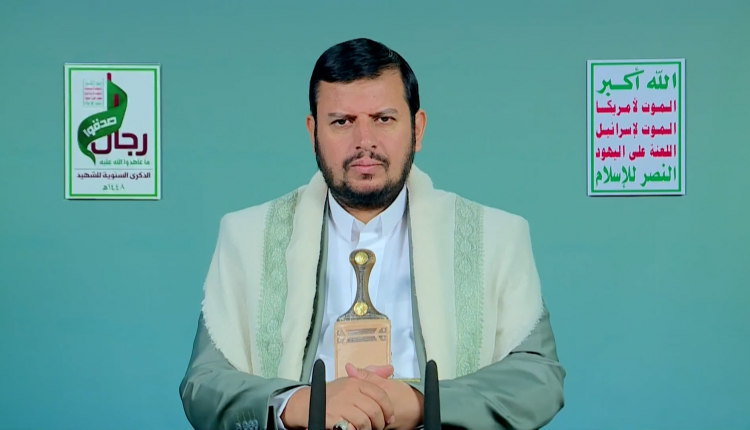
In his address marking the annual “Commemoration of the Martyr” (1448 AH), the Leader explained that the Saudi enemy controls sovereign resources, depriving the Yemeni people of them.
He emphasized that the Yemeni people’s demand is simply to be granted their right to freedom and independence.
He stated, “The Saudi enemy insists on continuing its aggression, criminality, injustice, and tyranny. Through its blockade and aggression, it seeks to mobilize others to join its cause. Furthermore, the Saudi enemy is not content with merely deploying all its own capabilities—or the wealth of the people of the Arabian Peninsula—in its aggression against our country.”
Al-Houthi pointed out that the Saudi regime exploits the wealth of the people of the Arabian Peninsula to fund the aggression against Yemen, while also funneling trillions to enemies such as the United States, Israel, and Britain. He added that the Saudi enemy propagates egregious falsehoods and leverages various pretexts to sow division and mobilize support across the Muslim world.
He further noted that the Saudi enemy acts in a manner that deepens fragmentation and discord among the people of the nation. It exploits sectarian narratives to foster polarization and promote the spread of takfiri ideology—noting that this takfiri apparatus consistently aligns its hostility with the strategic objectives of the United States.
He added, “The Takfiri tide does not move in the clear, righteous direction—such as the Palestinian cause, the plight of the Palestinians, or the confrontation against the Zionist enemy.” He emphasized that this Takfiri apparatus never mobilizes to confront the Israeli enemy, regardless of the enemy’s actions or the scale of the struggle and suffering in Palestine.
The Leader of the Revolution pointed out that the Takfiri tide remains unmoved by the plight of the Palestinians, no matter how severe it may be—as was the case in Gaza.
He noted that the Saudi enemy mobilizes these elements to serve American interests; both the Americans and the Saudis have, in fact, acknowledged that these groups are deployed in a manner that serves the United States.
He revealed that the Saudis have admitted to mobilizing these individuals to serve American interests, acting at the behest of the United States and the West. He stressed that the Saudi enemy has leveled a “great slander” against the people of Yemen—a nation defined by faith, wisdom, struggle, honor, values, and morality.
He stated, “The Saudi enemy has falsely accused the people of Yemen of targeting Islamic holy sites—Mecca and Medina. This is a ‘great slander,’ and it is transparently false to anyone who possesses even an ounce of awareness, insight, or sound understanding.”
He further remarked, “Some could have exercised patience and verified the facts before rushing to conclusions based on this Saudi fabrication. Indeed, some of those who receive this slander know full well that it is a lie; they harbor no doubt about it and are entirely certain of its falsity.”
He continued, “Some individuals acknowledge the truth when speaking with us or our representatives, yet they remain indifferent to—or even choose to adopt—this false accusation. Others embrace this Saudi-propagated falsehood for the sake of material gain or specific interests involving the Saudis. Still others adopt it driven by intense malice, deep-seated hatred, or sectarian and doctrinal complexes; the motives are varied.”
Sayyed Abdulmalik Badr al-Din al-Houthi emphasized that the Saudis leveled this false accusation against the people of Yemen—a people whose faith, values, and morals are authentically rooted in Islam; a people known for their steadfast support of Islam and Muslims, and for their fervent zeal and protective devotion toward Islamic sanctities.
He stated, “By raising this issue and leveling such a false accusation against the people of Yemen, the Saudi enemy sought to disparage Islamic sanctities and undermine their standing and moral significance within the Muslim Ummah. They have weaponized this fabrication—centered on Islamic sanctities—to further their own unjust and criminal agendas, all while serving the enemies of Islam.”
He further explained that the Saudi regime employs this falsehood to commit additional atrocities, deepen divisions within the Muslim community, and sow discord on a broad scale, adding, “It is truly astonishing how this oppressive, treacherous, and subservient regime acts in the service of the enemies of Islam.”
Al-Houthi pointed out that Islamic sanctities—foremost among them Makkah and Madinah—serve as one of the most vital unifying factors for Muslims, noting that all Muslims are united in their reverence and sanctification of these holy sites, which are intrinsically linked to their religious observances.
He continued, “There are no additional rights or prerogatives for any specific group living there—as if they somehow ‘own’ the Sacred House or the holy sites themselves. We have stated before, we state today, and we will continue to state: the Islamic holy sites do not belong to the Saudis, nor do we consider them their property.”
The Leader noted that the Islamic holy sites are intrinsically linked to religious obligations, rituals, acts of worship, and a sanctity recognized by the entire Muslim *Ummah*—not just by one segment of it. He emphasized that these holy sites are universal landmarks for everyone who identifies with Islam, the Quran, and the Prophet; they are an essential part of one’s Islamic identity.
He reiterated that the Islamic holy sites are not the property of the Saudis; rather, they are Islamic landmarks in which all Muslims share an equal standing—though the degree of reverence and sanctification shown toward these sites may vary among Muslims.
“By the grace of Allah,” he said, “our faith, principles, and culture place us among those who hold these holy sites in the highest regard and show the greatest reverence for the rituals of Allah. The Yemeni people stand at the forefront of all nations in their profound respect for the rituals of God and the sanctity of Islamic holy sites.”
He added, “Beyond this perspective—rooted in faith, Islam, values, and morality—there is also the dimension of wisdom, as reflected in the Prophetic tradition: ‘Wisdom is Yemeni.’ If any member of the Ummah has a grievance against the Saudi regime, would they ever consider taking action against the Islamic holy sites themselves?” He continued, “Even the fools and tyrants who identified as Muslims never contemplated targeting Islamic holy sites—despite the various conflicts some of them were involved in.” He then posed the question: “What could possibly drive the Yemeni people to target holy sites that are, in fact, their own—sites they hold in even greater reverence than the Saudis do?”
The Leader of the Revolution emphasized that the Saudi regime is not a guardian of the holy sites; rather, it exploits them, leveraging Islamic sacred places for political, economic, and commercial gain. It uses its influence—in all its forms—over these sites to serve the enemies of Islam and Muslims.
He affirmed, “The Yemeni people would never target these holy sites; they are our own sacred places—the sacred places of our noble Muslim people, whose faith runs deep. The Yemeni people are a great nation, defined by their values, their morality, and their authentic commitment to Islam. These Islamic holy sites belong to all Muslims.”
Al-Houthi continued, “We have no conflict with the holy sites, nor with the Islamic Ummah. These are our own sacred places; we hold them in the highest reverence, and they are integral to our religious rituals and acts of worship. Indeed, these Islamic holy sites hold a profound place within our creed, our culture, our principles—in every aspect of our lives.”
He added, “The Yemeni people would never target these sites; they are sacred to us—perhaps even more so than they are to the Saudis. With even the slightest bit of reflection, even the most dim-witted person in the Islamic world could grasp that these Saudi fabrications are entirely baseless and false. When some individuals—posing as religious, scholarly, or political leaders—repeat such slanders, it is clearly driven by other, ulterior motives.”
Sayyed Abdul-Malik Badr al-Din al-Houthi pointed out that some individuals accept and echo the Saudi narrative, not out of truth, but because they are driven by malice, deep-seated grudges, or existing financial and political ties to the regime. He pointed out that those who accept Saudi fabrications—driven by malice, spite, or financial and political ties—play a destructive role within the nation. Addressing certain entities that present themselves as “religious authorities,” he asked: “What are you doing for the nation? And what have you actually done?”
He highlighted the tragedy in Gaza, noting that the Zionist aggression against the Palestinian people has reached an extreme level of tyranny, injustice, criminality, and genocide. He asked, “As the tragedy in Gaza reached the depths of genocide, where were these entities that claim to be religious authorities?”
He further questioned, “Where were these groups during the Gaza tragedy? What did they do? What did they contribute? How did they act, and what role did they play? Instead of helping, they let our Islamic nation down and actively discouraged it from fulfilling its sacred duty to support the Palestinian people.”
He emphasized that the Saudi enemy opens the airspace of the Land of the Two Holy Mosques to the Zionists and Israel, while simultaneously closing the airspace of Yemen to the Yemeni people. “We are not asking them to open their airspace to us,” he stated, “but they are preventing the Yemeni people from using their own airports and blocking them from travel.”
He explained that the Saudi enemy prevents the Yemeni people from traveling—even those in need of medical care or those with other essential life needs—while this same regime opens the airspace of the Land of the Two Holy Mosques to Israel, all the while keeping the airspace of our own country closed to the people of Yemen. The Leader reaffirmed that the Saudi enemy is imposing a stifling blockade on Yemen, depriving the country of its national wealth—specifically oil and gas, along with the revenues derived from them, which are essential for public services and the payment of salaries. He further noted that the enemy commits the most heinous crimes, continuously and daily killing Yemeni children and women.
He remarked, “The Saudis are in an uproar because our people have reclaimed sovereignty over their own territory at Bab al-Mandab; yet, they show no such alarm while the Zionist enemy seeks to establish a foothold in Somaliland.”
He added that the Somali people are in need of support—including military intervention—to prevent the Zionist enemy from gaining a foothold on their land.