
Yemeni Strike on Ras Tanura Refinery Marks Strategic Shift in Deterrence
The deterrence equation has come to be measured by the ability to adapt to losses and maintain steadfastness in the arena of conflict across open, non-traditional geographic space — not by the density of air and ground firepower. This is what Yemeni armed forces demonstrate today, having moved the confrontation from the limits of steadfastness and internal defense to the heart of the Saudi enemy’s economic and logistical arteries.
The recent qualitative Yemeni operation that targeted the Ras Tanura refinery in response to Saudi attacks on civilians and Yemeni infrastructure reveals a deep shift in the operational range of the armed forces and in the cost of continuation for Saudi Arabia, as direct economic pressure intersects with the redrawing of field and maritime lines of engagement.
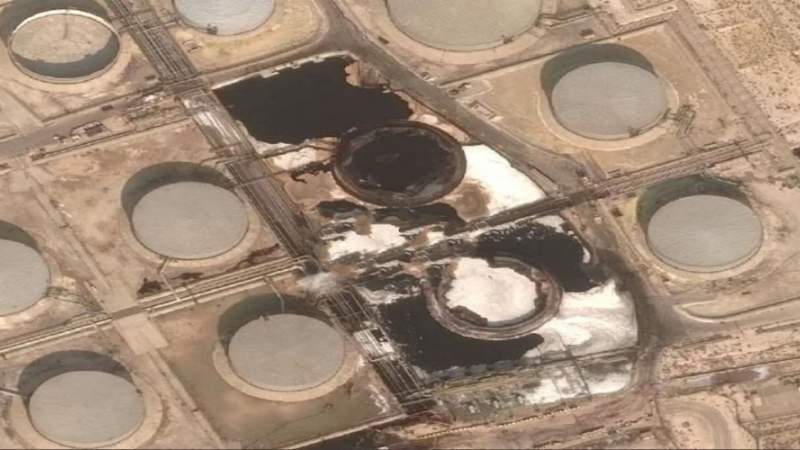
Satellite data show the impact of the operation exceeded the limited scope Saudi official narratives try to confine it to: NASA data via the Terra satellite detected a black cloud extending over about 600 square kilometers — larger than the area of Bahrain — while the Sentinel-2 satellite documented the density of the smoke plume over the largest Saudi refinery and in West Asia.
This documented visual area reflects the scale of actual combustion at a site with a refining capacity exceeding 550,000 barrels per day, supplying about 40% of Saudi domestic fuel demand within a huge oil complex on the Gulf coast.
International agencies covering the event noted that the scale of the fire and satellite monitoring directly contradict the Saudi official announcement, which spoke of intercepting four drones then two in the Eastern Region for a total of five drones without providing any visual or photographic evidence of the interceptions.
Observers affirm that the extent of the fire and smoke indicates the number of attacking Yemeni drones exceeded 10, carried out despite dense air cover involving British aircraft and Rafale, F-15 and Typhoon fighter jets.
More importantly, the Yemeni operational shift from the western coast to the eastern coast and Gulf waters reflects a capability exceeding 1,200 kilometers with pinpoint accuracy after the radar arc was displaced in al-Qahmah and the western coast opened up, according to experts.
The operation, alongside the broader war’s repercussions, translates into figures directly pressuring the economy and transport: oil production fell from an average of about 6.5 million barrels per day to about 4.5 million, a decline exceeding 30%, and crude exports dropped to less than 5 million barrels while Yanbu port alone exports 4 million barrels.
Despite Brent crude rising from the $65-70 range before the war to about $92, the daily loss from the production gap is estimated at about $112 million per day. In aviation, about 8,000 flights were canceled or delayed in one month according to Cirium data, with 86% of scheduled flights canceled at King Khalid Airport compared to 46.4% across Saudi airports excluding Mecca and Medina, alongside international companies suspending flights or changing routes to avoid Saudi airspace.
On the ground, image analysis conducted by the Masbar al-Arabiya fact-checking platform between November 14 and 20 shows leveling and dirt road-cutting work in the Khawr Umairah area extending about 22 kilometers, aimed at creating a watercourse linking the sea to the mountain along natural flood channels to serve as a barrier against Saudi-backed armored vehicles, carried out by the armed forces’ engineering unit.
Observers see this move as defensive in nature, preventing any counterattack, especially after Saudi mobilizations withdrew from Bab al-Mandab and Dhubab eastward toward Aden and Sanaa’s forces secured the coastal road in Lahj. This prompted Israeli assessments to conclude that the so-called “Dawn of Yemen” operation has effectively ended and a counterattack is impossible with the encirclement of Aden exposed.
Observers note that while the narrative of using Russian satellite images is employed to politicize the file and link it to other issues such as Libya, the Americans have redirected part of the file since November 17 toward Ukrainian intelligence and naval forces, while Riyadh has raised the pace of bombardment on Sanaa to 105 sorties and missile strikes.
In sum, the figure of $112 million per day captures the essence of the new equation: decisiveness is no longer contingent on the number of drones announced as downed or kept silent about, but on the scale of accumulating daily attrition that makes prolonging the war a mounting burden multiplying the cost of continuation for the Saudi aggressor. Whoever loses this amount daily does not need to be defeated in the field — the war only needs to drag on.