
Yemen’s Naval Blockade Forces Saudi Oil Tankers to Reroute, Driving Up Costs
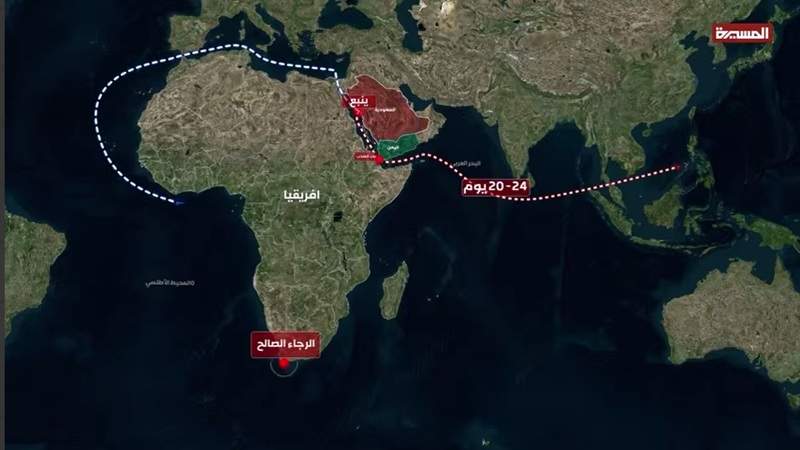
Yemen’s naval blockade on Saudi-linked shipping continues to tighten, forcing oil tankers to abandon the Red Sea and Bab al-Mandab route and seek longer, more expensive alternatives — imposing mounting logistical and commercial pressures on Saudi Arabia’s oil export system, according to shipping data and industry reports.
Data cited by Bloomberg indicates that tankers loaded with Saudi crude from the Yanbu terminal on the Red Sea have begun avoiding Bab al-Mandab entirely, instead sailing north toward Egyptian ports such as Ain Sukhna and Sidi Kerir. From there, shipments are redirected to their final destinations.
For cargoes bound for Asian markets, some very large crude carriers (VLCCs) have been forced to sail around the African continent — adding thousands of miles and up to 17,000 nautical miles to each journey — more than double the usual distance via the Red Sea. This has significantly raised fuel, insurance, and operational costs.
Four VLCCs Carry 8 Million Barrels via Gulf of Oman
Since August 11, at least four VLCCs have transported approximately 8 million barrels from Saudi ports on the Gulf, indicating a shift toward the kingdom’s eastern terminals in an effort to bypass the Red Sea chokepoint. However, these eastern routes still pass near the Strait of Hormuz, which remains a separate but ongoing risk.
The disruption extends beyond rerouting. Insurance premiums, charter rates, and port waiting times have all been affected. Analysts note that longer voyages reduce fleet availability and push up charter costs, while delays in delivery schedules create uncertainty for both producers and buyers.
The impact is already being felt in Asian markets, where some refiners are reportedly considering canceling scheduled September cargoes due to rising transport costs. If the disruption persists, buyers may increasingly turn to alternative crude sources with more stable and affordable delivery routes — potentially eroding Saudi market share in its most important export region.
Yemen’s Strategic Targeting
The blockade targets not only individual shipments but one of the world’s most critical maritime chokepoints: Bab al-Mandab. The strait connects the Red Sea to the Gulf of Aden and the Indian Ocean. Prolonged disruption forces shipping companies to adopt costly alternatives, and as these costs accumulate, they cascade through the entire supply chain — from tanker operators and insurers to refiners and consumers.
The longer the blockade continues, the more Saudi Arabia faces a structural challenge: maintaining export volumes at competitive costs. The rerouting has revealed a fundamental vulnerability — that geography can become an economic constraint when strategic waterways are contested.
The naval blockade was announced on July 20 as part of Yemen’s siege for siege campaign, targeting Saudi shipping in response to the kingdom’s 12‑year military aggression and blockade of Yemen. The Red Sea is a vital artery for Saudi oil exports, particularly from the Yanbu terminal, which handles a significant portion of the kingdom’s crude destined for Europe and Asia.
Yemeni forces have demonstrated the ability to enforce the blockade through drone and missile attacks on Saudi-linked vessels. The campaign has already led to a sharp decline in Saudi oil exports through the Red Sea and forced international buyers to seek alternative suppliers. The rerouting of tankers via the Cape of Good Hope adds approximately 10‑15 days to transit times, significantly increasing costs and reducing the competitiveness of Saudi crude in Asian markets.
The blockade is part of a broader campaign to pressure Saudi Arabia to lift its siege on Yemen and accept a political settlement. Yemeni officials have stated that the blockade will remain in place until their demands are met, suggesting that the economic pressure on Saudi Arabia is likely to continue.