
1,000 Days of Israel’s War of Extermination in Gaza Strip: Figures document tragedy, positions supporting “Al-Aqsa Flood”
This will allow us to understand the magnitude of the resulting tragedy—the tragedy endured by Palestinians in the besieged Strip.
Furthermore, it is crucial to highlight the positions that continue to support “Al-Aqsa Flood” battle, emphasizing the immense sacrifices Palestinians there continue to make. They reaffirm the strength of the resistance as the only weapon capable of achieving victory and liberation, ultimately leading to the establishment of a Palestinian state on all of its national territory, with al-Quds as its capital.
As Basem Naim, a member of the political bureau of the Islamic Resistance Movement (Hamas), stated, the Palestinian people “have paid a heavy price, but they have passed the test of freedom and dignity,” while “humanity, especially the West, has failed to defend its humanity and values.”
He also said, pausing at this pivotal moment: “For 1,000 days, our people in Gaza have been subjected to genocide live on air. We will inevitably achieve our goal, but history will record the lists of honor for those who stood up for their humanity, and the lists of shame for those who remained silent or supported the genocide.”
To return to the beginning… a thousand days have passed, and Gaza continues to burn under the fire of the Israeli enemy. These numbers are not mere statistics; they are human stories: a child who lost his family, a mother who lost her infant, a young man who lost his legs, a family who lost their home. And the world watches and observes this epic struggle of a people who have not lost hope in resistance.
“Al-Aqsa Flood” was a cry for help from a people who have been slowly being killed for decades, denied their right to life and dignity. Today, after a thousand days of genocide, the crucial question remains: Will the world continue to remain silent, or will it stand up for the oppressed people who will not die?
Here is Palestine speaking in all languages: “We are an unconquerable nation, Gaza will not die, al-Quds is ours, and Al-Aqsa will remain standing tall as long as a single heart beats within us.”
Figures Documenting the Tragedy
In this context, the Government Media Office in the Gaza Strip published an update on the most important statistics of the Israeli genocide, marking 1,000 days since this unprecedented crime in modern history.
The office indicated that over 2.4 million people in the Gaza Strip are being subjected to genocide, starvation, and ethnic cleansing, and that the enemy has inflicted over 90% of the destruction in the Gaza Strip.
It confirmed that the enemy has seized over 80% of the Gaza Strip’s area through invasion, bombardment, and forced displacement, while the enemy has bombed the Al-Mawasi area, which it claims is a “safe humanitarian zone,” 241 times and dropped over 223,000 tons of explosives on the Gaza Strip.
Regarding the martyrs, the missing, and the massacres, the statement reported the following as of yesterday, Thursday:
(73,066) Total number of martyrs who arrived at hospitals since the start of the war of extermination.
(9,500) Missing, including martyrs still under the rubble, or whose fate remains unknown.
(+21,500) Number of martyred children.
(+12,500) Number of martyred women.
(+9,000) Number of martyred mothers.
(22,500) Number of martyred fathers.
(+1,022) Children under the age of one year who were martyred.
(+520) Infants born and martyred during the war of extermination.
(1,700) Medical personnel martyred by the Israeli occupation.
(145) Civil Defense personnel martyred by the Israeli occupation.
(262) Journalists killed by the Israeli occupation.
(+194) Municipal employees killed in the Gaza Strip, including (4) mayors.
(+2,800) Martyrs from the police and aid security personnel killed by the Israeli occupation.
(+928) Martyrs from the sports movement across all sports.
(+39,022) Families subjected to massacres by the Israeli occupation.
(+2,700) Families wiped out and erased from the civil registry (8,574 martyrs).
(+6,020) Families wiped out, leaving only one survivor (12,917 martyrs).
(+55%) of the martyrs were children, women, and the elderly.
(460) Martyrs due to starvation and malnutrition, including (164) children.
(23) Martyrs due to erroneous airdrops of aid.
(43%) of kidney patients lost their lives due to lack of food and healthcare.
(+12,000) miscarriages among pregnant women due to lack of food and care. Health.
(28) Martyrs due to the cold in camps for internally displaced persons (including 25 children).
– Injuries, arrests, and humanitarian cases:
(173,514) Total number of wounded and injured who arrived at hospitals.
(+19,000) Total number of wounded requiring long-term rehabilitation.
(+5,400) Total number of amputations, including (18%) children.
(1,500) Total number of paralysis cases.
(1,200) Total number of cases of vision loss.
(433) Total number of injured journalists.
(362) Number of medical personnel arrested, 83 of whom remain detained.
(26,370) Total number of widows due to the war of extermination (whose husbands were killed).
(58,800) Total number of orphaned children (children without one or both parents), including (2,700 who lost both parents). (6,100) lost their mothers and (50,000) lost their fathers.
(+2.142) million people contracted various infectious diseases as a result of forced displacement.
(+71,338) people contracted hepatitis.
The Government Media Office revealed that the ongoing 1,000-day war on the Gaza Strip has caused initial direct losses estimated at approximately $80 billion, according to a comprehensive statistical report that documented the extent of the destruction and the human, material, and economic losses inflicted on various vital sectors in the Strip.
It stated that the initial direct losses in 15 vital sectors are estimated at approximately $80 billion.
The losses included approximately $34 billion in the housing sector, $6 billion in the health sector, and $6 billion in the services and municipalities sector.
The report documented losses of $5 billion in the commercial sector and the same amount in the residential sector, while losses in the education, industry and agriculture sectors were estimated at about $4 billion each.
It explained that the telecommunications and transportation sectors each incurred $3 billion in losses, while the electricity, entertainment, and hospitality sectors each suffered $2 billion in losses. The religious and media sectors each suffered an estimated $1 billion in losses.
The media office indicated that the occupation forces killed more than 830 teachers and educational staff, and 194 scientists, academics, and researchers.
It confirmed that the occupation forces killed 312 imams, preachers, Quran memorizers, and religious scholars, while 37 imams, preachers, and Quran memorizers remain among the prisoners and missing. Additionally, 20 members of the Christian community were killed.
The Office explained that the occupation forces completely destroyed 1,047 mosques out of 1,275, and partially destroyed 210 others. They also targeted three churches more than once and destroyed 40 out of 60 cemeteries.
The occupation forces stole more than 2,450 bodies from cemeteries and established seven mass graves inside hospitals, from which 529 martyrs were exhumed.
The report indicated that the total number of damaged buildings reached 227,703, while 510,000 housing units were damaged. 335,000 buildings and housing units were completely destroyed, and 75,000 were partially destroyed and rendered uninhabitable.
The total number of buildings and units completely destroyed or rendered uninhabitable reached 410,000, in addition to the partial destruction of more than 100,000 housing units that were still habitable.
The office indicated that more than 350,000 families are in need of shelter, with over 132,000 tents out of 135,000 worn out, more than two million Palestinians displaced, and 346 shelters targeted.
It stated that the occupation continues its policy of starvation and closure of crossings for more than 650 days, preventing the entry of more than 390,000 trucks carrying humanitarian aid and fuel.
The occupation targeted 48 soup kitchens and 64 aid distribution centers, killing 556 aid workers and carrying out 128 attacks on aid convoys, according to the report.
The death toll from what are known as “death traps” at US-Israeli aid centers has reached 2,605, with 19,124 injuries and more than 200 missing.
The office added that approximately 650,000 children are at risk of death due to malnutrition and hunger, including 40,000 infants under one year old who are threatened with death due to a shortage of baby formula.
It noted that more than 22,000 patients need treatment abroad but are prevented from traveling, and more than 5,200 children require urgent medical evacuation, along with 12,500 cancer patients.
The report indicated that 350,000 patients with chronic illnesses and 3,000 patients with various other diseases need treatment outside the Gaza Strip. Additionally, approximately 107,000 pregnant and lactating women are at risk due to the collapse of the healthcare system.
It further noted that the war destroyed 725 central water wells, 134 freshwater projects, 5,080 kilometers of electricity networks, 2,285 electricity distribution transformers, and 235,000 electricity meters.
The war deprived the Gaza Strip of more than 2.123 billion kilowatt-hours of electricity, in addition to destroying more than 700,000 linear meters of water and sanitation networks.
According to the report, the war destroyed more than three million linear meters of roads, 253 government buildings, 292 sports facilities, stadiums, and gyms, and 208 archaeological and heritage sites.
The report also indicated that more than 87% of the agricultural land in the Gaza Strip was destroyed, in addition to the destruction of 8,700 agricultural wells and 7,748 cattle, sheep, and poultry farms.
The war destroyed more than 87% of greenhouses, and the annual production of fruits and vegetables plummeted from 524,000 tons to only 20,000 tons. More than 69,000 head of livestock were killed, while 99% of the fish stocks were damaged.
Press and Media… Targeting Witnesses of Truth
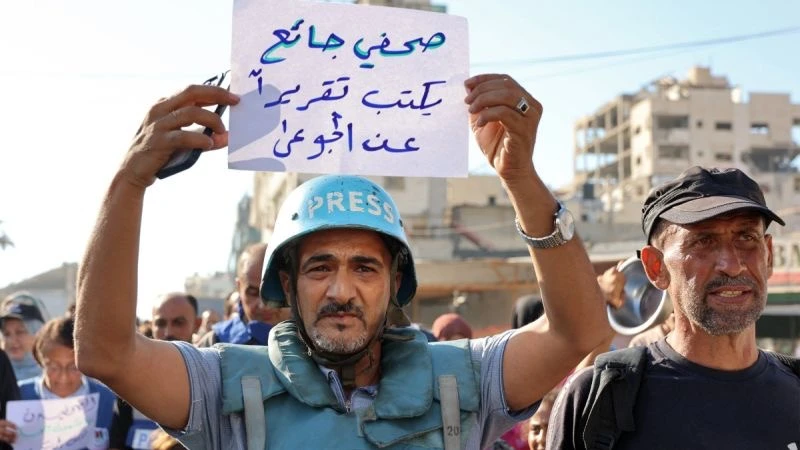
Regarding the press and media, the Palestinian Journalists Forum issued a report on Thursday documenting what it described as “grave and systematic violations” against journalists and media outlets, asserting that these violations constitute war crimes and crimes against humanity under international humanitarian law.
The report, published on the forum’s Facebook page and monitored by the Yemeni News Agency (SABA), and covering the period from October 7, 2023, to July 2, 2026, explained that the widespread and repeated targeting of journalists constitutes a flagrant violation of the principles of distinction and proportionality stipulated in the Geneva Conventions and Additional Protocol I.
It indicated that the number of journalists killed during this period reached 263, considering this an indication of a systematic pattern targeting press freedom. In addition, more than 400 journalists were injured, including serious cases resulting in permanent disabilities and amputations.
The report also documented the arrest of 47 journalists, along with cases of threats, intimidation, and enforced disappearances affecting three photojournalists, as well as the release of others who had been detained during the period of aggression.
The report accused the enemy forces of targeting media infrastructure, including the offices of television channels, news agencies, and broadcasting facilities, in what it considered a violation of Article 52 of Additional Protocol I and the conventions for the protection of civilian objects.
It pointed to the imposition of severe restrictions on the entry of international journalists into the Gaza Strip and the prevention of independent coverage, which led to a “forced media blackout” and deprived the public of its right to access information.
In conclusion, the report stressed that these violations necessitate an independent international investigation, the activation of universal jurisdiction, and the provision of urgent international protection for journalists. It emphasized that the passing of 1,000 days of aggression represents a “legal and moral turning point” to end impunity and hold those responsible for crimes committed against Palestinian journalists accountable.
The Economy: Seven Decades Backward
In this sector, Hossam Al-Huwaiti, Acting Head of the Chamber of Commerce in the Gaza Strip, stated that 1,000 days of the Israeli war of extermination led to the near-total collapse of the economy in the Strip, setting development back more than seven decades and transforming Gaza’s economy.
In this sector, the acting head of the Gaza Strip Chamber of Commerce, Hossam al-Huwaiti, stated that a thousand days of Israeli aggression have led to the near-total collapse of the Strip’s economy, setting back development to levels not seen in over seven decades and transforming Gaza’s economy from a productive one to one entirely dependent on humanitarian aid.
Al-Huwaiti explained to Sanad News Agency that the GDP has shrunk by between 85 and 88 percent, with economic and productive activities almost completely halted. He added that direct and indirect losses have exceeded $71 billion, emphasizing that recovery will take many years, even decades, under normal circumstances.
He noted that the average annual per capita income has fallen to less than $200, placing it among the lowest rates globally, due to the widespread collapse affecting various economic sectors.
He explained that the agricultural sector suffered destruction exceeding 94 percent of agricultural land, wells, and production facilities, leading to a collapse in food self-sufficiency. Between 90 and 95 percent of factories, workshops, and warehouses were also destroyed, coinciding with inflation rates soaring to over 230 percent and a severe shortage of basic commodities.
Regarding the construction sector, Al-Huwaiti explained that it was almost completely paralyzed, at 98 percent, due to the widespread destruction of infrastructure, water and electricity networks, and roads, in addition to the destruction of more than 80 percent of residential units.
He pointed out that the fishing sector came to a standstill by 96 percent due to the Israeli entity targeting ports and fishing boats and preventing safe access to fishing areas.
He confirmed that unemployment rates have risen to between 85 and 90 percent, while the percentage of the population living below the poverty line has exceeded 98 percent, with famine becoming a reality threatening all residents of the Gaza Strip.
The acting head of the Chamber of Commerce in the Gaza Strip governorates pointed out that the banking and financial sector has completely collapsed as a result of the loss of liquidity, the cessation of investments, and the disruption of regular salary payments.
He stressed that the economy in the Gaza Strip no longer possesses any capacity for resilience or self-recovery, emphasizing that any path to recovery requires an immediate cessation of the Israeli aggression, a complete lifting of the siege, and the urgent commencement of reconstruction and the resumption of economic activity.
He also affirmed that what the Gaza Strip has endured constitutes “systematic economic annihilation” targeting all aspects of life, production, and stability, and leading to the destruction of the foundations upon which the Palestinian economy in the Strip is built.
Health… Silent Killing!
In this sector, the Director General of the Ministry of Health in the Gaza Strip, Dr. Munir al-Barsh, stated that the passing of a thousand days since the war was not merely a number on a calendar, but rather “a thousand days of suffering, pages of pain, and stories that have not been written.”
In a post on the X platform, monitored by the Yemeni News Agency (Saba), Al-Barsh explained that this period witnessed “a thousand days of loss and betrayal, the most painful of which was the betrayal by relatives,” noting that humanity “has been stripped of its humanity” during this war.
He added that the killing of children has become “a fleeting breaking news item,” and the bombing of hospitals “a recurring scene,” while starving civilians and preventing access to medicine, water, and food has become “a tool of war,” alongside the continued denial of basic necessities without shame or accountability.
Al-Barsh pointed out that the agreements were not implemented and remained “ink on paper,” emphasizing that since then, more than 1,000 martyrs have been killed, the majority of them children and women, amidst a suffocating medicine crisis.
He explained that more than 52% of medicines are unavailable, along with a shortage exceeding 59% in medical supplies, exacerbating the drinking water crisis. He stressed that citizens “can no longer find clean drinking water,” and that what is happening constitutes “silent killing” in addition to the ongoing bombardment.
Civil Defense…Lack of the Most Basic Resources
The Civil Defense in the Gaza Strip stated in a statement seen by the Yemeni News Agency (Saba): “For a thousand days of the ongoing war of extermination on the Gaza Strip, the Israeli occupation’s policy has not been limited to targeting civilians and destroying homes and vital facilities, but has extended to targeting the foundations of civil protection in existing industrial and commercial establishments. This has been achieved by preventing the entry of safety and prevention equipment and firefighting supplies, a step that has paralyzed the fire prevention system, thus perpetuating the causes of disasters and exacerbating risks.”
The statement quoted Mohammed Shreir, Director of the Safety and Prevention Department at the Civil Defense, as saying that since the beginning of the war, the Zionist enemy has imposed severe restrictions on the entry of essential safety equipment, despite the urgent need for it given the overcrowding in displacement centers and camps, the increased risk of fires, and the reliance of displaced persons and remaining craftsmen on rudimentary methods of fire prevention after the enemy destroyed infrastructure and energy sources.
Shreir emphasized that the restrictions prohibit all types of safety equipment and devices, most notably fire extinguishers of all kinds: dry powder extinguishers used for extinguishing fires involving flammable solids and liquids, carbon dioxide (CO2) extinguishers for fires involving electrical appliances and equipment, and foam extinguishers for fires involving liquids and gases. This equipment constitutes the first line of defense in limiting the spread of fires and reducing losses.
He added that the enemy also prevents the entry of smoke detectors, which contribute to early warning of fires, and gas leak detectors, which help prevent explosions and domestic and industrial accidents. This increases the likelihood of disasters that could have been prevented or their effects mitigated.
According to Sharir, the ban extended to building and facility safety systems, including automatic water sprinkler systems, fire hose reels connected to water networks, fire-resistant doors, and iron water pipes used in equipping civil defense stations, centers, and various facilities. This has disrupted fire prevention equipment in many public and private facilities. The ban also prohibits the import of foam, which is used to extinguish fires involving liquid materials.
The Director of Safety and Prevention at the Civil Defense in the Gaza Strip warned that the continuation of this ban, coupled with the widespread destruction of infrastructure and the shortage of equipment and vehicles, increases the likelihood of large-scale fires that are difficult to control and multiplies the human and material losses. This comes at a time when civil defense personnel are working with limited resources and in extremely dangerous field conditions.
Why the Battle of Al-Aqsa?
The battle did not arise in a vacuum. Rather, it is a response to 16 years of continuous siege on the Gaza Strip (since 2007), which has transformed the Strip into an “open-air prison.” Against the continued settlement activity in the West Bank and al-Quds, and the Judaization of the city. Against the repeated incursions into Al-Aqsa Mosque by extremist settlers and occupation forces. Against the detention of thousands of Palestinians in occupation prisons, including women and children. Against the policy of “medical siege” and the prevention of travel for treatment. Against the ongoing daily war waged against the Palestinian people.
“Al-Aqsa Flood” succeeded in bringing the Palestinian cause back to the forefront of global attention, and a global awakening of conscience emerged, further isolating the Israeli enemy.
In this context, the Palestinian resistance factions affirmed that the Al-Aqsa Flood battle and the glorious crossing were significant milestones in the Palestinian people’s struggle and resistance, which has continued since the usurpation of Palestine in 1948. It was a natural response to the ongoing crimes of the Zionist entity in Gaza, the West Bank, and al-Quds, and against the siege, settlement activity, and Judaization.
This came in a press statement issued on the 1,000th day of the genocidal war and ethnic cleansing waged by the Zionist enemy against the Gaza Strip, which was received by the Yemeni News Agency (Saba).
The statement added, “Those who try to portray this operation as the beginning of the conflict or the cause of the problem and suffering endured by our people should remember that the crimes of the Zionist enemy have not ceased since the occupation of Palestine until today, while the resistance has always been active, continuous, and ablaze in all arenas of jihad, resistance, and struggle, affirming our people’s steadfastness and will in the face of Zionist aggression.”
The statement asserted that 1,000 days of Zionist genocide, directly supported by the American administration and Western lobbies, were a blatant embodiment of organized state terrorism, the true face of Zionist and Western colonialism. It noted that the world witnessed a systematic genocide in all its forms, through which the Zionist enemy failed to achieve its declared war aims, particularly those related to displacement and uprooting, despite the scale of the destruction and the vastness of the tragedy and humanitarian catastrophe.
The factions stated, “One thousand days of war and confrontation between the Zionist-American and Western colonial system, armed with all kinds of American and Western-made weapons, against our defenseless people—armed only with their will—have not resulted in the defeat of our proud people. The spirit of resistance ignited by Gaza and its overwhelming force can no longer be extinguished, and every attempt to impose surrender only sows the seeds of a deeper and broader resistance.”
The resistance factions affirmed “the Palestinian people’s right to resist in all its forms and the necessity of escalating resistance in the West Bank, al-Quds, and our occupied territories of 1948 to confront annexation plans, settlement policies, Judaization, and the enemy’s attempts to resolve the conflict.”
They declared their rejection of “any foreign guardianship over the Palestinian people,” emphasizing that “the administration of the Gaza Strip is an internal matter, and we call upon the Administrative Committee (the technocratic committee) to quickly enter the Gaza Strip and begin its duties.”
The statement also called for “the urgent need to launch a comprehensive national dialogue that establishes a genuine political partnership, develops a unified national strategy, addresses major national issues, reorganizes the Palestinian political landscape, and rebuilds national institutions, including the Palestine Liberation Organization, to be inclusive of all Palestinians, in order to confront the enormous challenges facing the Palestinian cause.”
The factions called for “a strong and unified Arab and Islamic stance to ensure a comprehensive and complete ceasefire, to utilize all available Arab and Islamic leverage, to activate the role of the masses and freedom fighters, and to confront all forms of normalization with the Zionist enemy.”
In closing, the statement said, “We salute with pride and honor the heroic martyrs of our people, especially the leaders and fighters in Gaza, the West Bank, the occupied territories, and on all fronts of confrontation, whose blood mingled with the blood of our people. Their sacrifices will remain immortal and a source of pride and inspiration for all generations and all freedom fighters in the nation and the world.”
The ceasefire agreement in the Gaza Strip came into effect on October 10th, following a Zionist war of genocide that lasted for more than two consecutive years. However, the Israeli enemy army continues to violate the agreement daily and still prevents the entry of most humanitarian aid into the Strip.
Violations… A Continuing War
In this context, Bassem Naim, a member of the political bureau of the Islamic Resistance Movement (Hamas), documented on Thursday 3,503 Israeli violations of the ceasefire agreement in the Gaza Strip since it came into effect. These violations have resulted in the martyrdom of 1,059 Palestinians and the injury of 3,429 others, in addition to the continued restrictions on the entry of humanitarian aid and the movement of travelers through the Rafah crossing.
According to the Palestine Online website, Naeem explained, in a post on the “X” platform that he published in conjunction with the passing of a thousand days since the Israeli enemy’s war on the Gaza Strip, that the violations included 1359 shooting operations, 1546 bombing operations, 145 ground incursions, 387 air raids, 66 arrests, and 387 house demolitions, with an average of 13.3 violations per day.