Leader of Revolution advises Turkey, Pakistan against getting embroiled with Saudis in aggression against Yemen
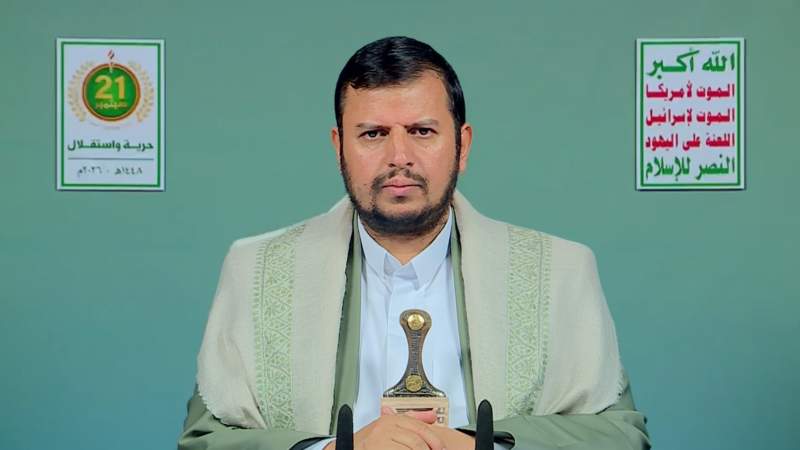
The Leader of the Revolution, Sayyed Abdulmalik Badr al-Din al-Houthi, denounced the positions of certain countries and entities expressing sympathy for the Saudi regime, which continues its aggression and blockade against the Yemeni people.
In his speech on Monday marking the 12th anniversary of the glorious September 21 Revolution, the Leader emphasized that the Saudi side seeks to embroil regional powers and even nations across the Islamic world in its aggression against Yemen, extending beyond the Arab arena. He noted that the Saudis sought to drag Turkey and Pakistan into the conflict, continually pleading for their assistance night and day, asking them to come to their aid, fight alongside them, and join in sin and aggression against the Yemeni people.
He said: “What the Saudis are attempting these days is to embroil others with them in the aggression against Yemen, specifically the Turks and Pakistanis. In the case of Turkey, they seek to involve takfiri groups in Syria who stand by watching the Israeli enemy as it violates Syria in every way—occupying land, violating honor, kidnapping Syrians, destroying, and killing.”
The Leader offered advice to the Turks and Pakistanis not to get embroiled out of greed for political or material gains from the Saudi enemy, who relies on the Americans as partners in their crimes.
He revealed the American role in conducting interception operations in Saudi airspace and studying further options for escalation alongside the Saudi enemy, adding: “Whoever sympathizes with the oppressor and bases their stance away from Islamic teachings is a loser and bears all consequences morally, legally, and humanely.”
He emphasized that it is fitting for those regimes to take an honorable stance with the oppressed Palestinian people, who hold an Islamic cause, rather than standing with the Saudis—partners with the Americans, the British, and the Israelis conspiring against the people of the nation—or at least taking a positive stance to end the war and conflict through fair solutions.
He said: “We are people of fairness and do not present impossible conditions. We say: stop the aggression, end the unjust blockade and the occupation of our country. Our demands are fair, legitimate rights for our people, and any party wishing to intervene is expected to play a positive role.”
The Leader questioned whether those countries and entities currently showing sympathy for the Saudi regime and willingness to cooperate with it would accept having their own airports closed to their citizens and flight movements completely halted—including for travelers, the wounded, patients, and commercial trade—or accept being deprived of civil aviation services and citizens’ travel for medical or commercial purposes.
He explained that this represents just one aspect of the direct blockade imposed by the Saudi regime on the Yemeni people through its attempts to block flights to and from the country. He asked whether the entities sympathizing with the Saudi regime and weeping over its oil facilities and the responses carried out by Yemeni armed forces against Saudi aggression and airstrikes would accept such measures if imposed upon themselves.
He noted that the grounds and background of the Yemeni people’s stance have been explained repeatedly, confirming that the Yemeni people possess a genuine cause and endure immense suffering unmatched by any other nation.
Sayyed Abdul-Malik Badr al-Din al-Houthi questioned the reason behind others’ condemnation and outrage over the Yemeni people’s movement against aggression, blockade, and injustice. He noted that if those complaining were asked to accept the conditions forced upon Yemen by the Saudi regime under American and Zionist supervision, they would never accept it, nor would any free nation in the world.
He further asked whether those entities would accept restrictions imposed on commercial imports, holding goods for long months in another country for inspection and arbitrary procedures—despite originating from Asian, Gulf, or even sympathizing countries—arriving at markets only at exorbitant prices.
He added: “Would they accept measures targeting the Yemeni currency, banking sector, and commercial movement—taking various forms to restrict and obstruct trade—or accept being completely deprived of their oil, gas, and public wealth?”
The Leader continued by asking which nation could accept such a situation, questioning whether it would be normal for officials and employees in Turkey or Pakistan to go without salaries for long years—ten, eleven, or twelve years—because their oil and sovereign wealth were blocked and diverted for the benefit of another country.
He affirmed that these are real, non-fictional issues, asking whether they do not justify a firm stance from the people, or whether Turks, Pakistanis, Gulf states, and other Islamic nations would accept detailed Saudi political interference in their internal affairs, allowing the Saudis to appoint their president, ministers, and public officials.
He explained that this is precisely what the Saudi regime does in Yemen, seeking exclusive authority under US supervision to appoint officials, claiming that anyone not appointed by Saudi Arabia lacks legitimacy, while restricting legitimacy to itself, the Americans, the Israelis, and the British.
The Leader noted that the will of the people, arising from their faith identity, holds no value to these forces, alongside their seizure of oil and public wealth, total violation of national sovereignty, and interference across all levels and domains.
He categorized this as a complete confiscation of freedom, independence, dignity, and honor, constituting outright enslavement. He explained that the Saudi regime, under American, Zionist, and British supervision, seeks absolute command and authority over all details inside Yemen.
He stated that this is the core issue with the Saudi side, noting that if Saudi Arabia understood the importance of establishing relations based on good neighborliness, commonalities, mutual interests, respect, and legitimate rights, no problem would exist in the first place.
He explained that the Saudi side instead pursues an aggressive, unjust, and arrogant path that cannot be accepted, persisting in its aggression and blockade to drive the Yemeni people toward total collapse and force surrender.
Sayyid Abdul-Malik Badr al-Din al-Houthi pointed out that the Saudi actions under US supervision represent a state of occupation, having occupied extensive territory and controlled it through recruited proxies operating under Saudi command.
He stated that these proxies possess no independent decision-making capability, acting merely as subordinates bought with money to act against their own people, with their agenda directed entirely at targeting Yemen across all sectors, primary among them the economy, acting as mere tools for Saudi, American, British, and Zionist interests.
He noted that at the beginning of the Hijri year, when the Yemeni people demanded and attempted to break the blockade, the Saudi enemy escalated by bombing Sana’a airport and mobilizing massive ground forces to eradicate the Yemeni people.
He said: “The renewal of Saudi escalation through airstrikes and ground mobilization was confronted by our people, who moved to face blockade with blockade and escalation with escalation.” He noted that the Saudi enemy mobilized tens of thousands to the deserts of Al-Jawf, Al-Mocha, the West Coast, and Al-Bayda, with its proxies boasting that they were heading to sweep through what remained of the country.
The Leader indicated that the Saudi enemy supervised mobilizations across all fronts, accompanied by media campaigns and ISIS-Zionist terror tactics. He affirmed that Yemen moved with its armed forces, relying on Allah, to confront the escalation initiated by Saudi airstrikes and ground mobilization.
He added: “Saudi officers lead operations from Yemeni governorates to invade what remains of the nation, and our people moved to respond in kind by striking deep inside Saudi territory. Our position was effective in countering the brutal aggression, while the Saudis cry out and scream for external help.” He noted that the US continues to support the Saudis because they act as proxies serving Israeli interests, with American and Zionist experts working alongside the Saudi enemy.
The Leader affirmed that due to the effectiveness of the Yemeni position, the Saudi enemy sought to bring America and Israel into a comprehensive aggression rather than limited participation.
He said: “Regional circumstances have kept the Americans and Israelis somewhat preoccupied, creating a problem for the Saudis, who want them to join in their aggression and blockade against the Yemeni people.”
He added: “The Saudi enemy has launched numerous airstrikes and missile strikes across several governorates in our country, targeting civilian objects in its bombardments.” He pointed out that the Saudi enemy bombs bridges and public towers, and targeted the Central Correctional Facility in Al-Jawf, killing people including women and children visitors.
The Leader questioned: “Who can justify to the Saudi enemy its targeting of the correctional facility in Al-Jawf? Is it not an overt crime? Has anyone condemned it? We do not rely on regimes for their positions; the free stance remains with the Axis of Jihad and Resistance and free individuals worldwide.”
He revealed that Saudi airstrikes reached 760 raids by yesterday. “If Pakistan or Turkey were bombed with this number of raids, would it not create a major crisis? Yet many regimes remain mute, moving only in wrong directions, but when Yemen responds, they get distressed and cause an uproar.”
He stated: “The Saudi enemy resorted to slander against our people by alleging the targeting of Makkah Al-Mukarramah—may our souls be sacrificed for it. We do not consider Makkah Al-Mukarramah a Saudi emirate, nor are the Saudis a rightful authority to use it as a shield against any country; rather, it is an Islamic landmark, and we are responsible for its sanctity and defense.”
Sayyid Abdul-Malik Badr al-Din al-Houthi added: “As Yemeni people, we may be among the greatest nations, if not the greatest, in venerating Makkah Al-Mukarramah, Al-Madinah Al-Munawwarah, Al-Aqsa Mosque, and all Islamic holy sites. We hold a deeply rooted faith belonging in our principles and direction, and we are the most faithful to Makkah and most worthy of supporting it against the Saudi client enemy.”