
Revolution Leader: Yemen’s position on Al-Aqsa Flood was highest level Yemenis could take
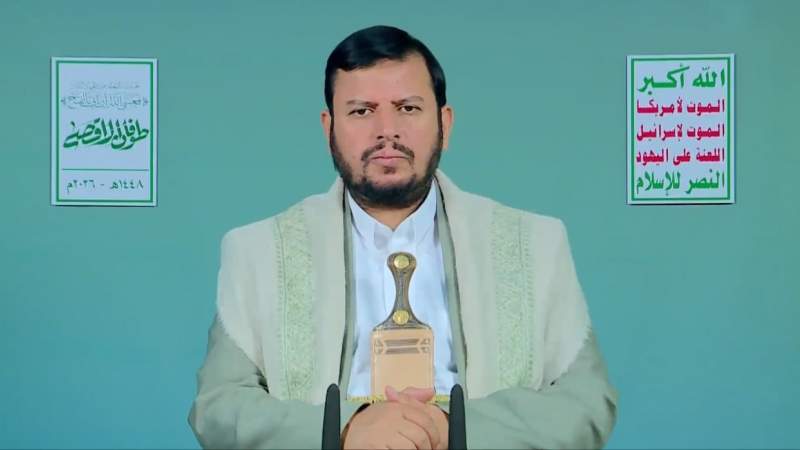
The Revolution Leader Sayyed Abdulmalik Badr al-Din al-Houthi said the “Al-Aqsa Flood” operation was the greatest battle in the Palestinian people’s struggle since the occupation and an unprecedented blow to the Israeli entity.
In a speech marking the third anniversary of the operation, he described the anniversary as an opportunity to assess its outcomes and reaffirm the responsibility toward the Palestinian cause.
He said Yemen had fulfilled its Islamic duty toward Palestine “to the fullest extent possible,” with unprecedented weekly mass rallies over two years and extensive military operations in support of Gaza that continued until the announcement of the ceasefire.
Al-Houthi stressed that the Yemeni people’s humanitarian solidarity with the Palestinians remained strong, noting that the operation also demonstrated the Palestinian people’s ability to fulfill their Islamic and humanitarian role.
He said the United States, Britain and other Western countries intervened to rescue Israel after the operation, as its impact caused unprecedented turmoil within the Israeli entity.
He described Al-Aqsa Flood as an opportunity for the Arab and Muslim nation to support the Palestinian people as part of its humanitarian and moral duty and in consideration of its national security.
He said, “The nation should have taken the initiative to provide all forms of support to the Palestinian people. Instead, those who took the initiative to fully support the occupying aggressor were the West and Zionist allies,” stressing that the United States went as far as becoming a full partner in supporting Israel, providing extensive cover, opening its regional stockpiles, and offering full support to the enemy.
He noted that the United States and the West went on full alert and immediately provided Israel with all forms of support, while working to address the internal turmoil within Israel.
He added, “The only ones who stood by the Palestinian people were the Islamic Resistance in Lebanon, the Islamic Republic of Iran, the Iraqi factions, and the Yemeni support front,” noting that the prevailing situation across the nation was one of abandonment, complicity by some, and limited support for the resistance and jihad axis.
The Revolution Leader expressed regret that Arabs and Muslims missed an opportunity to support the Palestinian people, saying, “It is regrettable that Muslims, particularly Arabs, missed a genuine opportunity to support the Palestinian people, because the Al-Aqsa Flood operation represented a turning point for the entire nation in its struggle against the enemy.”
He said the Palestinian side and its factions, which maintained a united position, demonstrated remarkable resilience and steadfastness. He noted that the Palestinian people’s resistance to Israel astonished the world, particularly given Israel’s access to the deadliest weapons and every form of support.
He continued, “The enemy confronted the Palestinian people with genocide using the deadliest weapons, dropping them on residential areas in the Gaza Strip.” He stressed that Israel targeted all aspects of life in Gaza, went as far as depriving Palestinians of water, destroyed entire neighborhoods with U.S.-made bombs, and killed large numbers of children and women, from sniper fire to airstrikes.
Sayyed Abdulmalik Badr al-Din al-Houthi stressed that Israel’s starvation campaign against Gaza’s residents was a disgraceful situation for the world, particularly Muslims. He noted that Israel even prevented milk from reaching infants in Gaza and, together with the United States, committed some of the most heinous crimes in the Strip.
He said, “Some crimes in Gaza were broadcast live, while Israel openly demonstrated its aggression and determination to carry out genocide and these horrific crimes,” stressing that Israel’s brutality shocked the world.
He added, “Some non-Muslim countries raised their voices against Zionist crimes amid the absence of Arab and Muslim voices.” He said Israel’s crimes exposed the collapse of Zionist claims about human rights and other such slogans.
He pointed out that the killing and targeting of children and the storming of hospitals in military operations exposed Israel even before the International Criminal Court. He also noted that the United States had recently criminalized activities supporting or expressing solidarity with the Palestinian people and opposing Israel.
He continued, “The extensive exposure of the Western system is very important for many intellectuals and young people, enabling them to view the West realistically,” noting that Western countries provided Israel with every means of support for the genocide in Gaza.
The Revolution Leader said the Palestinian cause and the holy sites in Palestine are part of the concerns of the Muslim nation and are tied to its responsibility toward them. He said that Operation Al-Aqsa Flood represented a major test that clearly distinguished positions across the Arab and Muslim world, according to divine laws, on an issue where the truth and right are clear.
He added that during Al-Aqsa Flood, some countries that claimed to represent the Muslim nation at the highest religious level—particularly the Saudi regime—revealed their true positions. He noted that the regime, established by Britain , assigned a specific and detrimental role in the Muslim world, has played a misleading role in serving the enemies of the nation.
He stressed that the nation must examine Saudi Arabia’s role toward the Palestinian cause, saying that such scrutiny would reveal a position that “stabs the nation in the back.”
He affirmed that the Saudi regime’s symbolic positions do not benefit the Palestinian people, adding that understanding its role is one of the key lessons that should be drawn from this period.
“When the Al-Aqsa Flood epic and the subsequent crimes against the Palestinian people took place, Saudi media presented events and developments in a way that served the Israeli enemy,” he said, citing its classification of Palestinian factions as terrorist groups as evidence of its position on the Palestinian cause.
He said Saudi Arabia’s response to the events in Gaza remained limited to statements and did not even reach the level of a boycott, unlike some non-Muslim countries that took more advanced measures. He added that there was evidence that the “Kingdom of the Devil’s Horn” and the Najdi regime helped facilitate aid reaching the Israeli enemy.
“Through its actions and positions, the Saudi regime and those following its example supported the Israeli enemy, while what was offered to the Palestinian people amounted to nothing more than statements on paper,” he said, noting that summit declarations and meetings had provided no practical measures capable of affecting Israel.
He also noted that Saudi Arabia continued to allow the Israeli enemy to use its airspace, unlike Arab countries such as Oman that banned it. He said Saudi media even sought to justify Israel’s crimes, at times adopting the same approach as some Israeli media outlets.
“It is important for our peoples to understand that events should serve as a major test and clarification, revealing people’s true positions so they are not deceived by certain descriptions,” he said.
Abdul-Malik Badr al-Din al-Houthi said some countries had clearly suppressed popular positions by banning demonstrations and pro-Palestinian media activity on social media. He praised the Axis of Jihad and Resistance, particularly Hezbollah, which opened a front and engaged in combat operations.
He praised Hezbollah for making great sacrifices and losing martyrs, foremost among them Hezbollah Secretary-General Sayyed Hassan Nasrallah, “martyr of Islam and humanity,” Sayyed Hashem Safieddine, and other Hezbollah leaders and fighters.
He noted that Hezbollah has been engaged in a major confrontation with the Israeli enemy since Operation Al-Aqsa Flood, while Israel has sought to end its role. He affirmed that Israel and the United States are working to dismantle Lebanon’s Islamic resistance front, with Saudi Arabia playing a key role in this effort.
He said the Saudi regime is pressuring Lebanon’s official circles to buy political positions and is mobilizing everyone against Hezbollah in a unified front with Israel and the United States. He stressed that Saudi hostility toward Hezbollah is not new and is not related to its position on Yemen, but dates back to the beginning, adding that Saudi Arabia has long conspired against Lebanon.
He affirmed that the Saudi regime contributed to the assassination of martyr Imad Mughniyeh and, from an early stage, to attempts to assassinate Hezbollah’s secretary-general. He said Saudi Arabia has carried out numerous hostile activities against Hezbollah, which are now at their peak, and is deploying all its weight in Lebanon in ways that serve Israel.
“The greatest service to Israel in Lebanon is to eliminate the Islamic resistance, which confronts the Zionist project targeting the entire region,” he said, explaining that the Saudi regime is openly and clearly serving Zionism, primarily benefiting Israel.
He added: “The Saudi regime does not need to classify the Palestinian resistance as terrorist, target its standing among the nation, or oppose Hezbollah. It stands behind strife and conspiracies in the Arab and Islamic world.”
He explained that the Zionist system was exposed as never before by Operation Al-Aqsa Flood, revealing practices and objectives that pose a danger to human societies.
“The exposure of the Zionist system has intensified through the crimes in Gaza and the scandals involving convicted sex offender Jeffrey Epstein, bringing the facts to light sufficiently,” he said.
The Revolution Leader affirmed that the Saudi regime had close ties with Jeffrey Epstein, saying photographs show an intimate relationship between Mohammed bin Salman and Epstein.
He also highlighted the significant outcomes of Operation Al-Aqsa Flood, including the rejection of Zionism, particularly the Israeli government and Prime Minister Benjamin Netanyahu. He said one manifestation of the global rejection of Zionism was the walkout of delegations at the United Nations during Netanyahu’s speech.
He went on to say, “It is shameful for the United Nations to give the Israeli enemy a seat in the General Assembly, as this undermines its principles.”
He noted that the Palestinian people continue to suffer immensely in the Gaza Strip, while the Israeli enemy has failed to honor the ceasefire agreements. Since the ceasefire, thousands have been killed or wounded in Gaza, amid killings, demolitions, ongoing aggression, and daily expansion of the occupation.
He pointed out that the Israeli enemy continues to prevent tents, mobile houses, and essential supplies from entering Gaza, leaving the Strip in severe hardship. He described Trump’s council as merely “a smokescreen.”
The Leader described the US position as shameful even to the American people and increasingly exposed before the world, stressing that Washington has sought to contain the situation to cover up Israeli crimes and achieve its objectives gradually.
He said, “People are ignoring the suffering in Gaza and want those brutal crimes to return before they pay attention to what is happening there. The nation bears a great responsibility to take a stand against Israeli crimes in Gaza.”
He said the steadfastness of the Palestinian people in the West Bank remains important amid forced displacement, the establishment of outposts, the fragmentation of Palestinian areas, and their separation from Al-Quds. He stressed that the nation remains largely unaware and negligent of what is happening in Palestine, except for the efforts of the axis of jihad and resistance.
He added, “The Zionist plan is fundamentally one of occupation, control, seizure, and domination of the region as a whole. It openly seeks to occupy large areas of the region, and criminal Netanyahu has spoken of ‘Greater Israel.’”
He continued, “Any country, people, or group that adopts a jihadist stance against the Israeli enemy faces the fiercest hostility from those aligned with the US and Israel.”
Sayyed Abdul-Malik Badr al-Din al-Houthi renewed his assertion that the Israeli enemy’s near-daily actions in the West Bank, including against people unaffiliated with the resistance, expose its ambitions to seize Palestinian land. He stressed that Israeli crimes target all segments of the Palestinian people.
He said, “All statistics on the Israeli enemy’s crimes show that everyone is targeted, not merely in response to the resistance. We must remain aware of the major campaigns targeting the jihadist stance against the Israeli enemy in Palestine, Lebanon, and the Islamic Republic of Iran.”
He noted that the Islamic Republic is waging a major battle against the Israeli and American enemies, highlighting its role toward Palestine , the region and stressing that its steadfastness in confronting Zionist tyranny benefits the entire nation.
He added, “Zionism and its arms have found in the Islamic Republic the greatest obstacle to supporting the Palestinian people and confronting the Zionist agenda,” praising Iran’s significant sacrifices in confronting Zionist tyranny, foremost among them those of the late Leader of the Islamic Revolution in Iran, Sayyed Ali al-Husseini Khamenei, may he rest in peace.
The Revolution Leader described the US withdrawal from Iraq as a major lesson for the nation and one of the fruits of resistance in Iraq, asking, “Otherwise, what would compel the Americans to leave?” He noted that Iraq’s free , courageous stance and its record of jihad resulted in the expulsion of the Americans from Iraq.
He said, “The remarks of dear Mujahid brother Ziad al-Nakhalah affirmed steadfastness and resilience on the 39th anniversary of the launch of the Islamic Jihad Movement and the Al-Quds Brigades. Had the Arabs supported the Palestinian people as the West supports the Israeli enemy, the situation would have been completely different.”