
Al-Khawlani Sponge Factory Massacre.. Workers under rubble, paramedics & journalists in crosshairs of Saudi malice
Report: Jameel Al-Qasham
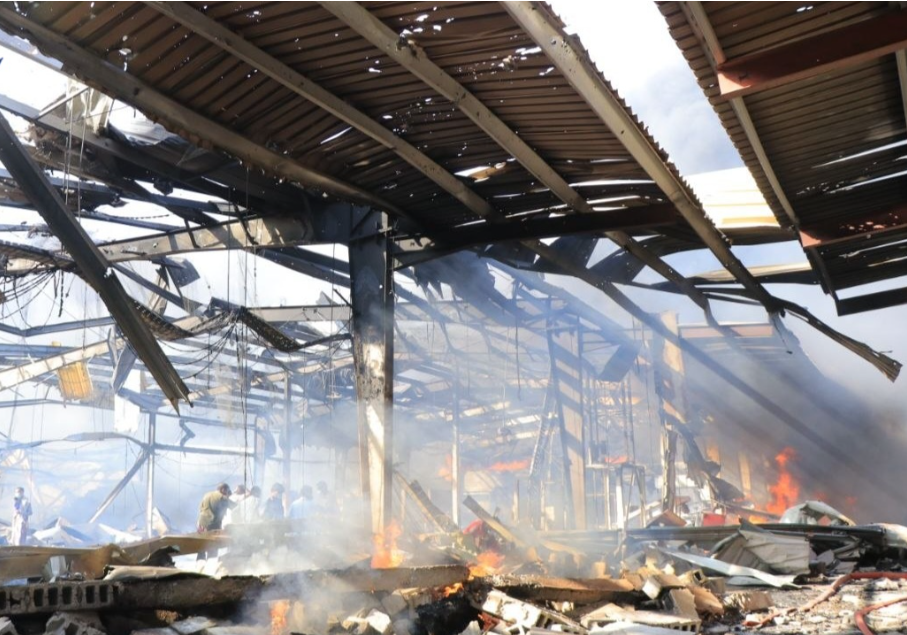
The Al-Khawlani Sponge Factory massacre in Hodeidah city embodies the peak of deep-seated malice and the bloodthirsty tendency inherent in the Saudi regime, whose aircraft poured the fire of its airstrikes on a civilian industrial facility teeming with workers, before extending to paramedics and media personnel during rescue operations and documentation of the crime.
Fourteen martyrs and ten wounded among the factory’s workers is the initial toll of the massacre that turned the facility into rubble, set fire to its facilities and warehouses, and scattered equipment and production materials under its ruins, while workers fell between martyrs and wounded inside their workplaces, leaving behind families who were waiting for their return, only to be stricken by the martyrdom or injury of their breadwinner, facing doubled pain with the loss of their source of livelihood.
The chapters of this crime are completed by the Saudi enemy aircraft’s renewed bombing of the factory while ambulance, rescue, and civil defense teams were conducting operations to recover the victims and treat the injured, as the second airstrike hit paramedics and media personnel at the crime scene, resulting in the martyrdom of a number of paramedics and humanitarian workers, and the injury of a number of Al-Yemen TV channel crew members with varying wounds.
Thus the factory yard turned into a stage for a complete crime, beginning with the bombing of workers inside their production sites, extending to ambulance and rescue teams during the recovery of victims, and reaching media personnel during the documentation of the massacre, with the second airstrike adding new victims to the crime’s toll.
The effects of this massacre exceed the scale of the destruction that befell the factory, for the place is a production facility where dozens of workers work to secure their families’ livelihood, and every worker, paramedic, or journalist who fell as a martyr or was injured has behind him a family that lost its breadwinner and source of income, while the facility faces the loss of its equipment, materials, and warehouses, and with it the livelihoods of workers whose daily lives were linked to this work stop.
The bombing and targeting of the Al-Khawlani factory reveals the nature of the targets hit by Saudi enemy airstrikes in Yemen—industrial facilities, service facilities, and residential homes—and the victims and damage they leave that extend beyond the targeted site to the lives of hundreds of families, in an extension of years of aggression and siege that have inflicted widespread damage on the components of life and production in the country.
The Saudi war machine’s picking on a civilian facility producing sponges reflects the depth of the military impasse and the state of bankruptcy experienced by the leadership of this criminal regime after it exhausted its so-called target bank, resorting to compensating for its humiliating field defeats by fabricating false heroics through bombing production lines, factory warehouses, and the sources of livelihood of struggling citizens.
The ugliest images of global hypocrisy and the moral collapse of complicit Western and Arab regimes are manifested in their frantic race to issue statements of condemnation and denunciation in defense of Saudi oil wells and facilities, versus their swallowing of tongues and shameful silence toward the blood of Yemeni workers and innocent citizens, confirming these regimes’ cheap subservience to tainted Saudi money and their prioritization of oil barrels over human lives and humanitarian covenants.
This double standard exposes the falsity of human rights slogans and the fall of the so-called international community into the mire of servility, as political and media energies are mobilized to protect the economic interests of the forces of arrogance, while daily genocide massacres against Yemeni facilities and their workers are met with blatant complicity that destroys all claims of justice and reveals the ugly face of a world governed by interests and devoid of the simplest moral values.
International audacity reaches its peak in the mobilization of those mercenary capitals to criminalize Yemen’s legitimate right of response and its targeting of the sources of funding for the aggression, blatantly ignoring long years of killing, destruction, and suffocating siege, proving these stances’ partnership in shedding Yemeni blood and confirming the inevitability of Yemen proceeding in deterrence and retribution regardless of the noise of this hypocritical world.
The Al-Khawlani factory massacre has added a bloody page to the record of 12 years of aggression on Yemen and returned to the forefront the victims’ right to justice and Yemen’s right to defend its people, confront the aggression, and hold those responsible for its crimes accountable, so that the blood of workers, paramedics, and journalists remains part of the memory of a homeland that has paid heavy prices in defense of its sovereignty and its right to life.