
“Greatest Burning Is in My Heart”.. Wounded Gazan Mother Weeps for Her Amputated Son, Her Child Threatened with Death
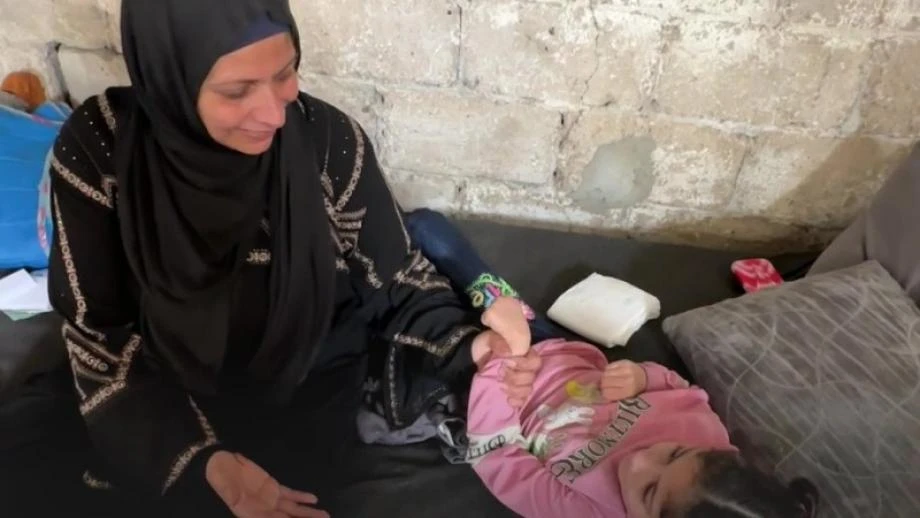
In a forgotten corner on the sidewalk of Tunnel Street in Gaza City, Umm Omar al-Naizi sits between walls that barely conceal her pain, besieged by burns, disability, and poverty on all sides. The Zionist war didn’t just steal her home and her safety; it also took her young son’s leg and burdened her sick child with double the suffering, transforming the family’s life from one of stability into a daily battle for survival.
Amidst cries of pain and the helplessness of need, the mother tells the story of a family exhausted by the bombing and the siege, their only remaining hope being that someone will hear their pleas before they are swallowed by oblivion.
Um Omar never imagined that her stable life would turn into this painful reality.
The Zionist bombing that struck her family didn’t just harm her body; it left deeper scars on her heart.
The mother suffered severe burns and fractures that required her leg to be fixed with metal and platinum, while her young son lost one of his legs at the same moment she was injured. The mother, her voice heavy with pain, told the newspaper Falastin, “The burns on my body pale in comparison to the burning pain in my heart for my son. He was our support, and now he needs help to stand and move, while I am unable to care for myself or my family as I used to.”
But the family’s tragedy doesn’t end there. In addition to the injury and amputation, ten-year-old Malak lies bedridden in a complex medical condition. Since birth, she has suffered from complete cerebral palsy due to oxygen deprivation, as well as frequent seizures caused by excessive electrical activity in her brain, requiring constant, round-the-clock medical care.
Umm Omar describes the most harrowing moments, saying, “When Malak starts having a seizure, her little body stiffens and she loses consciousness. The doctors have confirmed that taking her to the hospital is urgently necessary in these cases, but we often can’t even afford the transportation.”
Under the harsh living conditions in Gaza, the child’s medical needs have become an unbearable burden for the exhausted family. Malak requires special food and regular medication to control the seizures, in addition to a medical mattress to protect her from bedsores, and special diapers that the family cannot afford.
The mother says bitterly, “Every three days, my daughter needs a pack of special diapers, and the price today is equivalent to what we can’t afford for many days. We can’t even provide enough food, so how can we afford treatment and medical supplies?”
Adding to the family’s hardship, they live in a place lacking the most basic necessities for a dignified life, while temperatures soar with the arrival of summer. The family is unable to provide suitable clothing for the children or secure the basic necessities that were once considered essential. Umm Omar recalls one of the most harrowing periods of her life during the Israeli war, when she spent over seven months in the hospital after being injured, separated from her sick child.
“I lay on the hospital bed, thinking of Malak every moment,” she says. “I wondered if she was alright, hungry, or even alive. Those long months drained what little strength I had left.”
When she was discharged from the hospital, she found a reality even harsher than what she had left. Her son, who had been the family’s support, now needed a prosthetic limb to help him move around, and her daughter was still battling illness and seizures. She herself was unable to perform even the simplest daily tasks due to her injuries and the burns covering her body.
Today, the family finds itself facing a struggle to find treatment, food, care, and the bare necessities of life.
An injured mother, an amputee son, and a sick child requiring constant care, all amidst deteriorating living conditions, a lack of resources, and the absence of any source of income that could alleviate their suffering. In closing, Umm Omar makes a plea that encapsulates the magnitude of her family’s tragedy, demanding treatment and medical supplies for her daughter, a prosthetic limb for her son, and assistance in coping with the burdens of daily life, which have become unbearable.
Umm Omar’s story is but one page in the open book of suffering in Gaza, where the wounds of war intertwine with the harsh realities of illness, poverty, and displacement, and the most basic human rights become distant dreams. While this family continues its daily struggle for survival, thousands of other families await a glimmer of hope to lift them from a reality burdened by tragedy and wearied by waiting.