
Speech by Leader Al-Sayyid Abdul Malik Badruddin Al-Houthi Marking Day of Wilayah
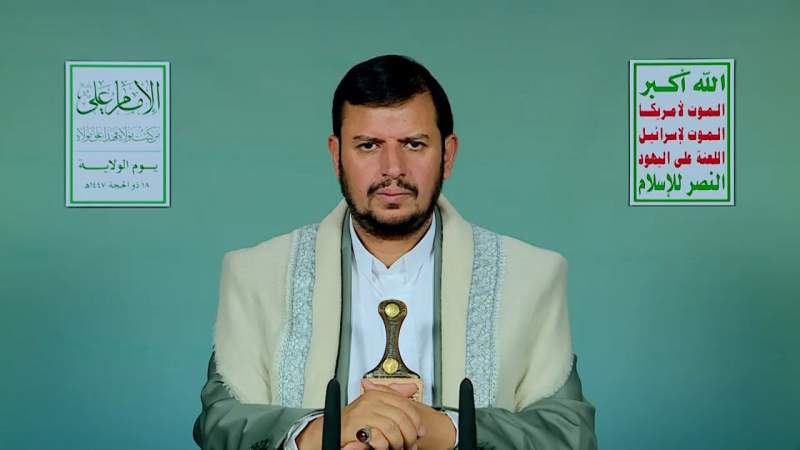
I seek refuge in Allah from Satan, the outcast.
In the name of Allah, the Compassionate, the Merciful.
Praise is to Allah, Lord of the Worlds. I bear witness that there is no god but Allah, the Sovereign and the Manifest Truth, and that our master Muhammad is His servant, Messenger, and Last Prophet.
O Allah! Bestow Your salat and blessings upon Muhammad and the Family of Muhammad as You bestowed Your salat and blessings upon Abraham and the Family of Abraham. You are Owner of Praise, Owner of Glory! And be pleased with Muhammad’s good companions and all Your righteous servants and mujahidin.
Brothers and sisters, peace be upon you and the mercy of Allah and His blessings.
On this blessed and significant religious occasion—the occasion of Ghadir Khumm [Pond of Khumm] and the Day of Wilayah [guardianship, allegiance, etc.]—I extend my warmest congratulations to our dear Yemeni Muslim people and the entire Islamic Ummah.
Our dear people have commemorated this blessed day in a magnificent way across the various free governorates, just as they do every year. They do so because this is an authentic religious occasion and part of their faith heritage as Yemeni Muslim people, about whom the Messenger of Allah (PBUH&F) said, ‘The belief is that of the Yemenites, and sagacity is that of the Yemenites.‘
Thus, this occasion is not something new to our dear people. Rather, they have commemorated it generation after generation, over many centuries, as part of their deep-rooted and genuine faith identity. They continue to do so because it is a great occasion of major significance in many respects, some of which we shall discuss.
Our people attach great importance to religious occasions, foremost among them the anniversary of the birth of the Noble Prophet (PBUH&F). These occasions help preserve their faith-based identity and strengthen their conscious faith. Among their other important benefits are deepening awareness and insight, reinforcing sound Quranic concepts, and drawing inspiration from their moral guidance.
They also value these occasions because doing so reflects appreciation for the blessings of Allah (the Exalted) and acknowledgment of the greatness of His religion. Allah (the Almighty) has bestowed this religion as a favour upon His servants, as He says in the Holy Quran, {‘Say, “In the bounty of Allah and in His mercy, let them rejoice; it is better than what they accumulate”‘}[Yunus 10:58].
The Day of Ghadir Khumm—including the event itself and the momentous historical proclamation—is an established historical fact. It is agreed upon by historians, scholars of hadith, and Islamic tradition at large, leaving no room for doubt or suspicion. Thus, this is a celebration of a verified and authentic occasion—one of the undeniable established facts of history.
The significance of the occasion of Ghadir Khumm—this radiant day, the Day of Wilayah—can be seen in many respects, as we have already mentioned. Foremost among them is that commemorating this occasion is a way of bearing witness to the perfection of the religion and the completion of the blessing, as Allah (Glory be to Him) says, {‘Today I have perfected your religion for you, completed My favour upon you, and chosen Islam as your way‘}[Al-Ma’idah 5:3]. This took place on the Day of Ghadir and the occasion of Wilayah. Commemorating this day is therefore part of appreciating the blessing of Allah (Glory be to Him). The perfection of religion and the completion of divine blessing are matters from which all good in this world and the Hereafter follows—provided that the Ummah conducts its life on this basis, instead of following a deficient approach to its religion after Allah has perfected it for them or dealing inadequately with Allah’s greatest blessings, foremost among them this blessing: the perfection of religion. Such blessings have a profound impact on people’s lives, and on the effectiveness and vitality of religion in all its details and fields that extend into people’s daily affairs and into the reality of the human soul.
When the Ummah fully directs itself on this basis, it truly attains the full blessing in every area of life:
- strength,
- liberation from the authority of tyranny,
- human dignity,
- goodness and prosperity that Allah has promised in this world, and
- the great success He has promised in the Hereafter.
- First, it was distinguished by a general mobilisation on an unprecedented scale. The Messenger of Allah (PBUH&F) was keen to ensure that as many Muslims as possible would come to perform Hajj. He issued a general call and a widespread summons for Hajj that year. He emphasised this and sent many messengers to different regions and tribes, urging them to come for Hajj. This effort succeeded, resulting in a gathering unparalleled in the history of the Arabs. Never before, from the time of Prophet Abrahm to the era of the Last Prophet and Master of Messengers, Muhammad (PBUH&F), had such a vast multitude attended Hajj. With the population of the Arabian Peninsula estimated at approximately five hundred thousand at the time, a pilgrim count of around one hundred thousand or more represents a massive turnout. This was one distinctive feature of that pilgrimage: the general mobilisation and the broad call for Muslims to participate and be present, since very important instructions were to be delivered during it.
- The second distinctive feature of the Farewell Pilgrimage is that it, as its very name indicates, was the occasion on which the Prophet (PBUH&F) bade farewell to his Ummah. This was deeply sorrowful news, but it is Allah’s way with His servants, as He (the Almighty) says, {‘You [O Prophet] will certainly die, and they will die too‘}[Az-Zumar 39:30]. He also said, {‘Muhammad is not but a messenger. [Other] messengers have passed on before him. So if he was to die or be killed, would you turn back on your heels [to unbelief]? And he who turns back on his heels will never harm Allah at all, but Allah will reward the grateful‘}[Ali ‘Imran 3:144]. Furthermore, {‘Everyone upon it [the earth] will perish‘}[Ar-Rahman 55:26]. This is Allah’s way with all His servants, just as it was the case with the messengers and prophets before him (PBUT). So his farewell to his Ummah and the notification of his approaching departure were intended to emphasise the critical arrangements necessary to safeguard the future of the Ummah. This announcement was not made simply to cause sorrow; rather, it was fundamentally linked to this very matter. The Prophet (PBUH&F) intended to provide vital instructions that would serve as a safeguard for his people following his departure. This becomes a central priority in such a situation—when he speaks of his imminent departure and says, ‘I am about to be called [by my Lord], and I must answer,‘ and when he says, ‘Perhaps I shall not meet you again after this year.‘ So this was said in the context of instructions and arrangements meant to secure the future of the Ummah after the death of the Messenger of Allah (PBUH&F) and to address the immense void that his departure would leave in the life of the Ummah. It is inconceivable that he would leave the Ummah neglected, with the serious consequences that would bring upon its reality—as a result of lack of wise guidance from Allah (Glory be to Him) in what He provides for His servants. If deviation or change occurs on the part of the Ummah, then the Ummah itself bears responsibility for that. As for Allah and His Messenger, there was no shortcoming on their part whatsoever.
- The Messenger of Allah (PBUH&F) ordered the pilgrims to gather immediately in a general emergency assembly. This was just before midday, at the height of the day’s heat. He ordered those pilgrims who had already gone ahead to return at once, and those who were lagging behind to hurry and attend the public gathering.
- He oversaw preparations at the site of Ghadir Khumm, an open, flat expanse. He ordered the venue to be cleared by sweeping away the thorns from beneath several large shade trees. Then, by the order of the Messenger of Allah (PBUH&F), camel saddles were stacked to form a pulpit from which the proclamation would be delivered. This itself indicates the large number of pilgrims and attendees present.
- ‘Ali is with the Quran, and the Quran is with Ali.‘
- ‘Ali is with the truth, and the truth is with Ali.‘
- ‘No one loves you but a believer, and no one hates you but a hypocrite‘—among many other hadiths that are widely known among Muslims.
- killing and the complete violation of our Ummah through acts of genocide;
- horrific crimes of rape, which have become part of an ongoing pattern of aggression that continues to expand, to the extent that they themselves publish and circulate footage documenting acts of sexual violence against people of all ages, including men, women, and children;
- the occupation of homelands; and
- the seizure of property.
These are outcomes of immense importance. So commemorating this occasion and bearing witness before Allah to the perfection of His religion and the completion of His blessing, is extremely important. It is among the benefits of this blessed occasion when it is observed properly.
One of the most important aspects of this occasion is that it preserves the record of the historic proclamation delivered by the Prophet (PBUH&F) in obedience to Allah’s command. This command appears in the Holy Quran, in the blessed verse that we will recite and reflect upon, in a manner that confers exceptional and immense significance upon that proclamation, as Allah says, {‘O Messenger! Convey what has been revealed to you from your Lord. If you do not, then you have not delivered His message‘}[Al-Ma’idah 5:67]. A proclamation of such utmost importance, as evidenced by the blessed verse, deserves our utmost attention and documentation by speaking about it. It is among the important matters that should be spoken about and continually brought to people’s attention.
The Messenger (PBUH&F) was also keen on this. He said to those great crowds of pilgrims, tens of thousands of them, ‘Let those of you who are present convey it to those who are absent.‘ So this matter is of great importance. The process of documenting this proclamation, making it known, and speaking about it is one of the important benefits of this occasion. Although, in reality, it is one of the firmly established truths, with no doubt about it, its meaning, implications, and practical application for the Ummah are often contested. Such opposition seeks to prevent the community from truly benefiting from it and to render it inactive.
Another important benefit of this occasion is that it bears witness for the Prophet (PBUH&F) that he obeyed Allah’s command and conveyed this great proclamation. He called upon the gathered crowds who were present—the very people to whom he first delivered this proclamation, so that it would continue to echo through the generations—to testify. Addressing them and asking them to bear witness, he said, ‘Have I not conveyed the message?‘ and they responded, ‘O Allah, yes!‘ He then said, ‘O Allah, be my witness!‘ Thus, he called Allah Himself as witness that he had delivered this great proclamation.
Furthermore, beyond the testimony and the discussion of this great historic proclamation, celebrating this occasion is vital for rooting the Quranic concept of guardianship as it appears in the Holy Quran. This concept serves as a safeguard for the Islamic Ummah, protecting it from aligning itself with the Jews and Christians or submitting to them as foreign powers that have the right to command the Ummah and control its affairs across all fields.
The Holy Quran places great emphasis on this issue within the concept of guardianship, to the extent that it presents this concept in this very context in Surah Al-Ma’idah. The theme of guardianship, of course, receives major attention in other surahs as well, but here, in Surah Al-Ma’idah, it comes specifically in the context of warning against taking the Jews and Christians as guardians and aligning oneself with them. Taking them as guardians means placing them in a position that enables them to impose their dictates on the Ummah and have the final say in all its affairs. As for alignment with them, it means supporting them, standing with them, backing them, and aligning with them in position, among other things. This poses a severe threat, as it risks subjecting the Ummah to the rule of taghut, moving it away from allegiance to Allah and into allegiance to taghut, which is a grave deviation that can lead to serious evil consequences. This is one of the points we will shed light on, Allah willing, within this same context.
The blessed verse from Surah Al-Ma’idah also reinforces the concept of guardianship, highlighting its role in granting the Ummah strength and protection and deepening its bond with Allah, the Almighty. This concept enables the Ummah to be among the party of Allah, which has been promised victory in the face of the Jews and their Christian supporters, as stated in the blessed verse: {‘And whoever takes for guardian Allah, His Messenger, and those who have believed, then it is certainly Allah’s party that will prevail‘}[Al-Ma’idah 5:56]. The Ummah is in the greatest need of this today. We can therefore see the important connection between this occasion and our present reality—our circumstances, the realities of our lives, and the nature of the challenges and dangers facing our Ummah.
For this reason, it is an occasion of great importance. It is directly connected to our current reality, our challenges, and the dangers we face. It is also connected to Islamic principles that hold major significance in our religion. It therefore deserves our attention, care, and effort to benefit from it. This is a necessary focus, especially when contrasted with the trivial occasions observed in some countries of the Ummah—including Jewish occasions that corrupt the soul and foster a sense of loyalty and attachment to the Jews.
Returning to the great historic proclamation, as we have said, speaking about this proclamation and keeping its memory alive is one of the important benefits of this occasion. This is extremely important. This great historic proclamation is connected to the Farewell Pilgrimage: the pilgrimage performed by the Prophet (PBUH&F) in the tenth year after the Hijrah. That pilgrimage was distinguished by two things:
The instructions the Prophet (PBUH&F) gave as part of his farewell to his Ummah were, as we have said, concerned with its future. And indeed, just as he (PBUH&F) had informed them of his imminent departure, less than three months passed before he left this transient world. Following his return from Hajj and Ghadir Khumm, the time remaining was brief. According to various historical accounts, he passed away at the end of the month of Safar or the beginning of Rabi’ Al-Awwal of the following year, meaning he lived only through Muharram and Safar after returning in Dhu Al-Hijjah.
During the Farewell Pilgrimage, the Prophet (PBUH&F) gave very important instructions regarding Hajj and the internal affairs of the Ummah. In the Farewell Sermon, delivered on the Day of Arafah during the Farewell Pilgrimage, he also made an important announcement regarding the ‘two weighty things‘ he was leaving behind. He announced, ‘I am leaving among you two weighty things; if you hold fast to them, you will never go astray after me.‘ He then spoke about these two things, identifying the first as ‘the book of Allah, which is a rope extended from heaven, one end in the hand of Allah and the other in your hands‘. He praised it and urged people to hold fast to it. He then added, ‘… and my progeny, my household. The All Subtle, the All Aware has informed me that the two shall never separate until they meet me at the Pond.‘
During his return from the Farewell Pilgrimage, when he reached Al-Juhfah, at a place known as Ghadir Khumm, a final junction before the pilgrims dispersed towards their respective homelands, Allah (the Almighty) revealed to him, {‘O Messenger! Convey what has been revealed to you from your Lord. If you do not, then you have not delivered His message. Allah will [certainly] protect you from the people. Indeed, Allah does not guide the people who disbelieve‘}[Al-Ma’idah 5:67]. The content of this blessed verse points to a matter of immense significance, given its effect on the entirety of the message already conveyed by the Messenger of Allah (PBUH&F). By this stage—the very end of his life—he had already conveyed the essential beliefs and core principles of Islam, such as monotheism and knowledge of Allah, and the comprehensive body of Islamic law. He had clarified the required positions towards the enemies of Islam in practical terms, through a movement of jihad against those who fought Islam, blocked people from the path of Allah, and sought to prevent the establishment of His religion and to wage war against His message. Thus, the Messenger of Allah (PBUH&F) demonstrated the stance towards them in a practical way by engaging in jihad and fighting against them, and Allah granted him victory over them: He confronted the polytheists among the Arabs, the Jews, and the Christian forces of disbelief at that time, among other adversaries.
Therefore, when Allah says, {‘If you do not, then you have not delivered His message‘}[Al-Ma’idah 5:67], this indicates that this very matter would affect everything that had already been conveyed of the message if it were not conveyed. Therefore, this alone is sufficient to make us realise the extraordinary significance of this matter.
Furthermore, when Allah said to him, {‘Allah will [certainly] protect you from the people‘}[Al-Ma’idah 5:67], this reveals that the matter was highly sensitive for people, especially for those to whom this proclamation was first delivered. Such a matter is broadly sensitive—not limited, for example, only to the disbelievers, the hypocrites, or certain factions. In other words, in human reality in general, this matter carries great sensitivity. People are extremely sensitive towards it in their reactions, in the positions they take, and in the consequences that follow. This is indeed the reality, and it will become even clearer, Allah willing, as we continue.
When Allah said to His Messenger (PBUH&F), {‘Allah will [certainly] protect you from people‘}[Al-Ma’idah 5:67], He gave him a significant boost and reassured him of divine backing in delivering this message, ensuring that no reaction following its proclamation would have a dangerous impact.
{‘Allah will [certainly] protect you from the people‘}[Al-Ma’idah 5:67]. So he was to be fully supported in conveying this message. The exact nature of this topic will become clear to us through the prophetic text, as will its profound sensitivity within human society across generations. In every age, it remains the most delicate issue among all strata of society. Simply put, the issue of leadership and authority—Wilayah—is consistently the most sensitive subject for any people across all factions. Whether among politicians, intellectuals, religious scholars, or social leaders, this matter provokes the most intense reactions and the firmest stances, far beyond any other matter. This sensitivity is a deeply rooted fact of human history.
What, then, was the content of this proclamation that Allah commanded the Messenger (PBUH&F) to deliver—{‘Convey what has been revealed to you from your Lord‘}[Al-Ma’idah 5:67]—although he was at the final stage of his life and had already conveyed the Quran, the Islamic laws, the core beliefs, and the essential stances of Islam? Indeed, he had delivered almost the entire religion to that point.
In any case, when this blessed verse was revealed to the Messenger (PBUH&F), he immediately took measures to arrange for the proclamation of this message. These were extraordinary measures, perfectly fitting the tone of the blessed verse, which treats the matter with the utmost gravity.
The arrangements and measures taken by the Messenger of Allah (PBUH&F) to announce this proclamation all served to signal the importance of what was about to be declared—that the message to be conveyed was a matter of immense significance:
The Muslim pilgrims all attended—both those who had arrived earlier and those who came later—and prepared for the noon prayer. When it was time for the noon prayer, the Messenger of Allah (PBUH&F) led them in prayer. Following the prayer, the Muslims waited to hear a historic and exceptional address concerning a matter of immense importance, one to which the Prophet (PBUH&F) devoted exceptional care and attention.
Then, the Messenger of Allah (PBUH&F) ascended the stacked camel saddles, took Ali (PBUH) with him, and delivered a great sermon. This is because people naturally direct their attention to what they can see. The gathered crowds listened attentively. In this sermon, the Prophet (PBUH&F) reiterated what he had said during the Farewell Pilgrimage about the approaching end of his life in this worldly abode. He also informed them that he was leaving among them the ‘two weighty things‘. When the Messenger (PBUH&F) reached the central theme of the sermon, he introduced it in a manner that drew the pilgrims’ attention to its significance. He said, ‘O people, Allah is my guardian, and I am the guardian of the believers, having greater authority over them than they have over themselves.‘ Then he took Ali (PBUH) by the hand and raised it together with his own, saying, ‘So for whoever I am his guardian, this (Ali) is his guardian. O Allah, be the ally of whoever stands as his ally, and be the enemy of whoever stands as his enemy. O Allah, support whoever supports him, and forsake whoever forsakes him.‘
With this proclamation, the Messenger of Allah (PBUH&F) took the testimony of the present pilgrims—who numbered in the tens of thousands—that he had conveyed the divine command. He said, ‘Have I not conveyed the message?‘ and they responded, ‘O Allah, yes!‘ He then said, ‘O Allah, be my witness!‘ Also, he commanded them that those present convey it to those absent, so that this proclamation would reach all Muslims. Following the sermon, as the Prophet (PBUH&F) stepped down from the pulpit of saddles and remained in that place, a new verse was sent down: {‘Today I have perfected your religion for you, completed My favour upon you, and chosen Islam as your way‘}[Al-Ma’idah 5:3].
Logically, this verse could not have been revealed before the earlier warning concerning that important proclamation: {‘If you do not, then you have not delivered His message‘}[Al-Ma’idah 5:67]. Therefore, there is no way that this verse—{‘Today I have perfected your religion for you‘}[Al-Ma’idah 5:3]—could have been sent down before the Prophet had conveyed what Allah had commanded him to convey—something about which Allah said, {‘If you do not, then you have not delivered His message‘}[Al-Ma’idah 5:67]. Thus, how could the religion be considered perfected while a matter of such importance had not yet been communicated to the Muslim community? It would be inconsistent for the religion to be declared complete while such a vital instruction remained undelivered
The great significance of this important proclamation lies in the fact that it established for the Muslim Ummah a secure path for the future. If the Ummah remained committed to it, it would attain the fullness of Islam in its practical reality and reap its immense fruits. Islam is a religion that has an impact on people’s souls, elevates them, and positively transform the reality of their life. We will highlight some of these great fruits that Allah has promised in the Holy Quran, both in this world and in the Hereafter.
The historic proclamation at Ghadir Khumm was preceded by many highly significant statements that affirmed the status of the Commander of the Believers, Ali (PBUH), within the Ummah. Among them is the statement of the Messenger (PBUH&F): ‘You are to me as Aaron was to Moses, except that there is no prophet after me.‘ There are also other well-known hadiths:
Moreover, this proclamation is also firmly rooted in the blessed verses of the Holy Quran, especially in those of Surah Al-Ma’idah—as mentioned earlier—and appears within a highly significant context. We need to understand the importance of this matter, as it is of great relevance to us at this stage. Indeed, it is relevant to Muslims in every era, for adherence to it would have protected the Ummah from the condition into which it has fallen in its struggles with its enemies among the Jews and Christians.
In the Holy Quran, in Surah Al-Ma’idah, Allah (Glory be to Him) says, {‘Indeed, your only guardian is Allah, His Messenger, and those who have believed, those who establish prayer and pay zakat while bowing‘}[Al-Ma’idah 5:55]. This serves as an affirmation of the principle of guardianship and a prominent presentation of it in the Holy Quran. For this reason, the Messenger’s declaration at Ghadir Khumm is regarded as a counterpart to this blessed Quranic text and as an elaboration upon it. Here, the divine guidance and command concerning the guardians of this Ummah are further expressed in His words, {‘And whoever takes for guardian Allah, His Messenger, and those who have believed, then it is certainly Allah’s party that will prevail‘}[Al-Ma’idah 5:56].
The context in which the issue of guardianship is presented demonstrates—as we have said—its immense and far-reaching significance for us. It appears in the context of warning against taking the Jews and Christians as allies and patrons, as Allah (Glory be to Him) says, {‘O believers! Take neither Jews nor Christians as guardians. They are guardians of each other. Whoever takes them as guardians becomes one of them‘}[Al-Ma’idah 5:51]. It also appears in a context that makes clear the inevitability of the struggle with them, portraying them as a force that poses a genuine threat to this Ummah and targets it with intense hostility and comprehensive aggression. The Quran details how they seek to lead this Ummah astray, deprive it of the honour of carrying the divine message, and reduce it to a state of subjugation, oppression, defeat, and humiliation. They seek to crush it, dominate it, wrong it, corrupt it, and misguide it. These and other details presented in the Holy Quran reveal the profoundly hostile nature of their attitudes towards this Ummah, the grave danger posed by their methods of deception and misguidance, their approaches to corruption and moral dilution, the nature of the conflict with them, their evil, and the magnitude of the threat they represent to this Ummah.
Therefore, the principle of guardianship in Islam is of the utmost importance to the effectiveness of Islam in the lives of Muslims and to the realisation of its fruits in this world and the Hereafter, as promised by Allah. Among its key purposes is safeguarding this Ummah from giving its allegiance to its enemies among the Jews and Christians, who are aligned with Satan, at the level of loyalty and affiliation that carry practical consequences. Concerning allegiance to the Jews and their Christian allies, Allah says, {‘They are guardians of each other‘}[Al-Ma’idah 5:51], explaining that they act in a coordinated and collective manner in their efforts to target us as a Muslim Ummah.
Allegiance to them is not merely an abstract political stance whose effects are confined to the political sphere. Rather, it carries negative consequences that extend into various aspects of our lives, often at the expense of our religious principles, our religious values, and Allah’s teachings.
The serious consequences of allegiance to them are far-reaching and extend into all aspects of our lives, because they typically move, through their directives and impositions upon this Ummah, to interfere in every sphere of its affairs. This reaches the level of education, cultural formation, and upbringing, as well as religious discourse and religious commitment, and extends further into political, economic, and social matters. This is precisely the domain of religion: economic, political, and social affairs, together with the various other affairs of life. Thus, the effects of allegiance to them extend, through their dictates and through policies of appeasement towards them, into every aspect of our lives. They pursue this objective through a deliberate and calculated policy aimed at stripping us of every source of strength and marginalising everything within the religion that is essential to our being an independent, resilient, dignified, and strong Ummah—one that is resistant to them and immune to their influence and domination, among other things. In this sense, the matter is extremely serious.
Allegiance to them results in practical consequences, representing a deviation from the path of religion in favour of its enemies and in a manner that serves no interest of the Ummah. Rather, it leads to harm against it: weakening it, humiliating it, fragmenting it, and subjugating it. It contributes to its misguidance, corruption, dilution, and decline. It also strips it of the honour of bearing the responsibility of conveying the divine message and inheriting the legacy of the prophets and messengers. Indeed, this is an extremely serious matter.
For this reason, allegiance to them is closely associated with taking them as allies and granting them authority and empowerment: allowing them to occupy positions of command and prohibition, to interfere in the affairs of this Ummah, and to direct its course—all while they are adversaries to this Ummah. They are not sincere advisers to this Ummah; rather, they are those whom Allah has described in the Holy Quran—and Allah is the Most Truthful of speakers—as not desiring any good for us. If they do not desire any good for us, then this necessarily means that they desire every form of harm instead. That is because the alternative to good is evil. They do not want any good for us, yet they actively seek and promote every form of harm. This is precisely what they focus on and succeed in advancing. In many cases, the relationship between numerous regimes and governments—and by extension, their societies—has come to reflect this reality: They receive directives across all areas of life from the Jews, from the Zionists of the present era, who represent a continuation of the global Jewish movement. This is an extremely serious matter, with grave and far-reaching consequences for Muslims. It constitutes a major threat that poses a comprehensive challenge to the Muslim Ummah in both its religious and worldly affairs. Hence, this matter must never be ignored; rather, the Ummah is required to be deeply vigilant and to take all necessary means to safeguard and protect itself against it. This inevitably leads to a departure from the fundamental principles of religion in favour of its enemies—enemies who are malicious, criminal, and deeply resentful—while they simultaneously work to remove those very religious principles, which play a crucial role in safeguarding the Ummah from their evil, strengthening it in facing their threat, and preparing it to withstand the challenges and dangers that come from them.
Accordingly, when the Ummah responds to them, it responds in ways that ultimately bring harm upon itself—ways that weaken it, distance it from Allah’s support and care, and strip it of the very elements of its strength. The result is that the Ummah loses its freedom and independence, which ought to be founded upon its faith-based and Islamic identity and its religious affiliation. Consequently, it suffers the loss of both its religion and its worldly well-being. Such a condition amounts to the subjugation of the Ummah. When Muslims become a community that submits to its enemies among the Jews and Christians, yielding to their directives and commands even at the expense of its religion, this is a state of servitude. These are deeply hostile adversaries who seek to subjugate and humiliate this Ummah. They have no genuine respect for it, nor even for those who align themselves with them sincerely and to the extent of loving them: {‘Here you are! You love them but they do not love you‘}[Ali ‘Imran 3:119]. Allah—Who knows the secrets of the heavens and the earth and is fully aware of what lies within hearts—has informed us that they seek to dominate this Ummah and reduce it to a condition of defeat, subjugation, and humiliation. This is a clear and established reality, about which there can be no doubt.
Therefore, this Ummah should be extremely uneasy and deeply concerned about the issue of taking Jews and Christians as allies and about allowing them to exercise guardianship over its various matters—to be the ones who hold positions of decision-making, command, and prohibition, despite all that they embody of evil, criminality, corruption, misguidance, and their complete contrast from this Ummah in terms of values and morals. That is because those people stand in opposition to the divine principles, divine values, divine ethics, and divine teachings that Allah has revealed in His Message and in the Holy Quran. Such a contrast places Muslims in a position where they are meant to remain distinct from those enemies. They must not accept that these people (who are characterised by such evil, wickedness, tyranny, disbelief, misguidance, corruption, and deep-seated hatred towards this Ummah) occupy a position in which they command it, dictate to it, and interfere in all its affairs. For this, too, carries grave dangers for the Ummah, and the Ummah should be keen to protect itself against such a situation.
In summary, giving them one’s allegiance and accepting them in a position of authority over this Ummah—commanding it, directing it, and exercising control over it, imposing their dictates in all its affairs, and seeking to make this community supportive of them, exploited by them, and violated by them—should be recognised for what it is: It leads those who accept it into subjection to the authority of taghut. The authority of taghut is completely incompatible with the path of faith. It constitutes a severance from allegiance to Allah and an entry into the dark and corrupt authority of taghut, whose inevitable end is the Fire of Hell, without any doubt, as Allah has affirmed in the Holy Quran.
This Ummah should not react with discomfort or misgivings when the guardianship of Allah is discussed. That is, some members of this Ummah react negatively to the moment they hear this term. They become uncomfortable, resentful, and alienated, and they do not want to hear anything about the subject. Even when Quranic verses related to this matter are recited to them, they find themselves unreceptive to anything connected with it—whether it comes from the Quran itself, from what the Messenger of Allah (PBUH&F) explained on the basis of the Holy Quran, or from realities and facts borne out by actual experience. They simply do not wish to hear anything at all about this subject.
The guardianship of Allah (Glory be to Him) has been presented to us in the Holy Quran, and this is what the Ummah should focus on: how it has been presented in the Quran and in the authentic and agreed-upon reports transmitted from the Messenger of Allah (PBUH&F). We will find that it has been presented to us in a noble and compelling manner, founded first and foremost upon the honouring of the human being. When Allah (Glory be to Him) said in the Holy Quran, {‘Indeed, your guardian is only Allah‘}[Al-Ma’idah 5:55], to whom is He speaking? He is addressing those who have believed—those who have embraced Islam and affirmed the divine message, the Holy Quran, and this great religion of Islam. Has He wronged us by saying this? Is this an expression that demeans us as Muslims: {‘Indeed, your guardian is only Allah‘}[Al-Ma’idah 5:55]? This is a tremendous honour for us that Allah (Glory be to Him), our Magnificent Lord, is our guardian.
Allah (Glory be to Him) has said in the Holy Quran, {‘And We have certainly honoured the children of Adam‘}[Al-Isra 17:70]. In the Holy Quran, Allah (Glory be to Him) has mentioned, {‘And to Allah belongs [all] honour, as well as to His Messenger and to the believers‘}[Al-Munafiqun 63:8]. Allah speaks to us in the Holy Quran about the greatness of this message—through its book, through the mission of His Messenger, and within the framework of divine guardianship—saying, {‘This is a book We have sent down to you, that you may take people out of darkness into light, by the permission of their Lord, to the path of the Mighty, the Praiseworthy‘}[Abraham 14:1]. He grants us from His might and bestows upon us from His praise and glory. Allah (Glory be to Him), Who is merciful towards us, began the chapters of His holy book with the words, {‘In the name of Allah, the Compassionate, the Merciful.‘} He repeatedly emphasises in many of His blessed verses that what He teaches us, commands us to do, and forbids us from doing stems from His mercy towards us. Indeed, He is the Most Merciful of the merciful, and the manifestations of His mercy are clearly evident throughout every aspect of our lives. Allah is the One of absolute perfection—in His greatness, majesty, and perfection—and He is the Sovereign of the heavens and the earth, the Lord of the heavens and the earth, to whom this world and the Hereafter belong, in whose hand are our life and death, and to whom is our ultimate return. He is our guardian: {‘Indeed, your guardian is only Allah‘}[Al-Ma’idah 5:55]. Why, then, do some people recoil even from hearing this statement, from hearing this concept?
Despite being attractive, great, and deeply honourable and despite the fact that it confers great dignity upon us because of its importance and its transformative impact, as it liberates us from servitude to taghut—this great Quranic concept has been the target of extensive propaganda campaigns by Jews, Christians, and hypocrites. It continues to be subjected to relentless propaganda aimed at distorting it through false narratives, lies, fabrications, and efforts to turn people away from it. No other Islamic concept has been subjected to the same degree of distortion and hostility. It has faced opposition, obstruction, and misrepresentation to an extent unmatched by any other concept in Islam.
When we speak about divine guardianship, we find that Allah speaks of it extensively in the Holy Quran. Everything mentioned about it is attractive, deeply profound, and meaningful. Allah says in the Holy Quran: {‘Allah is the Guardian of the believers—He brings them out of darkness and into light‘}[Al-Baqarah 2:257]. This act of bringing the believers out of darkness into light is realised through guidance and through the fruits and tangible outcomes of that guidance in real life. It is, therefore, an immense and highly significant outcome.
Allah then says, {‘As for the disbelievers, their guardians are taghut. They lead them out of light and into darkness. Those are the people of the Fire; they will abide therein eternally‘}[Al-Baqarah 2:257]. Thus, we see the great and assured result of taking Allah (Glory be to Him) as a guardian: being brought out of darkness into light in this world and attaining Jannah in the Hereafter. By contrast, the alternative to it is inevitably the guardianship of taghut. When one departs from the guardianship of Allah, he goes into the guardianship of taghut, which is one of evil, oppression, corruption, misguidance, deviation, falsehood, and tyranny. Its ultimate end is Hellfire. It is a loss for the human being because it places his enemies in authority over him, and because he gives his allegiance to those enemies—enemies who do not seek his good being.
Allah (Glory be to Him) says, {‘But no! Allah is your Guardian, and He is the best Helper‘}[Ali ‘Imran 3:150]. This means that we should not listen to our disbelieving enemies, submit to them, or allow them to be the ones who direct and command us. They seek to impose dictates upon us in order to distance us from our great and sacred religious principles, from the blessed and noble teachings of Allah, and from the profound guidance that we ought to follow in this life. Their aim is to lead us astray so that they may humiliate us, dominate us, control us, and bring us into subjugation. Indeed, they are our enemies, and they are a source of evil, disbelief, misguidance, corruption, tyranny, and criminality; they are not a force for good. As for Allah (Glory be to Him), He is our Lord, who watches over us with His care and protection, granting us support and victory.
Therefore, when we return to the blessed verse in Surah Al-Ma’idah, {‘Indeed, your only guardian is Allah…‘}[Al-Ma’idah 5:55], it becomes clear that the believers’ relationship with Allah’s guardianship is complete and all-encompassing. In other words, it is not merely an acknowledgement of Allah’s sovereignty over the universe through creation, ownership, bringing into existence, and His governance of the natural order—such as the movement of the sun, the moon, the rain, the stars, and the like. This was something that even the polytheists acknowledged.
What distinguishes faith and true religious commitment is that belief in Allah’s guardianship extends to guidance, legislation, and every aspect of life. Merely acknowledging that Allah is the Creator of the heavens and the earth and that He manages the universe and everything related to the created order—the movement of the stars and moons, the winds, the sun, the alternation of night and day, giving life and causing death, and all other such phenomena—is something acknowledged by Jews, Christians, other polytheists, and even idol worshippers. For this reason, Allah (Glory be to Him) says, {‘And if you asked them who created them, they would surely say, “Allah”‘}[Az-Zukhruf 43:87]: This acknowledgement is not what distinguishes Muslims alone, who believe in the divine message and the Holy Quran; rather, the polytheists themselves acknowledged that Allah is the Creator who created them. Allah says, {‘Should you ask them who has created the heavens and the earth, they will certainly say, “They are created by the Mighty, the Knowing”‘}[Az-Zukhruf 43:9], and He says, {‘Say [O Prophet], “Who gives you sustenance from the heavens and the earth? Or who controls the [powers of] hearing and seeing? And who brings forth the living from the dead, and brings forth the dead from the living? And who manages everything?” They will say, “Allah.” Then, [you] say, “Would you not, then, fear [Him]?”‘}[Yunus 10:31]. They acknowledged all of this, yet they were unwilling to accept its necessary implication: Allah’s guardianship in the sphere of legislation.
Acknowledging Allah’s guardianship in terms of creation, provision, giving life and causing death, and managing the universe is something shared by people in general. What distinguishes believers, however, is their faith in Allah’s complete guardianship, which encompasses all aspects of life, including guidance, legislation, commands, and prohibitions. Regarding this, Allah says, {‘To Him alone belong the creation and the command‘}[Al-A’raf 7:54]. Since He is the Creator, the Owner, the Provider, the Giver of life, the Causer of death, and the One Who administers the affairs of the heavens and the earth and of the universe in the most perfect manner and since He alone possesses exclusive ownership and sovereignty over the entirety of existence, He alone has the right to command and forbid, to legislate for His servants, and to direct the various affairs of their lives. Hence, the disbelievers’ rejection of Allah’s guardianship led them to submit to the authority of taghut and to the authority of Satan. Their orientation in life thus came to be governed by whims and desires—the desires of criminals and those who lead others astray.
When we return to the blessed verse in which Allah addresses us as believers—{‘Your only guardian is Allah …‘}—we find that He is our Lord, who rightfully possesses this authority over us and is more entitled to our allegiance than anyone else. He is our Lord—the Merciful, the Magnificent, the Generous—who honours us and bestows upon us from His dignity and glory. If we take Him as our guardian, His guardianship elevates us to the highest levels of honour and excellence. Therefore, He is the One whom we should take as our guardian through faith in Him, love for Him, seeking refuge in Him, trusting Him, relying upon Him in all our affairs, obeying Him, adhering to His guidance and teachings, and complying with His commands and prohibitions. This is the true meaning of taking Allah (Glory be to Him) as one’s guardian. It is this bond of faith that leads us to live our lives according to His guidance and teachings: trusting in Him, turning to Him for refuge, obeying Him, and remaining steadfast in adherence to His commands and prohibitions.
{‘Your only guardian is Allah, His Messenger, …‘}[Al-Ma’idah 5:55]: His Messenger represents the extension of this guardianship in matters of guidance and the practical administration of life’s affairs. This extension of guardianship to the Messenger of Allah (PBUH&F) derives from his role as the bearer of the divine message and from his status as a servant of Allah (Glory be to Him). Indeed, he is a Messenger sent by Allah (Glory be to Him); he conveys Allah’s message to us and works to establish it within the reality of our lives, thereby enabling us to realise this faith-based allegiance and devotion to Allah (Glory be to Him). This allegiance consists of obedience to Allah, turning to Him for refuge, submission to His commands and prohibitions, and practical obedience to Allah (Glory be to Him) in every aspect of life.
For this reason, the guardianship of the Messenger was never separate from or independent of the guardianship of Allah (Glory be to Him). Rather, it was an extension of Allah’s guardianship, exercised through the Messenger’s role in conveying the divine message. In that capacity, he was responsible for communicating the divine message and working to establish it in practice. He also served as the model and exemplar in this commitment and endeavour. Thus Allah (Glory be to Him) says, {‘The Prophet has a greater claim over the believers than they have over themselves‘}[Al-Ahzab 33:6], {‘We did not send any messenger but to be obeyed by the leave of Allah‘}[An-Nisa 4:64], and {‘There certainly has come to you a messenger from among yourselves. He is concerned by your suffering, anxious for your well-being, and gracious and merciful to the believers‘}[At-Tawbah 9:128]. Such is a guardianship founded upon these lofty values. He is a Messenger from Allah, characterised by mercy, concern, and genuine care for our welfare, all within the framework of Allah’s guardianship, whose defining hallmark is mercy towards us and the desire for our good. Its purpose is to lead us towards that which brings success, salvation, and ultimate triumph.
Thus, the Messenger (PBUH&F), by virtue of his role in the mission and his position as a servant of Allah, was fully committed to Allah’s command and followed the guidance of Allah (Glory be to Him). In this, he provided the highest example and model to be followed. Despite that, Allah taught him to say, {‘I only follow what is revealed to me‘}[Al-An’am 6:50]. In addition, He commanded him, {‘Follow what has been revealed to you‘}[Al-An’am 6:106] and {‘And follow what is revealed to you‘}[Yunus 10:109]. Therefore, the continuation of the path of guidance, command, and prohibition within the divine message continued through both the Quran and the Messenger. The Messenger (PBUH&F) was the one entrusted with implementing this divine project embodied in the Holy Quran, guiding people by it and leading them according to its principles. Regarding this, Allah says, {‘This is a book We have sent down to you, that you may take people out of darknesses into light‘}[Abraham 14:1]: through working to fulfil this mission, which is inseparably connected to the guardianship of Allah (Glory be to Him).
Therefore, the path of Islam that Muslims are meant to follow is founded upon holding firmly to the Holy Quran, seeking guidance through it, and adhering to it in every aspect of life. In other words, the objective is not to revert to the position of the polytheists, who acknowledged Allah’s authority of creation, while separating their lives from His holy book, His Noble Prophet, and the extension of His authority and guidance through them. Rather, the path of Islam is founded upon holding firmly to the Holy Quran, seeking guidance through it, and following it in every aspect of our lives. It is within this framework that Muslims must strive to fulfil their great and sacred responsibilities.
The relationship of Muslims to their religion is not merely one of limited practical observance; it is something greater than that. It is a mission, offering a distinguished example for humanity and carrying this message to the worlds. Concerning Muhammad, the Seal of the Prophets (PBUH&F), Allah says, {‘We have sent you [O Prophet] only as a mercy for the worlds‘}[Al-Anbya 21:107]. Muslims are bearers of a message and are entrusted with a great and sacred mission, and they must remain mindful of it. They must not allow the Jews and Christians to degrade them to a state in which they lose even their commitment to their religion within their own lives, communities, and lived reality. Such a condition would represent a profound decline from the station Allah intended for them as the nation entrusted with His message. They are meant to be a nation that moves among humanity, calling to what is good, enjoining what is right, and forbidding what is wrong and a nation that strives in the cause of Allah and works to establish justice in this life. These are great, sacred, and honourable responsibilities entrusted to this Ummah. Through fulfilling them, it attains Allah’s support, care, and victory, just as Allah (Glory be to Him) has promised.
Thus, it was necessary for this guardianship to extend, because the course of Muslims is founded upon this very principle. It was not a matter confined to a particular era or limited to the period during which the Messenger led the Ummah upon this great project and guided the Muslims through it. Hence, the blessed verse itself includes the phrase, {‘… and those who have believed‘}[Al-Ma’idah 5:55]. Further clarification came in Hadith Al-Wilayah during the event of Ghadir Khumm, which explains this extension signified by the words, {‘… and those who have believed‘}. It represents the extension of the path of guidance within the Ummah through faith and lofty qualities of faith, beginning with the most complete and exalted model: Imam Ali (PBUH), the Commander of Believers. Imam Ali occupies the station of spiritual perfection and exemplifies both guidance through the Holy Quran and adherence to its teachings. Concerning him, the Messenger of Allah (PBUH&F) said, ‘Ali is with the Quran, and the Quran is with Ali.‘ The fruits of this inseparable bond are realised within the framework of the mission entrusted to the Ummah. He is the one of whom the Messenger said, ‘You are to me as Aaron was to Moses, except that there is no prophet after me.‘ He is the one concerning whom he said, ‘Ali is with the truth, and the truth is with Ali.‘ The Messenger also introduced him as ‘a man who loves Allah and His Messenger, and who is loved by Allah and His Messenger‘.
Numerous well-known texts are widely recognised throughout the Ummah. The Messenger declared at Ghadir Khumm in that momentous proclamation: ‘O people, Allah is my guardian, and I am the guardian of the believers, having greater authority over them than they have over themselves. So for whoever I am his guardian this (Ali) is his guardian. O Allah, be the ally of whoever stands as his ally, and be the enemy of whoever stands as his enemy. O Allah, support whoever supports him, and forsake whoever forsakes him.‘ This is also within the framework of the enduring divine law among Allah’s servants, as Allah said to His Messenger, {‘You are but a warner; and for every people there is a guide‘}[Ar-Ra’d 13:7]. Divine guidance requires guides. The ongoing path of guardianship in guiding people according to Allah’s guidance and light does not cease, nor does it come to a halt after the death of the Messenger until the Day of Resurrection. Indeed, this matter is not left to become a chaotic and disorderly affair in which the misguided, the obscurantists, the hypocrites, and the corrupters on earth get involved. This would ultimately lead to a situation in which the enemies of this Ummah from among the Jews come to dominate its affairs, directing the Ummah in every sphere of life, controlling its educational curricula and religious discourse, and exercising authority over its various affairs. Such a situation would constitute a tremendous catastrophe, a devastating calamity, and a profoundly dangerous form of blindness for the Ummah.
For this reason, we believe that the course of divine guidance has never been interrupted. The role of Imam Ali (PBUH) stems from the perfection of his faith, which qualified him to continue this course within the framework of Allah’s guardianship, guiding people through the Holy Quran and the religion and leading the Ummah on this basis—as an extension of the authority of the Messenger of Allah. His role represents an extension of the guardianship to which Allah referred when He said, {‘His Messenger and those who have believed‘}[Al-Ma’idah 5:55]. This guardianship is inseparably linked to the authority of the Messenger of Allah (PBUH&F) and can never be separated from it. The course of guidance was never interrupted, nor was it confined to the generation contemporary with the Messenger of Allah, Muhammad (PBUH&F). Rather, it continues in an unbroken connection to him, not detached from him. Indeed, it identifies for us the link that connects us to him and his continuing extension within the Ummah along the correct path. Within that framework, the Muslim Ummah that is committed to Allah’s guardianship— separated from the authority of taghut and fortified by Allah’s guardianship—rises to fulfil its great and sacred responsibilities. As a result, it receives Allah’s support, assistance, victory, empowerment, and triumph. This is because it advances under these principles, these causes, and these lofty sacred responsibilities: carrying the truth and confronting falsehood and its adherents; calling to goodness, adhering to it, and acting upon it in the face of evil and its proponents; and advancing with justice, while striving to establish equity in confronting tyrants, tyranny, oppression, and oppressors. It advances through these great principles, which extend into every aspect of human life. They are not detached from life’s realities, circumstances, or affairs; rather, they encompass all aspects of life. Through them, this Ummah seeks to guide people by Allah’s light and bring them out of darkness.
This places the Ummah in a position of true allegiance to Allah, as Allah says, {‘And whoever takes for guardian Allah, His Messenger, and those who have believed, then it is certainly Allah’s party that will prevail‘}[Al-Ma’idah 5:56]. The Ummah becomes Allah’s party because it carries Allah’s message as its own mission in this life: It advances with truth against the proponents of falsehood and with Allah’s light against those who seek to mislead people, corrupt them, and spread corruption on the earth. It works to establish justice and equity in the face of tyrants and oppressors. In this way, it pursues causes that connect it to Allah, thereby attaining allegiance to Him and becoming the party of Allah. Allah then grants it support, bestows victory upon it, and enables it to overcome its enemies.
This is precisely what the Jewish and Christian enemies seek to deprive Muslims of; they want to strip this Ummah of the honour of carrying the divine message and undertaking those great responsibilities, causing it to abandon its greatest sources of strength, sink into narrow and trivial concerns, and consequently become vulnerable to misguidance, corruption, and the erosion of its identity. The result is that it would become susceptible to subjugation and humiliation, lose its bond of faith with Allah, and forfeit the fruits of Islam in its life and circumstances. Its attachment to Islam would become nothing more than a formal affiliation, bearing no tangible fruits in its life—no justice, no goodness, no dignity, no honour, no strength, and no nobility. Instead, the opposite would take place.
In contrast, we see how those Jewish and Christian enemies seek to portray themselves as champions of light, justice, and truth in opposition to darkness and its adherents, while in reality they are the most unjust, the most misguided, and the most corrupt of people, for they seek to lead humanity astray, corrupt human societies, and spread vice, crime, and corruption throughout them.
Why do the Jews pursue this course? It is because they actively work to strip this Ummah of the honour of carrying the divine message and upholding those great and sacred ideals. Their efforts go so far that many members of the Ummah come to feel embarrassed by these ideals and alienated from them, viewing them as signs of backwardness and as concepts no longer acceptable to them. The Jewish enemies actively pursue such objectives because they are enemies in every sense of the word. Their enmity is expressed through deliberate and systematic efforts aimed at driving the Ummah towards collapse, degradation, and the loss of all its honour. In that state, it becomes vulnerable to corruption and misguidance, deprived of every source of strength. They seek to penetrate and influence it until it becomes subordinate to their interests. Their goal is to transform this Ummah—which Allah intended to enjoy independence and to fulfil a great and honourable role through carrying the divine message, remaining committed to it, and conveying it to the world—into a nation obedient to its enemies, who are the worst of people, the worst of creation. Allah describes them in the Quran as the worst of creation, and indeed, they are the worst of humanity, embodying evil in every sense of the term. They seek to turn this Ummah into a nation obedient to them, accepting their guardianship—that is, supporting them, siding with them, championing their cause, and accepting their claim to such a role. In this way, their role would become accepted within the Ummah: They would become the authority that commands and forbids, while sections of the Ummah rally behind their positions and even turn against those within its own ranks who reject such domination. As a result, some members of the Ummah would come to regard as their greatest enemy anyone who refuses to submit to the Jews, obey the Jews and Christians, or surrender to them. In their eyes, the foremost enemy would be the person who rejects subservience to Jewish and Christian authority.
This is a grave disaster because it enables those enemies to exploit and subjugate the Ummah with ease. As enemies, they seek no good for it; their projects are aggressive and criminal, and their agendas and plans are destructive schemes directed against the Ummah. Such efforts would cause it to lose its worldly well-being, its religion, and its Hereafter. It is a catastrophe in every sense of the word.
What is particularly regrettable is that many regimes, governments, elites, political parties, and influential forces appear to accept this role and this relationship with America and Israel, with Zionist Jews, and with the West, which is under Zionist influence. They accept this relationship to be based on dependency, obedience, acceptance of externally imposed dictates, and adaptation to whatever comes from those powers at the expense of religion, divine values, and divine guidance. These divine principles are the source of the Ummah’s welfare, dignity, honour, success, salvation, and connection with Allah through His guardianship, care, support, and assistance. Indeed, this situation is a calamity and a grave misfortune.
For this reason, we see many governments and political forces openly and explicitly operating on this basis. They speak publicly through their media outlets about their meetings and engagements with Jews and Christians. The scope of these meetings extends to various aspects of life, including political affairs, public positions, cultural matters, education, military affairs, and security issues. These interactions are based on receiving and accepting those dictates and on maintaining ties with those enemies—America, Britain, the Zionist Jews, the West (which remains under Zionist influence), and even Jews directly—within this framework: that the Ummah becomes receptive to external instructions, directives, and direction in shaping its positions and its orientations.
What determined the stance of most governments and regimes towards the Israeli assault on the Gaza Strip, carried out with American partnership, and towards the most heinous and horrific crimes imaginable, including starvation? What shaped the response of many regimes and governments, along with their allies, was American directives and Zionist instructions. As a result, they abandoned Palestine, remained passive in the face of unfolding events, and allowed the Palestinian people in Gaza to suffer severe hunger, to the point where many died of starvation. They also stood by as horrific crimes were committed, including genocide, the killing of premature infants and babies, the killing of unborn children still in their mothers’ wombs, and the mass killing of both adults and children in the most appalling crimes imaginable. The decisive factor behind these positions was adherence to American directives and submission to Zionist instructions. In fact, American directives are Zionist in nature, and they align with the Jews.
Thus, there exists within the Ummah an acceptance of a situation in which Zionist Jews and their international arms—America, Britain, Israel, and the West, which operates under Zionist influence and American leadership—exercise substantial influence over its affairs. This is evident even in political appointments and in the hierarchical structures of governments and regimes. The situation reaches a stage where they exert direct influence over appointments: Anyone they do not approve of is marginalised or excluded. In the Arab world above all, and across much of the Islamic world, the criterion becomes whether government officials and political leaders are acceptable to America. We have seen this in Iraq recently, where Donald Trump openly opposed Nouri Al-Maliki’s becoming Prime Minister, and Al-Maliki was effectively struck from the list of candidates because he was not acceptable to America. If this can happen in a country like Iraq, then it can happen elsewhere even more easily.
The situation is one of total subjugation, to the extent that political legitimacy itself becomes linked to American approval: Those who are not accepted by America and Israel are deemed to lack legitimacy, even if they govern their own countries within established political systems that enjoy domestic legitimacy, whether democratic or otherwise. Anyone who is not acceptable to America, who is not aligned with American and Israeli interests, and who does not accept Zionist authority—which is an authority of taghut, evil, and criminality—is denied recognition and legitimacy. Conversely, those who align themselves with America and Israel, remain subordinate to them, implement their agenda, and seek to serve their interests are the ones accepted as officials, rulers, and leaders. This influence extends even to the sphere of political leadership itself, as these powers seek to tighten their control over this Ummah and, indeed, over other nations as well.
One of the most disastrous mistakes is for a policy of appeasement, compliance, and subjugation towards them to become a fundamental approach adopted by many governments and their peoples, because this comes at the expense of the principles and values of religion. Indeed, the issue extends beyond morals and values to affect the very relationship with the Holy Quran itself—in terms of which Quranic verses remain in official educational curricula and which are removed from them. Among the most abhorrent, appalling, and criminal developments in some Arab and Muslim countries today is the removal, deletion, and exclusion of Quranic verses from official educational curricula in order to appease the Jews. The situation has reached a point where relations with them are allowed to influence what is included from the Holy Quran in educational curricula and what is excluded from it. This constitutes a catastrophe in every sense of the word. It also impacts the Ummah’s relationship with the Messenger of Allah (PBUH&F) and with the sanctities. This is an extremely grave reality—one that is both profoundly lamentable and dangerous.
For this reason, faith in the guardianship of Allah and the Ummah’s conscious and practical commitment to taking Allah as its guardian are essential for the perfection of its religion and for protecting it from penetration into the spheres of authority, leadership, and governance. This is among the most dangerous forms of infiltration. When the Jews and global Zionism seek to penetrate the Ummah through positions of authority and leadership, this represents the gravest and most comprehensive form of penetration, as it enables them to exercise complete control over the affairs of these peoples and every aspect of their lives. It is the worst, most dangerous, and most extensive form of infiltration, for it opens the door to penetration across all the Ummah’s cultural, intellectual, moral, and value-based spheres, as well as its political, economic, social, and other affairs. This ultimately—given that they are enemies—serves to destroy this Ummah: to corrupt it, lead it astray, cause it to lose its direction, strip it of every source of strength, and advance their own objectives that are fundamentally hostile to it, reducing it to subjugation under the authority of the arrogant forces of taghut. This is a deeply grave and dangerous state of affairs.
Faith in the guardianship of Allah and the Ummah’s conscious and practical commitment to taking Allah as its guardian is essential for perfecting its religion, for protecting it from such infiltration, and for preparing it to become the party of Allah. It is through this path that the Ummah is enabled to fulfil its role, carry out its responsibilities, advance its causes, and attain Allah’s care, guidance, support, and victory. As a result, it gains the upper hand over its enemies rather than remaining subdued, humiliated, and overpowered. It becomes the victorious side, as Allah (the Almighty) says, {‘And whoever takes for guardian Allah, His Messenger, and those who have believed, then it is certainly Allah’s party that will prevail‘}[Al-Ma’idah 5:56] .
It is evident that just as the Jews, Christians, and disbelievers strive to oppose the guardianship of Allah (Glory be to Him)—this important Quranic concept—the hypocrites also join them in a relentless effort to bring this Ummah into allegiance and loyalty to the Jews and Christians. This constitutes a grave crime against the Ummah, as they seek to bind it to its worst, most wicked, and most tyrannical enemies, who actively target it. It is, indeed, a tremendous offence against the Ummah’s religious and worldly interests and, in the end, leads only to loss and ruin even for those hypocrites who pursue such a course.
It is important for our Ummah to listen to Allah, to His book, and to His guidance, and not to heed the hypocrites or believe their claims. Their course, in seeking to bring this Ummah into allegiance to Jews and Christians, and to place its affairs under their authority, is a disastrous path for the Ummah—extremely dangerous for its religion, worldly affairs, and the Hereafter. The Jewish enemies and their Christian partners who stand alongside them within the framework of Zionism and mutual loyalty against this Ummah—as Allah says, {‘They are guardians of each other‘}[Al-Ma’idah 5:51]—are enemies whose evil nature is plainly evident.
Their crimes in Palestine over the past two years alone provide ample proof of this, let alone all that preceded them. This is not to mention what they have done throughout their history in other countries and against other nations and peoples. The books written about them and the well-known facts that have been published concerning them all reveal the extent of their wrongdoing, evil, and criminality. They likewise expose their aggressive objectives. The details of their crimes are countless and continue to emerge on a daily basis. As we have already noted, these crimes continue in Palestine and against Lebanon, while in Palestine, in particular, they have persisted day after day without interruption. They include:
The daily realities that many people hear about—and have become accustomed to hearing—reveal their true nature. They are indeed characterised by such a level of wickedness, criminality, injustice, and tyranny. They show mercy to no one: They attack the elderly, the unarmed, and families in their own homes who pose no threat to them whatsoever. They target people in their lives, their honour, and their property, while seeking to seize land, occupy homelands, and appropriate possessions. No other people should expect to be treated any better than the Palestinian people have been, nor should anyone expect them to show greater respect for other holy sites—such as the Sacred Mosque, Mecca, and Medina—than they have shown towards the Al-Aqsa Mosque, Al-Quds, and the Ibrahimi Mosque.
O people of our Islamic Ummah, we are passing through a critical stage, and the conflict has reached its peak. This requires, first and foremost, a high degree of awareness and, secondly, a strong sense of responsibility. All the options being pushed upon the Ummah—foremost among them the path of submission and surrender—offer no salvation for this Ummah. On the contrary, this choice makes the Ummah a tempting target for the enemy’s ambitions and inevitably enables the enemy to dominate and control it. Moreover, it stands in direct contradiction to the book of Allah, His teachings, and His guidance.
Likewise, the path of hypocrisy and betrayal is not a path of good for the Ummah, nor does it offer any salvation. It amounts to dedicating one’s self, capabilities, and efforts to the service of an enemy who will never abandon his enmity and who will never appreciate such service from anyone. Allah (Glory be to Him) has informed us of this reality about them in the Holy Quran, {‘Here you are! You love them but they do not love you‘}[Ali ‘Imran 3:119]—even if matters were to reach such an extreme.
The certain and inevitable outcome of the path of hypocrisy and betrayal, as Allah has revealed in the Holy Quran, is regret and loss: Allah says, {‘And they will become, over what they have been concealing within themselves, regretful‘}[Al-Maidah 5:52]. He also says about those who turn towards allegiance with the Jews and Christians, {‘Their deeds have been nullified, so they became losers‘}[Al-Ma’idah 5:53].
Salvation, honour, and success lie in taking Allah as a guardian, aligning oneself with His party and His allies, holding fast to His book, and trusting in His true promise: Allah (the Almighty) says, {‘And whoever takes for guardian Allah, His Messenger, and those who have believed, then it is certainly Allah’s party that will prevail‘}[Al-Ma’idah 5:56]. He also says regarding the ultimate outcome of the conflict with the Zionist Jews, the arrogant corrupters on the earth, {‘But if you return, We will return‘}[Al-Isra 17:8].
On this blessed occasion, and at the conclusion of this speech, we wish to reaffirm several important points:
- Firstly, we stress the need to continue strengthening our connection to the Holy Quran within the framework of the guardianship of Allah (the Almighty), following His blessed light and guidance, and freeing ourselves from the satanic guardianship of taghut, whose banner in this age is carried by the Zionist Jews and the leaders of disbelief—America and Israel.
- Secondly, we reaffirm our steadfast commitment to the path of the Holy Quran in our position towards the enemies of Islam and humanity: the Zionist Jews and the leaders of disbelief—America and Israel. Our position towards them is a Quranic one, rooted in what Allah has commanded and guided us to in the Holy Quran, and in the truths that He has set forth therein concerning them. This is the foundation of our position—it is a certain, undeniable, and self-evident reality. Our stance is one of opposition to their evil, criminality, and tyranny; to their aggression against our Islamic Ummah in Palestine, Lebanon, and Iran; to their aggression against our Yemeni people; to their violations in Syria; and to the danger they pose to the Ummah as a whole and to the entire region under their well-known objective of ‘establishing Greater Israel and reshaping the Middle East’. It is also a stance against the threat they pose to all Islamic holy sites, including Mecca and Medina—a matter that is perfectly clear. Accordingly, our stance towards them—standing against their evil, tyranny, aggression, conspiracies, and schemes, and against their satanic, hostile, and unjust agenda—is a stance rooted in the Quran. It is an authentic stance in every sense of the word, a righteous position in which we take pride and which we are honoured to uphold.
- Thirdly, we also reaffirm our readiness to confront them—with Allah’s help and through our trust in Him—in any future round of escalation or any developments within the current situation. We remain in full coordination with our mujahidin brothers in the Axis of Jihad, Resistance, and Al-Quds regarding the events unfolding in Lebanon and Palestine, as well as the unjust and aggressive measures taken by America, and whatever action these developments may require.
- Fourthly, we offer our sincere advice to all forces and entities in our region to beware of being drawn by America into fighting in the service of the Zionist enemy. America is genuinely seeking to bring them to precisely this point: to draw them into a comprehensive battle fought on behalf of the Zionist Jews and in service of Israel. This would pose a grave danger to them, as it would mean serving an enemy that targets everyone in every respect. The outcome for those who follow this course will be loss, disgrace, and humiliation, together with severe consequences, the ultimate end of which is Jahannam (May Allah forbid).
In conclusion, we ask Allah (Glory be to Him) to grant us and you success in being among those who take Him as their Guardian, who are sincere in their loyalty and devotion to Him, and who remain steadfast in upholding His guardianship as it extends through His Messenger and the believers, foremost among them the Commander of the Believers, Ali (PBUH).
We ask Allah (Glory be to Him) to grant us success in seeking what pleases Him. O Allah! Have mercy on our virtuous martyrs, heal the wounded among us, set free our captives, and grant us victory. You are the Hearer of Prayer!
Peace be upon you and the mercy of Allah and His blessings.