
Leader of Revolution: Unity is great national achievement that must be appreciated, protected, preserved
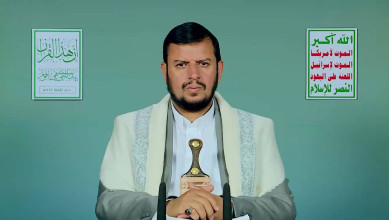
The Leader of the Revolution, Sayyed Abdulmalik Badr al-Din al-Houthi, on Friday extended his warmest congratulations and blessings to the Yemeni people and their official institutions on the anniversary of Yemeni Unity.
In his fourth lecture of the month of Dhu al-Hijjah, delivered today as part of the series “Indeed, this Qur’an guides to that which is most upright,” the Leader emphasized that Yemeni unity is a great national achievement and a right that must always be appreciated, protected, and consolidated on sound foundations.
He pointed out that “all developments since the unification until now have proven that the greatest threats to this important achievement for our dear people are two main factors. The first is the greed and personal, partisan, and factional calculations within the country, and the second is subservience to foreign powers that seek complete control over our people, usurp their freedom and independence, and exploit our country’s geographical location and resources.”
He explained that “two of the most important factors guaranteeing the unity of our people are: consolidating the unifying faith-based identity, ensuring it remains the fundamental basis for unity, and adopting a liberationist approach that preserves the country’s independence and truly contributes to achieving a genuine national renaissance.”
The leader of the revolution also emphasized that the unifying faith-based identity of the Yemeni people is what safeguards their unity and makes them a people united in their orientations, positions, and goals, adding, “With this faith-based identity, the enemies of our people cannot sow the seeds of discord among them.”
He pointed out that a unifying faith-based identity is a fundamental pillar that preserves brotherhood, unity, and cooperation in righteousness and piety, and protects the people from all factors of division.
He explained that external powers, which do not want this nation to be unified, free, dignified, and strong, and to achieve a true renaissance, want it to remain weak, helpless, and subservient.
He emphasized the Saudi regime’s clear and explicit intention to keep the Yemeni people subjugated, under its command and control, and under American supervision, clarifying that the Saudi regime itself is also subject to American and British oversight.
Mr. Abdul-Malik Badr al-Din al-Houthi stated that a faith-based identity protects the people from all causes of division and the agendas pursued by external powers and their local proxies.
He asserted that the factions that have submitted to external powers have compromised the people’s freedom and dignity, betraying them in every sense of the word, and have acted under banners that incite sectarian and regional strife, stirring up enmity, hatred, and animosity.
He pointed out that the liberation approach preserves the country’s independence and truly helps achieve a genuine renaissance for our nation. He emphasized that the Yemeni people will never accept being merely a file on the Saudi special committee’s agenda, managed according to external calculations, bets, and interests, and under the supervision of a quartet committee comprised of Americans, British, Israelis, and Saudis. This, he asserted, poses a grave threat to the country in every aspect: its freedom, its independence, its present, and its future.
He stated, “Our people cannot submit to foreign tutelage and mortgage their destiny on this basis.” He explained that foreign powers operate according to aggressive and destructive calculations that violate the dignity of our people.
He added, “Our dear people, with their faith-based identity, are committed to their freedom and steadfast on the path of liberation, regardless of the difficulties, challenges, and suffering resulting from the American and Israeli aggression, carried out through their regional proxies and traitors from within our own country.”
The leader stated that the traitors among the country’s own people are insignificant and incapable of comprehending the concept of a free Yemen. They neither believe in nor accept such a thing, knowing only subservience to foreign powers. He pointed out that these traitors care only about achieving their own petty gains and ambitions, emphasizing that the Yemeni people are determined to thwart the plans and machinations of the enemies and their agents.
He further noted that regardless of the difficulties, challenges, and suffering, the Yemeni people remain steadfast in their adherence to their faith-based identity and their path of liberation. He explained that the enemies seek to subjugate the people and control the country by exploiting every divisive tactic, from sectarianism to the radicalization of the population.
He explained that the enemies sought to target the Yemeni people with the Takfiri ideology to incite enmity and hatred among the people of this country. He emphasized that the enemies’ efforts are doomed to failure and will ultimately perish, while the truths rooted in our people’s identity—the identity of faith, which is a badge of honor and a great distinction, testified to by the Prophet Muhammad (peace and blessings be upon him and his family) when he said: “Faith is Yemeni, and wisdom is Yemeni.”
The leader of the revolution spoke about the economic boycott, considering it a very important topic deserving of significant attention and continuous awareness campaigns.
He said, “When facing major economic problems in America, the American president turns to Arab countries, especially the Gulf states, to obtain trillions of dollars.”
He pointed out that the American president boasts and brags about returning from the Gulf states with vast sums of money, which he uses to solve economic problems and crises in America. He also boasts that he has found a solution to the unemployment problem and that he will create hundreds of thousands of jobs as a result of what he brought from the heart of the Islamic world.
He indicated that most of the Arab and Islamic world’s money goes to America, to the point that the volume of investment reaches 14 trillion dollars, explaining that Most of the funds and assets of Arab and Islamic banks are in America and are invested there primarily for the benefit of Americans, a truly appalling situation.
He added, “When America withdrew from Afghanistan, it became clear that the Afghan people had $10 billion in America, which America refused to return.” He pointed out that the Yemeni Central Bank’s dollar reserves are not in Sana’a but in America, and these funds rightfully belong to the Yemeni people.
Sayyed Abdulmalik Badr al-Din al-Houthi noted that much of the money and economic interests in Arab countries are tied to America and Britain, and now there is a move to link them to the Zionist enemy.
He revealed that there is a trend toward linking the region’s economy by diverting the import and export of goods, including oil, through occupied Palestine under Israeli control. There is also a move to replace the Suez Canal with another waterway, a canal they call the “Ben Gurion Canal,” leading to the Mediterranean Sea.
Sayyed al-Houthi reiterated that normalization is the umbrella they want to use to completely tie the interests and resources of the nation to the Zionist enemy.
He stated that Sierra Leone is one of the richest countries in diamonds, and the biggest investor in this wealth is the Zionist enemy. He pointed out that France possesses enormous gold reserves and has exploited the resources of African countries to obtain vast quantities of uranium at very low prices.
He continued, “The American ambassador used to say that Yemen is still a virgin country in terms of its resources, and America wants to extract and exploit those resources.”
The leader addressed the Saudi intervention of past decades, which was blatant and overt, preventing the extraction of large quantities of oil in Al-Jawf Governorate. He explained that the Saudi regime prevented oil extraction in Al-Jawf because Yemen would benefit, and it does not want the Yemeni people to live in dignity.
He emphasized that the Saudi regime does not want Yemen to have its own economic resources that would make it independent of any other country. He pointed out that the Saudi regime also prevented the extraction of oil fields in Ma’rib and Al-Mahra Governorates.
He clarified that Saudi Arabia forced foreign companies to leave Al-Mahra Governorate and not explore for oil and its resources there. A similar situation occurred in Hadramawt. He noted that the Saudi role is linked to the British and Americans and has no independent agenda. Since its inception, Saudi Arabia has been entirely dependent on the British first, and then on the British and Americans second.
Mr. Abdul-Malik Badr al-Din al-Houthi stated that throughout the period of aggression and to this day, the Yemeni people have suffered from being deprived of their own oil and national wealth.
In his speech, he addressed the practice of Zionist and American companies adding deadly toxins to food products, stating, “Zionist and American companies deposit deadly toxins in food and pharmaceutical products, which we then purchase with our own money, giving them enormous profits.”
He reported that investigations in America have definitively proven that major Western companies deposit substances harmful to people’s health and spreading numerous deadly diseases in their consumer products.
Sayyed al-Houthi added, “The importance of economic boycotts lies in liberating ourselves from the control and domination of our people by our enemies. It is absolutely unacceptable for us to depend on our enemies for our food, medicine, clothing, and basic necessities.”
He pointed out that some non-Muslim nations consider securing their own food production a matter of national security, and that food security is a key component of national security in other countries.
The Leader of the Revolution emphasized that when nations remain dependent on others, they become vulnerable to pressure, and their essential needs become bargaining chips in the hands of their enemies. He explained that economic policies over the past decades have been designed to make nations beholden to foreign powers for all their needs. He pointed out that the boycott could be an incentive for local production, as it is essential for national and food security. He emphasized that economic policies in Yemen over the past decades have been designed to make the people dependent on foreign countries for all their needs.
Sayyed al-Houthi explained that there is a list of 50 countries from which Yemeni merchants import very simple items that could easily be manufactured locally. Businessmen still import even simple tomato sauce, which is one of the easiest things to produce locally in abundance and without difficulty.
Sayyed Abdulmalik Badr al-Din al-Houthi also affirmed that if the focus were shifted to local production and capital were channeled domestically, it would create an economic renaissance.
He noted that large segments of television and radio channels are dedicated to idle chatter, neglecting economic and developmental production. He added that developmental and economic issues are also absent from school curricula and university environments, stressing that agriculture itself will be the backbone of the national economy.