
Revolution Leader: September 21 revolution achieved freedom, independence for our people based on their faith identity
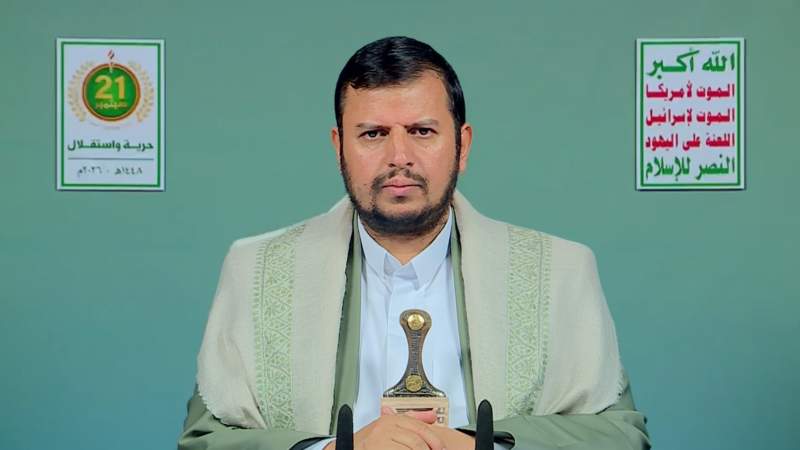
The Leader of the Revolution, Sayyed Abdulmalik Badr al-Din al-Houthi, confirmed that the September 21 Revolution achieved freedom and independence for the Yemeni people based on their faith identity and liberation from American hegemony.
In his speech on Monday on the occasion of the 12th anniversary of the September 21 Revolution, the Leader offered praise and gratitude to Allah for supporting our dear people with victory and backing in their blessed September 21 Revolution.
He also extended congratulations to the Yemeni people—foremost among them the revolutionaries across their various endeavors, the martyrs, the families of martyrs, the wounded, official institutions, and all who extended congratulations on this cherished occasion.
Al-Houthi pointed out that the blessing of liberation, independence, and halting the erroneous trajectory under foreign guardianship was a great blessing and one of the days of Allah.
He said: “The period preceding the September 21 Revolution highlighted our people’s desperate need for it, because what occurred prior was a confiscation of our people’s freedom and independence, subjecting them to foreign guardianship which constitutes a confiscation of freedom and independence and the massive losses that entail.”
Sayyed Al-Houthi added: “Had the September 21 Revolution not taken place, our people would have lost their freedom and independence and succumbed completely to the enemies. The strange thing is that certain factions surrendered to foreign guardianship, accepted it, and dealt with them as though they were charitable organizations,” emphasizing that the declared foreign guardianship was hostile and its entities were criminal, seeking to achieve their ambitions without the slightest regard for the interests of other peoples.
The Leader of the Revolution noted that decision-making in Yemen was handed over to foreign guardianship, while the authority in Sana’a was purely superficial, serving merely to execute their dictates. He indicated that the official program across all fields became aligned with what the Americans, the British, and their allies desired at the time.
He stressed that the guardianship was driving the country toward collapse across all fields, marked by fragmentation, division, dispersion, and escalating crises. He pointed out that on the military level, the enemies moved to dismantle the army despite its subordination to the authority loyal to them, even targeting everything that could serve to counter external aggression.
Al-Houthi explained that the air force, air defense, and naval force—despite their modest capabilities—were targeted. The security situation under guardianship moved toward total collapse, with non-stop assassinations in Sana’a targeting security personnel, military officers, and academics prior to the revolution, reaching the point where hospitals were stormed by takfiri elements.
He pointed out that price hikes were imposed on the people despite the existence of oil and gas wealth and the absence of war. The economic collapse prior to the revolution continued because it was a systematic collapse, stressing that guardianship prior to the September 21 Revolution intervened in all affairs of the country, with ambassadors at the time meddling in every state domain.
Sayyed Abdul-Malik Badr al-Din al-Houthi stated that the enemies viewed the guardianship phase as a golden opportunity, with the American ambassador acting as the ruler in Sana’a. Decision-making before the revolution was in the hands of the American ambassador, and steps were taken to establish military bases even in the capital, Sana’a, emphasizing that freedom and independence are priceless and represent the highest human value.
The Leader noted that the popular revolution restored the people’s dignity and preserved their faith-based honor. It was not a revolution driven by external backing from any global party; rather, the decision for the revolution was authentic, moving by its own resolve and capabilities, rising significantly and instilling fear in the Ten Nations.
He stated that the popular revolution was distinguished by a genuine liberationist approach, which explains the enemies’ stance against the people when they moved with this revolution. He explained that the enemies moved to act against Yemen and adopted a hostile stance, despite the people adhering to rights recognized for any nation in the world.
The leader said: “Our people in their revolution possess noble characteristics; they are neither an aggressive nation nor greedy for the wealth of others. Their stance was clear regarding foreign policy and their Arab and Islamic surroundings, based on mutual respect and shared interests while respecting their independence.”
He added: “Our people hold an authentic stance regarding the issues of the nation and the dangers threatening our Islamic nation,” pointing out that the enemies conspired against Yemen and attempted to regain control over it after it was liberated from guardianship.
He continued: “As long as the American objective remains control over our people and turning our country into its military bases, the conflict with them and their tools will persist,” emphasizing that the popular revolution emerged on the principles of peace and partnership, but the enemies took a hostile stance and recruited proxies to subject it once again.
The Leader of the Revolution affirmed that the Saudi regime—driven, supervised, and joined by the Americans, British, and Zionists—moved to execute an all-out, unjust aggression against Yemen. Joined by the US, it committed the most heinous crimes in Yemen from day one of its aggression, targeting all elements of life in our country.
He categorized the Saudi regime’s brutal acts as war crimes against humanity, noting that all definitions of war crimes apply to the atrocities committed by the Saudi regime in Yemen. He pointed out that the Arab and Islamic stance regarding the Saudi aggression on Yemen was negligent, with the exception of the Axis of Jihad and Resistance and free people around the world.
Al-Houthi explained that the US provided political cover for the crimes committed in Yemen and offered major deals to the Saudis to kill the Yemeni people. The Saudi regime was exposed in its Zionist image during the years of escalation in Yemen, revealing its brutal nature when it killed thousands of children, women, and civilians in their homes, mosques, schools, and markets in Yemen.
He noted that the Saudi regime targeted more than two thousand mosques as well as wedding and funeral gatherings, with all documentation and footage pertaining to these crimes fully recorded. He stressed that Saudi criminal acts were committed before the eyes and ears of the world, while most governments and regimes issued no condemnation or disapproval for the killing of thousands of children and women in Yemen.
Sayyed Abdul-Malik Badr al-Din al-Houthi stated that all Saudi crimes committed in Yemen were met with passive watching due to the absence of principles in the policies adopted by most regimes.
In conclusion, he said: “Had our dear people waited for the United Nations, the Security Council, or other institutions in the face of all these crimes, they would have done nothing for them. Some of our people were even forced to eat tree leaves due to the suffering caused by the aggressive Saudi blockade.”